Roja Dove — Lost In Paris
Essence
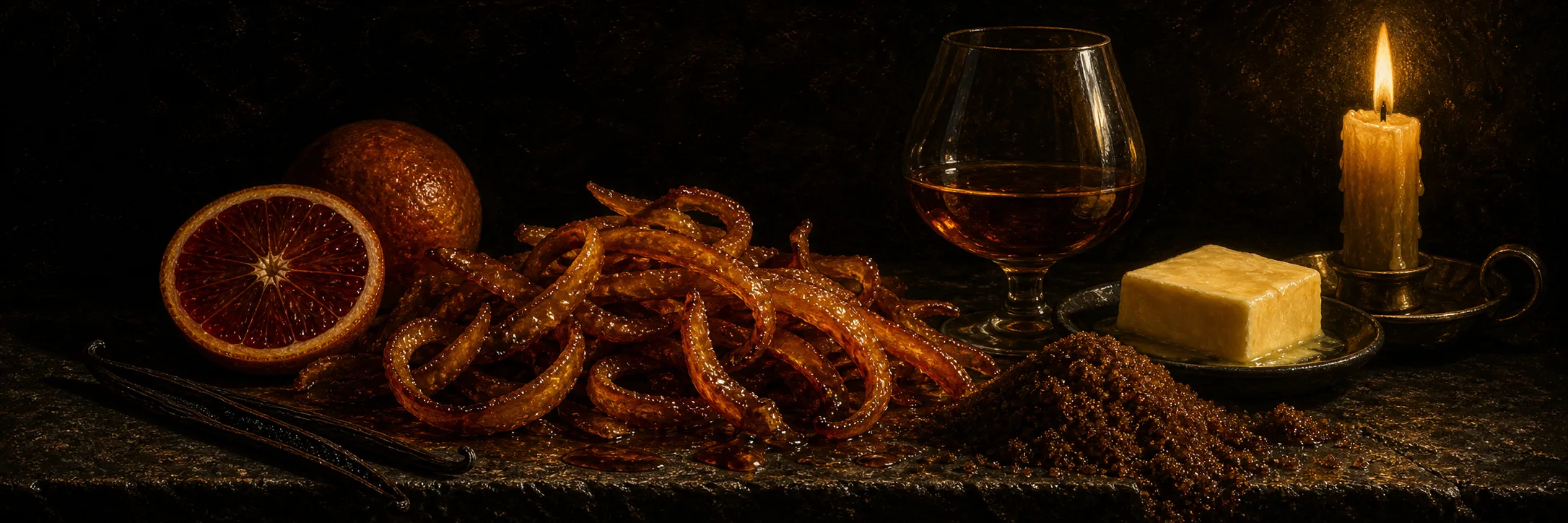
Lost In Paris is Roja Dove’s 2024 surrender to the gourmand wave: an extrait that smells, quite literally, like Crepes Suzette - caramelised orange peel flambeed in Grand Marnier over a pool of melted butter and brown sugar. Where the rest of the Roja catalogue trades in chypre nostalgia, dry ouds and tobacco-and-vanilla orientals, this one is unapologetically dessert. It is the house’s most overtly gourmand release to date, and by most accounts the closest Dove has come to chasing the social-media crowd rather than the perfume archive.
Scent Profile
The opening is a bright, almost shocking citrus flash - blood orange and bitter orange peel rather than juice, with mandarin riding alongside. Within the first minute the rum and Grand Marnier arrive as a boozy lacquer over the citrus rather than a separate accord, exactly the effect of a table-side flambe when the alcohol burns off and leaves a sticky glaze. Everything listed is genuinely perceptible here; nothing is buried. There is a brief solvent, almost window-cleaner edge from the mandarin terpenes that clears inside fifteen minutes. From roughly twenty minutes to two hours the composition settles into its signature accord: caramelised sugar and a genuinely convincing butter note. This is the part everyone argues about. The butter is dairy-dense rather than the abstract lactonic creaminess of an Angel descendant - it reads like a stick of melting Echire on a hot pan. Brown sugar and bourbon vanilla thicken underneath, and the citrus retreats into the middle ground, where it works almost as a salt-counterpoint to the sugar. There is no real heart, and structurally it shows: Lost In Paris essentially runs straight from top to base with the caramelised-orange-and-butter accord doing all the connective work. The drydown after three hours is the controversial stretch. Several reviewers flag it as the weakest phase, where the bakery brilliance collapses into a more conventional musk-and-ambergris-over-vanilla skin scent, with cashmere wood and a quiet clove-cinnamon backbone keeping it from going flat. Ambergris does the heavy lifting for radiance without adding much character of its own. The thing you remember is the salty-sweet butter-and-burnt-orange dance of hours one and two; from there the wear is broadly linear, an evolution of decay rather than transformation.
Performance
Projection is moderate - about an arm’s length for the first hour, then within personal space. Sillage is paradoxically generous on clothing, with wearers reporting it persisting on a sweater into the next day, which is not standard Roja behaviour. On skin, longevity averages six to eight hours before fading to a sweet musk; on fabric, twenty-four hours and more is realistic. It behaves well in cold, dry conditions where the buttery sweetness keeps its architecture; in heat and humidity the caramel can collapse into something cloying. Two sprays to the chest and one to a scarf is the optimal strategy - oversprayed, the butter accord turns into pancake batter quickly.
Wearing Context
Cold weather, evening, indoors. Lost In Paris is a winter restaurant fragrance: dim lighting, dessert course, a second glass of armagnac. It is functionally useless in summer heat, where the butter-caramel becomes nauseating. It reads as female-leaning unisex - sweet enough to skew feminine, but with enough boozy citrus edge to be wearable on anyone comfortable with overtly sweet compositions. It will fall flat in a corporate office, too edible and too loud about it, and in any setting where you want to be taken seriously without being noticed. Where it shines is dinner parties, holiday gatherings and date nights, contexts that consistently treat it as a compliment-getter. Anyone already steeped in gourmands, though, will find it familiar rather than transcendent.
Comparisons & DNA
Within Roja’s own catalogue the closest sibling is Sweetie Aoud, which deploys a similar French-patisserie accord but pulls it toward a drier woody-amber base - Sweetie Aoud is roughly what Lost In Paris would smell like with the butter removed and cumin added. It is also frequently set against Akro Bake, the cult dark-bakery gourmand, which is more directly bread-and-pastry and far cheaper at around two hundred dollars; Lost In Paris is prettier and more refined but not categorically different. Bortnikoff Panettone comes up too, sharing the candied-citrus and brown-sugar vector while leaning toward dried fruit where Lost In Paris leans toward fresh peel. Further out, Maison Francis Kurkdjian Grand Soir does the boozy-vanilla-resin idea in a more austere mode; Initio Atomic Rose, Kayali Vanilla 28 and Mancera Cedrat Boise sit in the citrus-meets-sweet vein without replicating the butter accord; Tom Ford Soleil Brulant overlaps on orange-caramel but is sunnier and less bakery-specific. No credible budget clone exists yet - the scent is too recent and too specific to have been copied competently. Lineage-wise it sits at the intersection of the late-2010s niche gourmand explosion and the 2020s ultra-luxury price tier, confirming Roja’s pivot toward a broader, younger, social-media-driven audience rather than defining any new trend itself.
Reception
This is polarising in a way few Rojas are, with opinion split but tilting in its favour. Common praise: the photo-realistic butter accord, the quality of the caramelised orange, the surprising tenacity on clothing, and the absence of the sharp synthetic sweetness common to cheaper gourmands. Common criticism: the steep price, the collapse of the drydown into generic musky vanilla, and a sense that the artistry lives in the opening fifteen minutes. One detailed review summed up the skeptical case neatly - the opening is the sale, but the drydown is very average, with Roja’s blend quality the only thing carrying it forward, a shortfall for a house known for elite blending. Another concluded it was the best gourmand-leaning Roja yet, while still finding it not special or must-have enough to justify the spend. Notably, the major critics have largely stayed quiet, an absence that stands out given Roja’s profile. The honest verdict is to sample first rather than blind-buy; the small travel bottle is the rational entry point.
Versions & Reformulation
A single composition as of mid-2026, sold in two configurations: a 100ml extrait and a 10ml travel atomiser. The brand’s perfumery and London sites use slightly different marketing copy, and the perfumery page calls it “An Evening In Paris” in some descriptions, which appears to be an alternate working title rather than a separate product. No reformulations have been reported. The bottle is the standard Prestige Collection presentation with a purple Swarovski-studded cap, though some owners feel the post-2024 packaging update - which removed Roja Dove’s signature from the cap - feels a touch less premium than older Prestige releases.
Acquisition Notes
This sits in the ultra-luxury tier, among the more expensive contemporary gourmands on the market. It comes in a 100ml extrait at around £995 and a 10ml travel size at around £150. It is sold through Roja Dove’s own perfumery and website and stocked by a handful of luxury department stores and niche retailers; a healthy decant market also makes 1ml-10ml splits easy to find. Buy from Roja directly or an authorised retailer to be sure of what you are getting.
Notable Facts & Lore
- Roja Dove’s stated inspiration is autobiographical and very specific: eating Crepes Suzette on a freezing Paris street after dinner at Le Meurice, the contrast between the haute-luxe interior and the street-food joy.
- In brand materials he has said he had just left a party “floating in a world of elegance” when he stumbled across a crepe stand in the freezing night, and in that contrast between luxury and street-side joy found a truth - that even when life feels perfect, there is always room for more indulgence.
- The 19th-century Crepes Suzette, with its caramelised orange, butter, sugar and orange liqueur set alight tableside, is essentially the literal blueprint.
- The release coincided with a broader brand pivot: updated packaging, the recruitment of a junior perfumer in late 2024, and a string of gourmand-leaning launches.
- Lost In Paris went on to become a significant social-media fragrance through late 2024 and early 2025, driven by influencer reviews - the “did you smell the Roja crepe?” scent of that micro-era.
- One news write-up memorably framed the whole conceit as making an olfactory copy of a popular dish that costs a hundred times more, removing the taste and leaving only the aroma.