Roja Dove — Fortnum & Mason The Perfume
Essence
A 2018 Fortnum & Mason exclusive that, in actual wear, reads very little like its marketing suggests. It is sold as a classically opulent ambree creation with a mouth-watering twist of peach and lemon, but on skin it is a dirty-sweet animalic floriental dominated by castoreum, smoky labdanum and dense resin work, closer in spirit to vintage Bal a Versailles than to any juicy fruity amber. The peach is real and gives the opening its candy-like sparkle, but the perfume’s true character is animalic.
Scent Profile
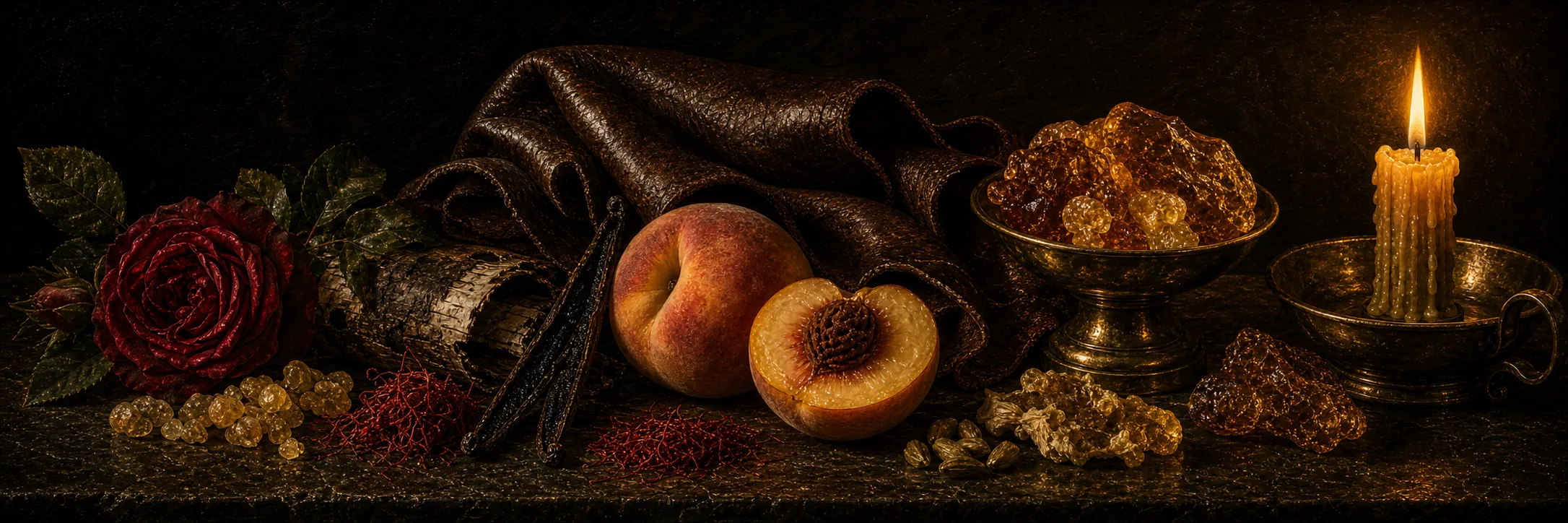
The top is genuinely peach-driven; wearers consistently describe it as smelling like peach gummy rings or Japanese peach candy for the first five to ten minutes, supported by a bright but unpiercing lemon-bergamot citrus. This juicy candy opening is a deliberate trompe-l’oeil, with the perfume’s real identity hiding behind it. Within fifteen minutes the castoreum surfaces and rewrites the whole reading: a leathery, slightly fecal, distinctly animalic warmth bleeds through the fruit, supported by labdanum’s resinous-leather sweetness and a clearly perceptible birch-tar smokiness. The rose and jasmine in the heart are present but submerged, functioning as connective tissue between the candied top and the dark base rather than as featured notes, while geranium adds a green-mineral edge that keeps the rose from going syrupy and orange blossom is the clearest of the florals on the way down. The base is what most wearers register as the perfume, an extraordinarily dense ambree-leather scaffold of castoreum, amber, vanilla, sandalwood, amyris, benzoin, oakmoss, patchouli and olibanum. The amyris matters here; the house flags it specifically as an unusual material reminiscent of benzoin and cedar together, and it gives the base a dry, resinous-woody backbone that keeps the vanilla and amber from going pillowy. The signature accord is a peach-castoreum-labdanum-amber triangle, sweet and dirty at once. It is far from linear, evolving over six to eight hours, with the fruit burning off entirely in the first hour and the smoky-animalic base growing more pronounced over the next four, until by the sixth hour it is a soft amber-leather skin scent. Wearers who know the house note that this base shares clear DNA with Roja’s Kuwait and Fruity Aoud, and that this one sits stylistically between the two.
Performance
Projection is heavy in the opening, reaching three to four feet off the body for the first ninety minutes before settling to a strong arm’s-length cloud through hours two to five. The trail is consistently above average, with wearers noting its strong presence and lasting power. Longevity is ten to twelve hours on skin and well over a day on clothing, with the castoreum-birch combination persisting on wool for days. It behaves beautifully in cold weather, where the resins and animalic notes warm without going aggressive, and well in humidity, which softens the smokier elements, while heat is more dangerous, since above roughly the mid-twenties Celsius the castoreum can read genuinely fecal to non-fans, and dry climates accentuate the amyris-cedar dryness in the base. This is essentially a one-to-two-spray fragrance unless you have a high tolerance for animalic projection; three sprays produces a trail that follows you into the next room.
Wearing Context
It belongs to autumn through winter, late afternoon into evening, and formal or date settings where you want presence. It excels in dark restaurants, candlelit dinners, the opera, and anywhere a bold, slightly transgressive scent reads as confidence rather than aggression. It falls flat in offices, where it is too animalic, in heat, where the castoreum goes wrong, and on anyone uncomfortable with skin-coded perfumes, since wearers describe it as dirty and sweet at the same time and as not trying to be mass-appealing. It is unisex in positioning but skews feminine-leaning in the Western reading because of the peach top and rose-jasmine heart, while in Middle Eastern reception it reads decisively unisex. The social read is high-end and slightly unusual; it does not smell like anything else widely worn, so identification is uncommon and the reaction is binary, people either lean in or recoil.
Comparisons & DNA
Within Roja’s own line it is most often compared to Kuwait, for the peach-castoreum density, and Fruity Aoud, for the candied-fruit-over-animalic-base concept, with one wearer estimating it at roughly two-thirds Fruity Aoud and one-third Kuwait. It also shares clear DNA with Enigma Pour Homme in the labdanum-castoreum base. Outside the house, the obvious lineage is the great animalic French chypres: vintage Bal a Versailles for the peach-castoreum-resin triangle, and Frederic Malle Une Fleur de Cassie for the violet-mimosa-animalic interplay, though this is sweeter and darker. By Kilian Back to Black sits in adjacent smoky tobacco-honey territory but cleaner and less animalic, Parfums MDCI Chypre Palatin delivers a comparable resinous-leather density at a more reasonable price, Tom Ford Tobacco Vanille is sweeter and less leathery, and Maison Francis Kurkdjian Grand Soir sits nearby on the amber-resin axis but far cleaner. For clone hunters, there is no recognized direct dupe in the budget Arabic ecosystem, and the closest cheap approximation in spirit, Maison Alhambra Layali Khaleeji, delivers a similar peach-amber-leather idea without the castoreum dirtiness. Among Roja collectors the consensus is that no clone fully captures the castoreum density that defines the perfume.
Reception
Consensus is strongly positive among those who appreciate animalic fragrances and strongly negative among those who do not; the love leans heavy, but the negative reviews are emphatic. The dividing lines are castoreum tolerance, since anyone who finds Bal a Versailles or vintage Magie Noire challenging will find this unwearable, its similarity to existing Roja releases, since owners of Kuwait and Fruity Aoud find it redundant, and the price-to-presence ratio, which at the top of the Roja range is contested. As a blind buy it is simply not advisable; the castoreum makes it polarizing enough that a sample is mandatory. No major critic published a dedicated review. The most substantial coverage came from one blogger who described it as smelling of vanilla and cakes from the bakery, spices and tea leaves from the hampers, and florals and frankincense from the spa and beauty hall, explicitly evoking the store’s product mix as the conceptual hook. Critic Persolaise’s broader writing on Dove’s love of animalic materials applies thematically here, though no specific review exists.
Versions & Reformulation
A single composition since 2018, a 50ml parfum, with no documented reformulation, no flanker and no concentration variant. Both the house and Fortnum & Mason continue to carry the original formula.
Acquisition Notes
It retails around the mid-400s in British pounds for the 50ml parfum at Fortnum & Mason, with identical availability through Roja’s own channels under the brand’s Fortnum & Mason sub-collection, so it is no longer strictly an exclusive though it keeps its themed bottle and presentation. US distribution is direct and through selected niche retailers, and the decant ecosystem is solid, with small samples widely available, which is the only sensible way to approach something this polarizing before committing.
Notable Facts & Lore
- Dove’s stated intent at launch was that it is impossible not to be enveloped by the richness of this iconic symbol of British luxury, that he loves its understated elegance and the subtle gestures that are distinctly British, and that he reflected this in a composition built on a luxurious amber base, rarely used in perfumery, with leather, oud and precious woods intermingling with rose, the flower of England, while the sunburst emblem of the store adorns the label and box.
- The bottle is one of the most recognizable in the Roja catalogue, a lush Fortnum’s-green plaque with a vintage sundial-sunburst design and the standard crystal-studded crown cap.
- It launched in autumn 2018 as the second Fortnum & Mason collaboration, following Taif Aoud in 2014, timed to the store’s broader heritage marketing around its 1707 founding.
- There are no celebrity associations and no viral moments; it has stayed a connoisseur’s pick rather than a hype scent, its quiet footprint standing in contrast to Roja Elysium, which became a widely recommended summer favorite around the turn of the decade.
- Among collectors it is frequently called one of the brand’s most British-smelling compositions despite being an Eastern animalic at heart, a reading reinforced by the house’s own framing of it as evoking every floor of Fortnum & Mason.