Roja Dove — Oceania
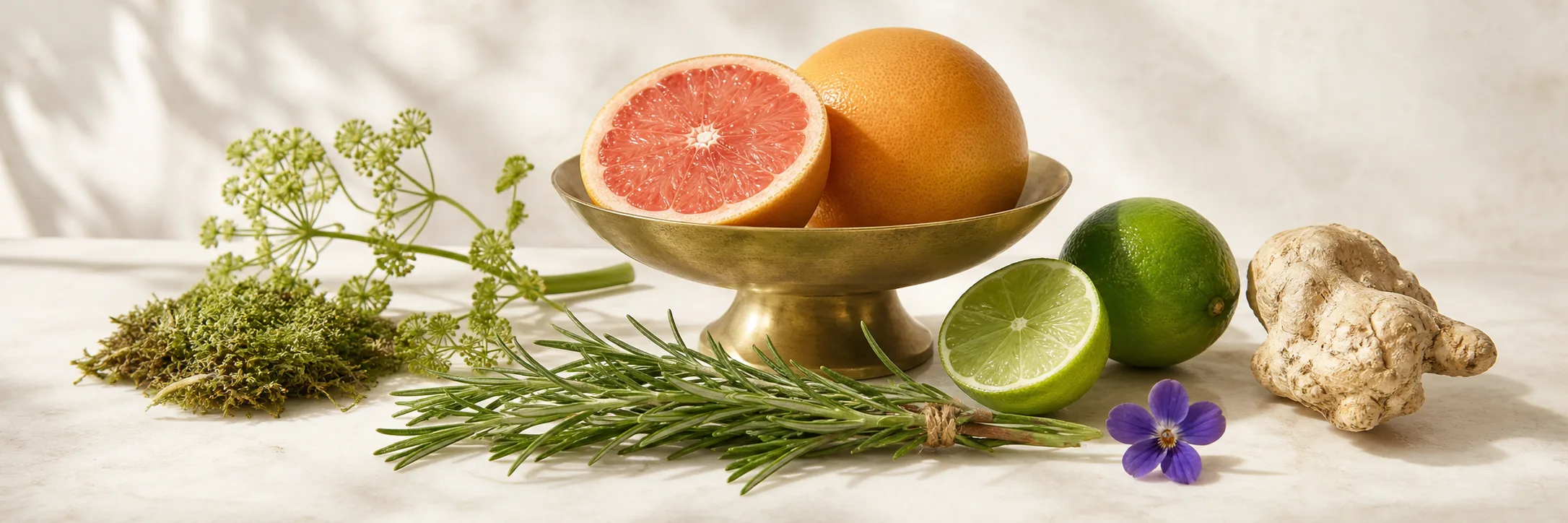
Essence
Oceania is Roja Dove’s 2019 take on a fresh fragrance that pointedly refuses the “blue” aquatic cliche. Created for Selfridges as a charity-tied release supporting ocean conservation, it reads as a sun-bleached luxury cologne rather than a marine: a five-citrus opening, a classical white-floral middle, and a green-mossy-orris base, with not a synthetic sea molecule in sight. What sets it apart within the Roja line is its restraint. It is essentially an old-school eau de cologne pushed up to eau de parfum weight, with iris, galbanum, and labdanum doing the architectural work. Unisex, daytime, and noticeably quieter than the rest of the catalog.
Scent Profile
The first ten to twenty minutes are a citrus pile-on of bergamot, lemon, lime, grapefruit, and mandarin, sharpened by the lemon-candy lift of litsea cubeba and given an aromatic backbone by rosemary, thyme, and lavender. The effect is bright and slightly soapy rather than juicy; grapefruit and lime dominate, and the litsea cubeba adds a confectionary lemon-sherbet edge that makes clear this is not chasing Mediterranean realism. The signature accord forms here: aromatic citrus over an immediately perceptible orris-galbanum stem, which stands in for the salty marine effect competitors lean on. In the heart, between roughly forty-five minutes and three hours, geranium and ylang become the most noticeable notes, with jasmine more felt than identified. Roja’s habit of blending individual flowers into a single white-floral wash is on full display. Violet adds the powdery softness that pulls the composition gently feminine; without it, Oceania would read solidly masculine. This is the stage where a sheer, luminous floral skin emerges rather than a heady single-flower note. From three hours onward, the drydown is where Oceania most resembles a chypre-flecked aromatic fougere: iris and orris give a powdery suede texture, moss adds a green herbal damp, juniper berries push a gin-like dryness, and a labdanum-benzoin-vanilla trio warms the base without sweetening it. Cedar and sandalwood stay quiet, holding everything together, while vetiver registers only as an earthy counter-pressure under the citrus residue. The fragrance moves clearly through three stages rather than running flat, but the transitions are smooth and a faint citrus thread persists throughout.
Performance
Projection is moderate and lasts longer in the first ninety minutes than most cologne structures, because the citrus is anchored by iris and labdanum. Sillage turns intimate by the second hour; Oceania does not announce itself across a room. On skin, expect roughly six to eight hours; on clothing, a faint mossy-floral residue can linger twelve hours or more. In heat the citrus blooms more aggressively but the overall arc compresses, with the floral heart and drydown arriving sooner. In dry cold it underperforms, the citrus and aromatics struggling to lift while the iris-musk base feels flat. Humidity suits it better, bringing out the green-mossy facets. Apply generously, four to six sprays to the chest with one at the back of the neck; pulse-point dabbing undersells it. This is one of the few Roja releases where a heavier hand is rewarded rather than punished.
Wearing Context
Oceania is unambiguously a spring-summer fragrance with a daytime bias, best from early morning through mid-afternoon. It shines outdoors in warm, dry, bright conditions: beach clubs, daytime weddings, garden lunches, and business-casual settings from May through September. It falls flat at night, in candlelit interiors, and in winter, reading thin and effortful when the citrus cannot lift. Office wear works fine, since the sillage is restrained enough that no colleague will object. Socially it skews “old money on holiday” rather than “cologne-aisle fresh”; the orris and labdanum mark it as expensive to anyone familiar with niche, while a layperson may simply register it as clean and well-dressed. That understatement is also its commercial limitation, since it does not perform the loud luxury signaling some Roja buyers expect.
Comparisons & DNA
The closest in-house cousin is Roja’s own Burlington 1819, which shares the same chiseled British-cologne posture, though Oceania is fresher, less ambered, and more floral. Within the island-themed collection that grew up around it, Oceania reads as the floral-aromatic anchor. Outside the house, the most-cited comparison is Creed Erolfa: critic Eddie Bulliqi observed that, given the color, the name, and the blend, it feels as if Roja asked his perfumer for his own version of Erolfa. Both are five-citrus aromatic colognes with iris-musk bases, though Erolfa’s salty ambergris is the true marine signal Oceania declines to use. Acqua di Parma Colonia Pura sits in adjacent territory but is simpler and less floral, while Profumum Roma Acqua di Sale offers the genuinely marine reading Oceania does not. Hermes Eau de Neroli Dore is the closest mainstream analogue in mood, though without Roja’s iris-galbanum base. No widely recognized designer clone of Oceania exists; the cleanest lineage inside Roja’s own catalog runs from his Vetiver and from the aldehyde-adjacent brightness of Reckless, an effect Oceania pulls from litsea cubeba and orris rather than true aldehydes.
Reception
Wearers opinion is sharply divided. The praise centers on quality, with admirers calling it one of the more refined citrus blends in niche and applauding the unexpected non-marine direction; the criticism centers on value, with detractors arguing that cheaper houses do something similar for a fraction of the price. Eddie Bulliqi’s pointed editorial, which framed it as an average blend at an exorbitant price, became a touchstone for skeptical enthusiasts, with many defending his candor against what they saw as influencer overhyping. Among other enthusiasts, longevity is the most common complaint, and forum reviewers split between those who consider it a masterwork and those who see it as a more expensive Erolfa. Michelyn Camen, Editor-in-Chief of Cafleurebon, offered the most-quoted favorable take, noting that you cannot judge this perfume by its name or its bottle, that it is pointedly not oceanic with nothing salty or marine about it, and describing it as billowy, bright, energizing, and fresh, an infusion of fruit, aromatics, resins, and flowers meant to lift the spirits. With little coverage from the major perfume critics, the broader critical record stays thin. The practical verdict: not an easy blind buy at full retail, and the disagreement on value alone makes a decant the smart first step. Buyers who love classical aromatic colognes, and who have already worn Erolfa and Burlington 1819, are the most likely to find it worth keeping.
Versions & Reformulation
A Parfum concentration arrived in 2025 as part of a broader reshuffle of the island collection, while the original 2019 eau de parfum is widely reported as discontinued, with Roja’s customer service indicating that supply will not be replenished. Bottle batch codes shifted from the older five- to six-digit format to a newer four-digit production system around 2022 to 2023, coinciding with the parent company’s renaming to Roja Parfums Holdings Limited. Some bottles from 2023 onward dropped the engraved gold-leaf signature on the cap, a legitimate cost-reduction redesign that buyers occasionally mistake for a sign of a fake.
Acquisition Notes
The eau de parfum has listed around 345 GBP for 100ml, and the original 2019 launch price sat at the lower end of Roja’s range before rising over the years. With the eau de parfum now end-of-life, remaining authentic stock surfaces intermittently through discounters and Roja’s own farewell listings, and decants are widely available through the usual split services and Roja’s small discovery atomizers. For a guaranteed-genuine bottle, buy from an authorized retailer or directly from Roja.
Notable Facts & Lore
- Roja Dove framed Oceania around conservation rather than pure olfaction.
- The launch materials stated that, deeply concerned by the vulnerability of our fragile oceans, a donation from every sale would go to charities dedicated to protecting the seas, and described the fragrance as opening with a wave of invigorating freshness from bergamot, lime, and mandarin; the recipient charities were never publicly named.
- The release was timed against Selfridges’ long-running Project Ocean campaign, first launched in 2011 with the Zoological Society of London.
- Dove later described Oceania as part of an “imaginary archipelago,” positioned as the journey between islands rather than a destination of its own.
- There was no celebrity tie-in and no real controversy beyond the familiar grumbling about Roja’s prices.
- Fittingly, the original eau de parfum was discontinued and reissued as a Parfum in 2025, a move several enthusiasts read as Roja recapturing value lost to heavy discounting.