Roja Dove — Pierre de Velay No. 1
Essence
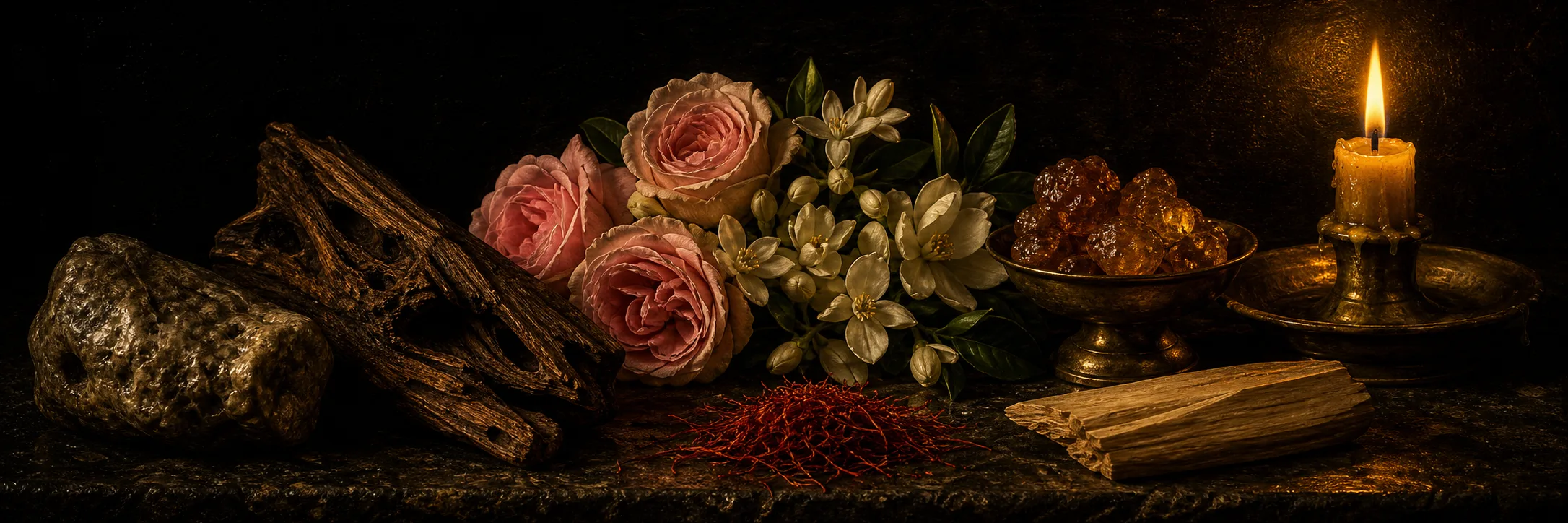
Pierre de Velay No. 1 (2017) is the inaugural fragrance in Roja Dove’s secondary “lost-perfumer’s-formula-book” line, sold exclusively at the Roja Dove Haute Parfumerie in Harrods. The collection’s inspiration, by Roja’s account, came from a small book of perfume formulae bearing the name “Pierre de Velay” that he found at a market in the South of France. The fragrance is an ambree-floriental built around bergamot, May rose, jasmine, and orange blossom, anchored by a rich base of oud, saffron, ambergris, leather, labdanum, vanilla, patchouli, sandalwood, cedar, cypriol, benzoin, and musk. What makes it distinctive is its East-meets-West synthesis: a classical French floral structure set atop a Middle Eastern oud-saffron-amber base.
Scent Profile
The first ten to twenty minutes are a brief bergamot top that, for most wearers, clears within five to ten minutes. The white florals - May rose, jasmine, orange blossom - emerge almost immediately, supported by saffron. That saffron is the most-debated element: depending on skin and batch, it reads either as a sophisticated dry-spice lift or as a rubbery-medicinal facet, and it genuinely polarizes wearers, some finding it perfectly balanced and others finding it screechy. In the heart, from about one to three hours, the rose-jasmine-orange-blossom trio is luxuriant and sweet but never candied - Roja’s habit of blending individual florals into a generalized white-floral wash is fully on display, with orange blossom tending to dominate on warmer skin and rose on cooler. The oud begins surfacing around forty-five minutes, in a cleaner Western style rather than a barnyard Cambodian one, while ambergris adds a salty-mineral lift that keeps the florals from turning too dense. From three hours on, the deep base comes forward: leather, labdanum, vanilla, patchouli, sandalwood, cedar, cypriol, benzoin, and musk. The leather is creamy rather than smoky, closer to soft Bottega-style leather than to anything harsh; labdanum brings a leathery-amber warmth, vanilla sweetens without going gourmand, patchouli adds earthy depth, cypriol a mossy-camphor edge, and sandalwood and cedar the woody backbone. The second half is more linear than evolving - once the rose-oud-saffron-ambergris signature sets by hour two, it holds with only slow shifts in which note leads.
Performance
Projection is strong for the first three hours and moderate thereafter, with sillage filling a small room early and contracting to an intimate aura by hour four. Longevity runs ten or more hours on skin, with some wearers reporting fifteen-plus. Heat can intensify the rubbery side of the saffron, so apply sparingly when it is warm; cold weather lets the oud-leather-amber core find its proper register. Humidity helps the oud bloom, while dry air can flatten the saffron. Two to three sprays to the neck and chest is plenty, and at this concentration pulse-point dabbing is enough.
Wearing Context
It is year-round capable but happiest from autumn through spring, since high-summer heat can push a faint cumin-skin facet into oppressive territory on some skin. It leans evening, though the white florals make it credible for late-afternoon and early-evening transitions, and it suits formal dinners, weddings, cocktail events, and dressier date nights, with careful office wear possible if sprayed lightly. The social read is unisex with a strong luxury-Eastern-floral coding that anyone familiar with niche will register as expensive. The rose-oud-saffron register sits right on the gender-neutral line - some wearers find it too feminine, others appropriately masculine.
Comparisons & DNA
Within Roja’s own catalog, No. 1 is closest to Amber Aoud (the same sweet rose-oud-amber DNA, but brighter and more floral here), then Taif Aoud for the rose-saffron-oud register. A common shorthand among wearer feedback is that it pairs the florals of the line’s No. 23 with the sweet base of Amber Aoud. Outside the house, the most-cited parallels are Xerjoff Alexandria III, Maison Francis Kurkdjian Oud Satin Mood (rose-oud-amber-vanilla), Tom Ford Oud Wood (a cleaner Western-style oud), and Initio Oud for Greatness (deeper and more incense-driven). Because the Pierre de Velay line is Harrods-exclusive, dedicated clones are rare; the closest mass-market approaches are oud-rose-saffron compositions from Lattafa, Armaf, and Maison Alhambra.
Reception
Reception is polarized in an unusual way for a Roja release. Admirers count it among the greatest things Roja has made - one called it possibly the greatest fragrance ever created, praising the Amber Aoud-like base and the bright florals over it - while detractors find the rose-oud-saffron combination synthetic or too feminine, and several owners have admitted selling or gifting their bottles after realizing they simply could not wear it. The split runs along the saffron and the perceived gender skew rather than the price, which is high but unsurprising at this tier. Dedicated critical coverage is thin, focused mostly on the romantic origin story of the line rather than on this fragrance specifically. Because personal chemistry matters so much here, sampling first is essential and a blind buy is hard to recommend.
Versions & Reformulation
This is a single composition with no known reformulations, continuously available since 2017 from the Roja Dove Haute Parfumerie in Harrods. The bottle design has stayed consistent across the line’s life - the distinctive Art Deco-inspired flacon Roja designed specifically for Pierre de Velay.
Acquisition Notes
Retail is around 495 GBP for 100ml Parfum, sold exclusively through Roja’s own perfumery and boutique locations and deliberately ringfenced from the main Roja London distribution and major department stores. Decants are available in 2ml to 10ml sizes, and the Pierre de Velay Discovery set of five atomizers is the recommended way in. For guaranteed authenticity, buy direct from Roja’s perfumery or the Haute Parfumerie counter.
Notable Facts & Lore
- The line’s mythology is the most evocative in Roja’s catalog.
- By his account: “In a market in the South of France, I discovered a little book of perfume formulae inscribed with the name, Pierre de Velay.
- I used them as the inspiration for a collection that is now coveted amongst fragrance lovers all over the world.”
- The expanded lore holds that Velay is a real town near Grasse, but that Roja’s research turned up no historical perfumer by that name; he speculates the formulator likely worked in the 1920s or 1930s, since many of the formulas lean on aldehydes, which did not appear until Chanel No.
- 5 in 1921.
- Whether the diary discovery is literal history or creative framing remains unresolved - Roja has consistently maintained the literal version, and no independent verification has surfaced.
- The collection launched in 2013 with Nos. 11, 23, and 6, with Nos.