Roja Dove — Aoud
Essence
Roja Dove’s 2010 Aoud is the house’s most stripped-back, ingredient-focused composition - a parfum built to show off what Dove considers genuine oud at high concentration, with woody and warm-spicy facets as the only structural elements he bothers to name. It is not the more elaborate, much better-known Amber Aoud, but an austere oud parfum in the tradition of Arabian attars. Within the range it functions almost as a reference specimen: this is what the house treats as an unornamented oud parfum.
Scent Profile
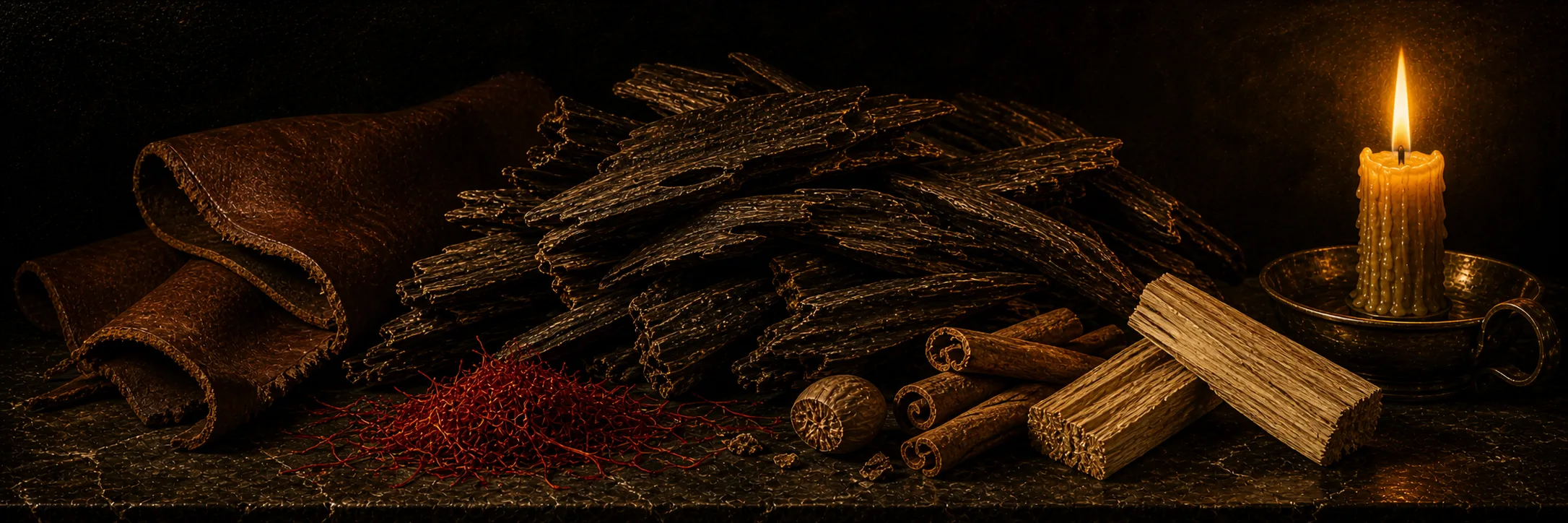
The opening lands hot and animalic. The oud here is the polished-but-still-pungent kind - neither the raw barnyard medicinal of unaged Hindi oud nor the sanitised, oud-flavoured wood of designer “oud” releases. The first ten to twenty minutes are dominated by a leather-and-bandage smoky-resinous oud, with a peppery warmth - most wearers read a saffron-cinnamon-nutmeg trio - providing lift. There is no real citrus top phase to speak of. Through the heart, across the first one to three hours, the composition holds its dominant pose: oud, woody resinous warmth, spice. A faint rose flickers through, lifting the wood rather than leading. The signature accord is essentially oud-spice-amber held in tight focus; this does not so much evolve as warm and soften, and it is the most linear thing in Roja’s main range. The drydown, from around the third hour, reveals a sandalwood-and-resin character beneath the still-present oud. The smoky-medicinal edge of the opening recedes, leaving a polished woody-warm core with the spice dropped to a steady simmer. At six to eight hours the skin scent is a clean, slightly powdery oud-wood - recognisably oud, but no longer aggressive. The sense of “real oud” holds throughout, and many wearers consider this Roja’s most credible oud in terms of approximating high-quality oud oil rather than oud-themed perfumery. Linearity is the point: it delivers one statement at high quality and holds it.
Performance
Projection is moderate-to-strong in the opening hour, then settles to moderate. Dense oud compositions tend to project less far than amber- or citrus-driven scents but persist far longer, and Aoud follows that pattern; in the first two hours it makes its presence known in any closed room. Longevity on skin runs ten to twelve hours, and on fabric well past forty-eight - oud is notoriously tenacious on textiles, and the parfum concentration amplifies it. In cold, dry weather the oud reads smokier and more resinous; in warm humidity it pushes more animalic and slightly sour, which some wearers love and others do not. One spray on skin is the ceiling here; many prefer to dab from a sample or use controlled microsprays. Applying to fabric is a near-permanent commitment given the staining and the longevity.
Wearing Context
Fall, winter, and cool spring, and evening rather than day. In temperament this is an Arabian-tradition oud parfum scaled to Western niche pricing, and it sits most naturally in the formal indoor evening settings where attars are at home: weddings, theatre, late dinners, intimate gatherings. It struggles in casual contexts, where the oud-spice profile reads as special-occasion rather than ambient. It falls flat in summer heat, in open-plan offices, and in any environment running on mass-market scent norms - most untrained noses will find it overpowering, even unpleasant, on first encounter. The cultural read matters: in Middle Eastern and South Asian contexts, Aoud comes across as sophisticated and appropriate for many occasions; in Western settings it lands squarely in niche-enthusiast territory and may be misread as a heavy cologne by colleagues unfamiliar with oud.
Comparisons & DNA
Within the house, the original Amber Aoud is the far more elaborately constructed sibling - sweeter, more amber-resinous, less austere - while Aoud Crystal pushes a cleaner, brighter oud and the later Musk Aoud goes more skin-musk-driven. This 2010 Aoud is the unornamented benchmark among them. Outside the house, Tom Ford Oud Wood is the obvious Western reference: both feature a polished oud at a high price, but Oud Wood is significantly milder, more sandalwood-driven, less smoky, and dialled back for broad appeal. Aoud is to Oud Wood roughly what an espresso is to a flat white. Amouage Tribute Attar sits in the same austere-oud quadrant and is considered a peer, though smokier and more incense-driven. Among the prolific oud houses, Montale Black Aoud is sweeter and rose-forward and Mancera Aoud Lemon Mint brighter and citric, while Initio Oud for Greatness is a louder, more ambroxan-supported modern interpretation - none of which match Aoud’s particular austerity. Enthusiasts who own pure oud oils tend to regard this as a refined Western parfum interpretation rather than an attar substitute, and the cheaper rose-oud and amber-oud releases that flood the category aim at Amber Aoud’s territory rather than this one. In lineage terms it descends from the Arabian attar tradition, scaled into the European niche-parfum format, and fed into the broader 2010s niche-oud movement without ever being a flagship of it.
Reception
Consensus is favourable from a relatively small group of wearers - Aoud is one of the lower-volume releases in the catalogue - with praise centred on oud quality, longevity, and the absence of cluttering ornamentation. The criticism runs to price relative to the apparent simplicity, a suspicion among some that the oud reads synthetic-supported despite the marketing, and the limited evolution, which is a feature to some and a flaw to others. The common framing among enthusiasts is that this is the Roja to try if you want to see what the house does with oud unornamented, even as most reach for the Amber Aoud variants for daily wearability. The major critics did not single out this release at length, though Roja’s oud work generally has been discussed approvingly by Persolaise. As a blind buy it is emphatically not recommended - sample first, both for the price and because genuine oud is so polarising for Western noses.
Versions & Reformulation
A single composition as marketed, with no public reformulation. The broader Aoud family - Aoud Crystal, Aoud Parfum, and various flankers across the years - is a set of sibling fragrances rather than concentration variants of this 2010 Aoud.
Acquisition Notes
Ultra-luxury tier, in the same range as the Amber Aoud line - roughly $600 and up for 50ml parfum, scaling for 100ml, with smaller travel sizes appearing occasionally. It circulates in the decant market at lower volume than the Amber Aoud line, but samples are available and, at this price and given how divisive oud is, sampling first is the obvious move.
Notable Facts & Lore
- Roja Dove has spoken often about the difficulty and expense of sourcing high-quality oud oil for perfumery, with the Aoud line framed broadly as an attempt to bring credible oud quality into Western niche composition.
- This 2010 release is the most pared-back expression of that intent in the catalogue, closer to attar tradition than to elaborated Western structure.
- Beyond that, there is no major launch story, celebrity association, or viral moment attached to it; its lore lives inside the wider Aoud-line conversation and the comparison to Amber Aoud.
- Within the oud-enthusiast wearers it is occasionally cited as a kind of blueprint for how Roja approaches an ingredient-first composition at parfum strength - more credibility among specialists than visibility in the broader fragrance world.