Roja Dove — Lakmé
Essence
Lakme is Roja Dove’s 2019 bespoke commission for the Royal Opera House Muscat’s world-premiere production of Leo Delibes’ 1883 opera Lakme. The fragrance was diffused into the auditorium during the gala premiere, then released commercially first as an eau de parfum exclusive to the opera house and later as a parfum exclusive to Harrods. The composition is a rose-iris-lily-of-the-valley floral over an unmistakably Eastern base of Mysore sandalwood, oud and frankincense from Salalah, a deliberate East-meets-West construction mirroring the opera’s narrative.
Scent Profile
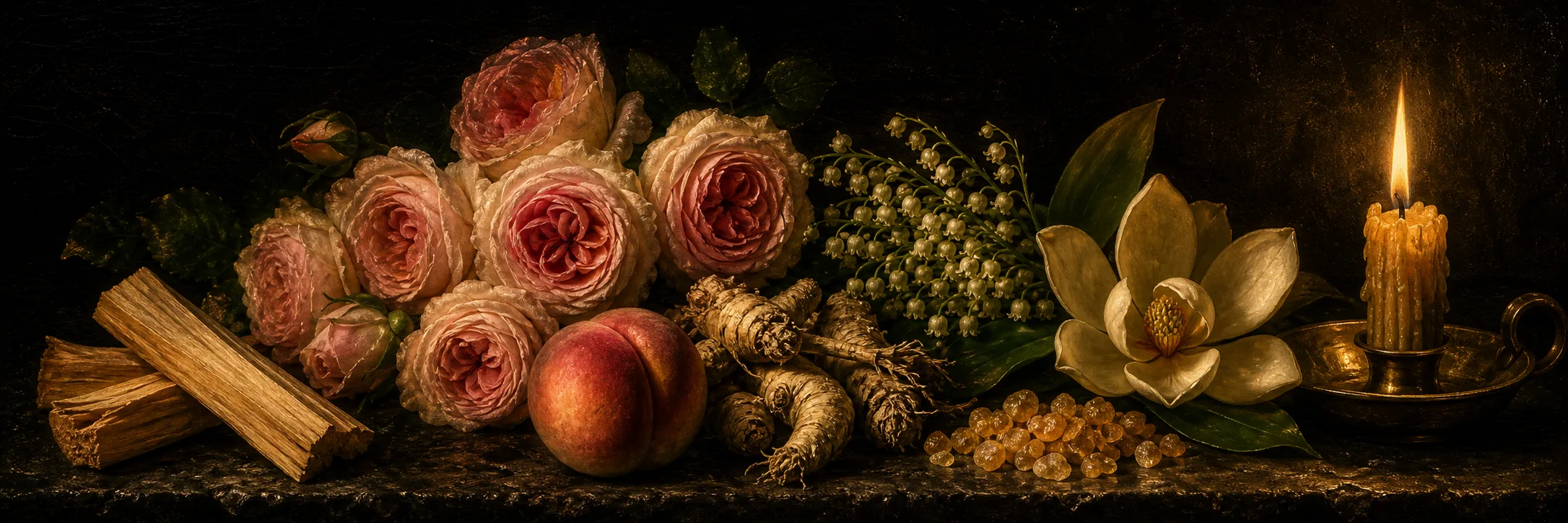
The opening is a brief sparkle of aldehydes and bright citrus that one wearer described as a faint plastic note in the first minute before it blooms into a very smooth, bright, white, uplifting floral within five. The aldehydes recall vintage Chanel No 5 or Lanvin Arpege in their soapy shimmer, but they yield quickly to the heart. The heart is the composition’s center of gravity: rose de Mai and Taif rose woven with iris, magnolia, lily-of-the-valley and peach. Roja described the structure as a fragrant opera of rose and iris evoking the Flower Duet, with lily-of-the-valley, the bell-shaped flower, paying homage to the Bell Aria, and that metaphor is genuinely detectable in wear, the rose dewy rather than overpowering, the iris buttery, the lily-of-the-valley supplying brightness, and the peach, a Roja signature, acting as juicy connective tissue between rose and iris. The base is where the East-West concept resolves: creamy Mysore-style sandalwood, a subtle oud, Omani frankincense from Salalah, benzoin, cypriol, cashmere wood, vanilla, orris, labdanum, ambergris, pink pepper and musk. The frankincense is the structural anchor that places the fragrance in the opera’s geographic setting, while the oud stays restrained and never animalic, a quiet undertow rather than a featured note, and wearers consistently read the base as creamy, a buttery sandalwood-amber rose. The signature accord is dewy rose and buttery iris over sandalwood and frankincense.
Performance
Performance is strong. Wearers note it is surprisingly loud for a parfum with outstanding longevity, commonly eight to ten hours on skin and overnight on clothing, with moderate-to-strong projection in the first couple of hours before it settles, the rose and iris remaining detectable to the end of the day. Cool weather suits it best, the rose-iris reading as plush and the sandalwood-frankincense as enveloping, while in heat the aldehydes and the floral indoles can read sharper. Two sprays of the parfum is more than enough, since the composition is dense and rewards restraint.
Wearing Context
All seasons but best from spring through autumn, daytime and evening, with evening the natural setting given the opulent base. It suits formal occasions, the opera, the theatre, dinners and weddings, anywhere a serious classical floral signals luxury, and it falls flat at the beach, in casual daywear and in any setting expecting a modern fruity-floral. It leans feminine, though the sandalwood-frankincense base makes it wearable by men comfortable with rose-iris compositions, and some wearers report men carrying it confidently or layering it.
Comparisons & DNA
Within the house, Lakme sits alongside Roja’s Eastern frankincense-and-rose works, such as Sultanate of Oman, and is most often compared to Nuwa (rose-amber-oud) and to Turandot, the rose-iris opera-adjacent reference from the same period; against Turandot it is more airy and rose-led, and against Sultanate of Oman it is more floral and less frankincense-dominant. Externally, it draws comparisons to vintage Chanel No 5 (though Lakme is more rose-and-iris-led), Guerlain Nahema (rose-amber, sweeter), Amouage Lyric Woman (rose-incense, spicier) and Tom Ford Cafe Rose (rose-coffee-amber, less classical), and it remains obscure enough outside collector circles to have attracted almost no clones. It belongs to the broader niche-commission genre of bespoke fragrances made for institutions and events, but the opera-house partnership is unusual in that the scent was actively diffused into the auditorium during the performance, making it a multi-sensory production element rather than only a souvenir.
Reception
Reception is consistently positive. Common praise goes to the rose quality, the iris-sandalwood pairing, the sophisticated old-school character and the opera-based concept; common criticism centers on the limited distribution as a Harrods exclusive for the parfum, the pricing, and an occasional report that it can read as roses mixed with talcum powder on certain skins. No major dedicated critic review surfaced, though the launch and the opera production drew coverage in the press, including Roja’s commission interview and reporting on the premiere itself. The blind-buy verdict: safe for collectors of classical rose florals who trust the house style, but worth sampling first because the aldehydic opening is briefly polarizing.
Versions & Reformulation
Two concentrations exist: the original 2019 eau de parfum, created in a limited edition exclusively for the Royal Opera House Muscat, and the subsequent parfum, released by Harrods as a globally exclusive concentration. The parfum is denser and longer-lasting, while the eau de parfum carries a brighter aldehydic shimmer. The original eau de parfum, framed as a souvenir available only at the opera house and its gift shop, appears to have been discontinued, while the Harrods parfum remains in production, the global release having followed because the original, in the brand’s words, captured the world’s imagination.
Acquisition Notes
A luxury-tier release. The current parfum is a Harrods exclusive in 50 ml, priced comparably to other Roja parfums, while the original 2019 eau de parfum was distributed through the Royal Opera House Muscat gift shop and is now largely a secondary-market item. Samples of both are available through the usual decant services, which is the easy way to test the aldehydic opening before committing.
Notable Facts & Lore
- Roja described being delighted to be approached by the Royal Opera House Muscat to create a scent for their new Lakme, noting that the opera has so many indirect references to perfumery that the collaboration felt natural, and adding that opera is one of his greatest loves, with some 350 recordings in his collection.
- The premiere of the opera and the fragrance took place on 28 March 2019 at the Royal Opera House Muscat, with an Italian director, the orchestra and chorus of Teatro Carlo Felice di Genova, dancers from Opera Australia and a Spanish conductor, and the scent was diffused into the auditorium at specific points in the performance, making it the first production there to commission its own bespoke in-theatre scent; the collaboration came about through a member of the Omani royal family rather than the opera house’s commercial team.
- Delibes’ Lakme tells the story of a Hindu priestess in British-Raj-era India who falls in love with a British officer, with tragic consequences; its Flower Duet is among the most famous passages in all of opera, and the Bell Aria is the title character’s vocal showpiece.
- Roja’s decision to pair rose as the East and iris as the West as the two duet partners, and to use the bell shape of lily-of-the-valley as the Bell Aria reference, is the most documented case in his career of a fragrance built explicitly on a musical metaphor.
- Within the catalogue it is associated with his broader Gulf tributes and his relationships in the Omani luxury market, and it carries no celebrity association or viral moment.