Chanel — 1957 Eau de Parfum
Essence
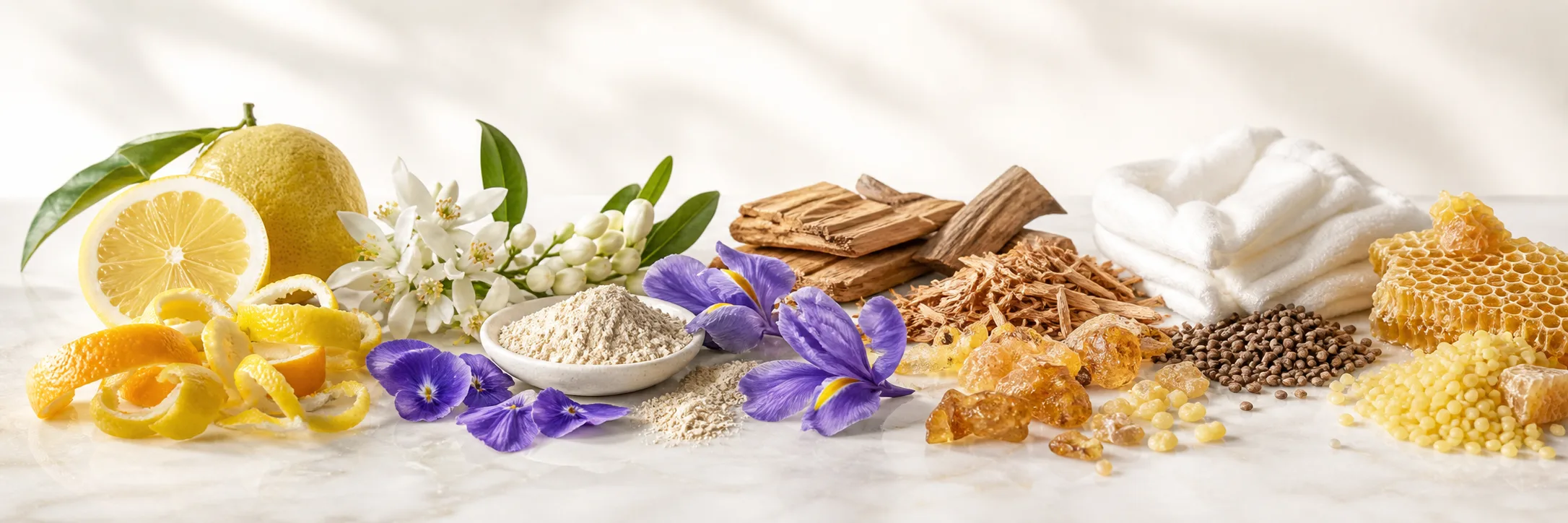
1957 is Chanel’s white-musk dissertation: a composition built from eight different musk molecules layered to behave like a textile rather than a fragrance. It exists to demonstrate that “clean” need not be cheap or anonymous, and it sits at the intersection of skin-scent intimacy and Chanel’s aldehydic-floral house signature. The opening sparkles, the heart breathes orange-blossom-tinted honey, and the drydown is a cumulus of cottony musk threaded with iris and cedar. Distinctive because almost everything else in the white-musk category retails for under $100; this one announces that the note deserves luxury treatment.
Scent Profile
The first ten to twenty minutes are the loudest 1957 ever gets, which is a relative statement. Aldehydes detonate in a fizzy, soap-bubble manner - Chanel’s house calling card - alongside a tingling pink pepper and a slip of bergamot. Coriander shows up as a faint citrus-spice texture more than an identifiable seed; if you weren’t told it was there, you wouldn’t catalogue it. Even at this most projecting stage, the perfume reads as polished cotton rather than perfume in the traditional sense. Within fifteen minutes the pink pepper has burned off and the bergamot has thinned. The heart, from roughly the thirty-minute mark to about three hours, is where 1957 reveals its sleight of hand. The listed orange blossom and jasmine are present but submerged - they function as warming agents inside the musk rather than as standalone florals. The honey note, by contrast, is more perceptible than the notes list suggests: a translucent, slightly waxy sweetness that connects this fragrance to Beige in the same line. Iris arrives during this phase as a powdery, lipstick-adjacent facet, restrained and dry rather than rooty. The signature accord is the interaction of this honeyed iris-musk with cedar’s quiet woody backbone - it reads as “scrubbed-clean skin that nonetheless smells expensive.” From three hours onward, 1957 collapses into pure skin scent. Cashmeran adds a velvety, slightly fuzzy warmth that prevents the drydown from going sterile-laundry. Cedar dries the composition; vanilla is essentially undetectable as vanilla, contributing only mouthfeel-equivalent roundness. The eight-musk architecture becomes obvious here: a cottony foreground musk, an animalic-leaning shadow musk, a powdery musk, and so on, none of them individually identifiable but collectively producing the “downy halo” effect Now Smell This memorably described. Evolution is real but compressed - this is not a perfume that travels great olfactory distances. It is closer to a single textured note examined under different lights for eight hours.
Performance
Projection is light, sometimes light-to-moderate in the first twenty minutes, then settling to a tight skin-radius of roughly 15 to 30 cm. Sillage is minimal by design; Olivier Polge described 1957 as a fragrance “revealed fully on the unique chemistry of each person’s skin,” which is the official way of saying it is built for closeness. On skin, longevity runs eight to ten hours, occasionally longer on dry, well-moisturized skin; on a wool scarf or cotton shirt, the musks persist through laundry day and beyond - twenty-four hours plus on fabric is routine. The fragrance performs best in moderate temperatures and dry cold. In humidity it can read slightly laundry-detergent; in extreme heat the musks bloom but the projection envelope does not expand much. Dry winter weather flatters the iris-cedar facet and lets the honey glow without becoming cloying. Best application strategy is liberal: three to five sprays minimum, spread across pulse points and clothing. Single sprays disappear inside an hour for many wearers. Chanel sells a companion body oil specifically because the format extends sillage and longevity meaningfully - wearers testing on wearer discussions consistently confirms the oil-plus-EDP layering doubles trail.
Wearing Context
1957 is a four-season fragrance with a strong cool-weather bias. Spring and autumn are its sweet spots; mild winter days where the musk reads as a cashmere sweater are arguably its peak. High summer humidity flattens the composition into something close to expensive fabric softener, which is fine but uninspired. It works any time of day, with a slight skew toward daytime simply because evening occasions tend to reward louder, more declarative scents. Best occasions: office, daytime errands, second dates, intimate settings where you want the person across from you to lean in. It is excellent on wedding mornings, brunches, and any context where a “you smell amazing” remark should come from within hugging distance rather than across a room. It falls flat at loud dinners, nightclubs, or any scenario where ambient odor would overwhelm a skin scent. It is also a poor choice if you want fragrance recognition or compliments from strangers - its strengths are private. Social-perception skew leans expensive-unfussy. Because Chanel’s white musk architecture differs from the laundry-musk and clean-musk archetypes saturating mass market perfumery, people who can’t identify it often guess “fancy soap,” “good shampoo,” or “rich-person skin.” This is intended.
Comparisons & DNA
The closest niche reference points are Frederic Malle Musc Ravageur (which 1957 is emphatically not - that is animalic and indolic; 1957 is the opposite), and the white-musk school inhabited by Narciso Rodriguez For Her (more rose-musk, less aldehydic), Glossier You (an obvious comparison wearers make repeatedly, though 1957 is more complex and durable), and Diptyque Fleur de Peau (an iris-musk skin scent that occupies adjacent territory but with a more pronounced ambrette-iris angle). 1957 is more aldehydic and honeyed than any of these. Within Chanel, the lineage is clear: 1957 is descended from No. 19 Poudre (the powdery iris-musk axis), shares a body-temperature philosophy with Beige (honey-floral warmth without weight), and answers Boy Chanel in the same line - where Boy was the masculine fougere reinterpretation, 1957 is the unisex musk reinterpretation. Cafleurebon’s reviewer drew this parallel explicitly: “What Boy did for fougere, 1957 does for musk.” Misia is its other immediate sibling, sharing Olivier Polge’s powdery-lipstick vocabulary. Designer comparisons skew unfavorably for 1957 only on a price-per-effect basis: Mugler Cologne (musk-heavy fresh) and Clean Classic Skin both occupy a similar “ethereal cotton” lane for a fraction of the cost; neither has 1957’s depth or the honey-iris layer. Kiehl’s Original Musk is a frequently cited “smells like 1957’s distant cousin” budget reference. Among Middle-Eastern clone houses, 1957 has been targeted less aggressively than Bleu de Chanel or Coco Mademoiselle because its signature is harder to mass-replicate convincingly - the multi-musk layering is technically demanding. Armaf and Lattafa have not produced a recognized 1957 clone as of mid-2026; the closest functional dupes in that market are generic “white musk” compositions that capture roughly thirty percent of the effect. Sylvaine Delacourte’s Florentina and Aedes de Venustas Musc Encense were cited by Cafleurebon as the niche peers that take the musk-as-luxury argument seriously. In terms of trends started: 1957 anchored, alongside Maison Francis Kurkdjian’s musk-heavy work, the late-2010s reframing of white musk as a luxury category rather than a budget filler.
Reception
Critical reception was largely warm. Now Smell This wrote one of the most cited paragraphs in the fragrance blogosphere about 1957: “1957 is a lesson in musk as texture. Its musk builds cumulus fluff barely touched with face-powder iris and tingly neroli, so that you almost feel the fragrance more than smell it… 1957 is a true skin scent. It’s not a fragrance to wear if you want to make a statement. Instead, it’s the nude lipstick of perfume.” Cafleurebon was effusive - “musk as viewed through an ethereal white gauze filter; soft and angelic but tenacious and long lasting” - and slotted it alongside Aedes de Venustas Musc Encense as a peer-level musk achievement. Dissenting critical opinion came from The Black Narcissus, where the reviewer called the fragrance “wan - potently so - and uninspiring,” critiquing it as “an unrelentingly pleasant” Chanel-style citrus-musk perfectionism without an interesting hook - “almost AGGRESSIVE… polite smile.” This is a useful counter-axis: 1957 polarizes specifically because it commits so completely to inoffensiveness that some perfumistas read it as bland. Wearer response settles around: praise for blending quality, the honey-iris-musk interaction, and second-day fabric performance; criticism for the price (one of the most common refrains: “smells like better Kiehl’s Musk for ten times the cost”), the projection that some find disappointing for the money, and the resemblance to expensive fabric softener that some wearers find off-putting. Blind buy verdict: not recommended without a sample, both because the white-musk note can read very differently on different skin chemistries and because at $300+ for 75 ml the price stakes are high. For anyone who already loves Glossier You, Narciso Rodriguez For Her, or No. 19 Poudre, 1957 is highly likely to please.
Versions & Reformulation
Single composition, no known reformulations. Released in early 2019 (after a very limited 2018 U.S. pre-release at the New York East 57th Street boutique), 1957 has remained in Chanel’s Les Exclusifs lineup unchanged. A companion body oil exists and is genuinely useful for extending performance rather than a redundant ancillary. Periodic rumors that Chanel would discontinue 1957 (one circulating in early 2019 around the time of launch was reported by Cafleurebon) have proved unfounded; the fragrance has been steadily restocked through 2026 and remains a permanent member of the collection.
Acquisition Notes
Pricing tier: luxury, sitting at the standard Les Exclusifs price point. As of 2026, the 75 ml EDP retails at approximately $300 USD and the 200 ml at approximately $500 USD, with periodic increases reflecting Chanel’s recurring annual price adjustments. The body oil retails around $130. Sizes are limited to 75 ml and 200 ml - there is no 35 ml or 50 ml version, and the older Les Exclusifs 4 ml mini-splash format is no longer in production for 1957.
Notable Facts & Lore
- Olivier Polge’s stated intent is unusually well-documented for this fragrance.
- In Chanel’s launch materials, he explained: “For each fragrance in the Les Exclusifs de Chanel collection, we explore a path we have never taken.
- This time, I opted to work with musk, more specifically white musks.
- Their whiteness hides a great complexity: enveloping, they emit a more or less pronounced light, and vary in their soft and sensual effects.“
- He has also described the structure as a deliberate layering of “transparent, translucent and opaque” musks, which is the technical claim underpinning the eight-musk count.
- The name is a triple reference.
- 1957 was the year Coco Chanel received the Neiman Marcus Award for Distinguished Service in the Field of Fashion in Dallas - naming her, per the citation, the most influential designer of the twentieth century.
- 19 is also Chanel’s symbolic number (her August 19 birthday, the date used in No.