Chanel — Allure
Essence
Allure (1996) is Chanel’s mainstream pivot into the warm, fruity-floral-vanillic 1990s - peach, magnolia, and white florals folded into a soft amber-vanilla base, marketed under Chanel’s “six facets” non-pyramid concept. It was Jacques Polge’s commercial answer to the Lancome Tresor / Jean Paul Gaultier Classique / Hermes 24 Faubourg generation of luminous, peachy, slightly powdered florals. Distinctive within Chanel for its accessibility and lack of aldehydic chill, Allure is the bridge between the house’s classical canon and its later mass-pillars (Chance, Coco Mademoiselle). The EDT is the lightest of the family.
Scent Profile
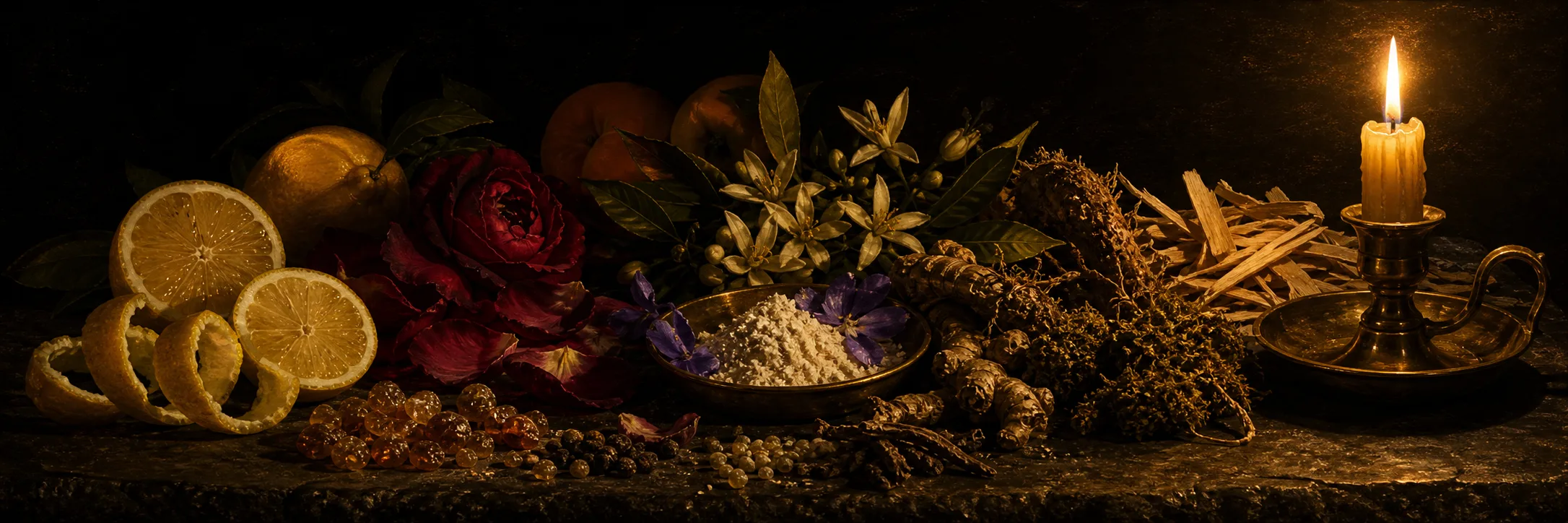
The first ten to twenty minutes of Allure EDT are bright and slightly indistinct - by design. Mandarin and bergamot lead with a sparkly citrus crispness, lemon adds a sharper edge, and peach is immediately apparent as a soft, fuzzy, slightly waxy stone-fruit note. Passionfruit is the most submerged of the listed top notes, contributing a vague tropical tang rather than identifying as passionfruit. There is a faintly soapy, almost aldehydic shimmer running through this stage - Chanel’s house texture, even though aldehydes are not in the notes list. The opening reads warmer and more rounded than typical citrus tops because of the peach. From thirty minutes to roughly three hours, the heart unfolds. Allure’s “six facets” marketing was a real compositional choice: Polge constructed the fragrance to evolve as overlapping facets rather than a top-heart-base pyramid, so heart and base bleed into each other in ways that traditional perfume analysis struggles to chart. White florals dominate this phase - magnolia is the most perceptible (lemony-creamy), honeysuckle adds a honeyed nectarous quality, and jasmine and May rose function as a generalized “Chanel floral” bouquet rather than as soloists. Peony and water lily contribute a watery, slightly dewy texture. The signature accord is the peach-jasmine-magnolia interaction, with the peach as the connective tissue. From three hours onward, Allure settles into a soft drydown that is the most “Chanel-classical” portion of the perfume. Vanilla is present but restrained - not gourmand, not creamy-bakery, but warm and slightly woody. Sandalwood (almost certainly a Polysantol/Javanol-type synthetic sandalwood rather than Mysore, per the standard Turin/Sanchez critique of modern sandalwood claims) contributes smoothness. Vetiver and cedar add a discreet woody dryness that prevents the drydown from going syrupy. Amber and tonka close the composition with a soft sweet warmth; patchouli is essentially undetectable as patchouli, functioning as a darkening agent. Submerged notes throughout: passionfruit, peony, water lily, tonka. Linearity is unusually high for a Chanel - the “facets” architecture means the perfume reads broadly similar from hour one to hour six, which is what some wearers love and others find boring.
Performance
Projection is moderate for the first hour, dropping to light by the second; the EDT is calibrated as a daytime, polite fragrance rather than a sillage monster. Sillage is light-to-moderate, in the 30-50 cm range. Longevity on skin runs four to seven hours for the current formulation; Wearer response is that the modern EDT is meaningfully less tenacious than 1996-2005 bottles, with some wearer discussions and wearer reports describing post-2014 batches as “two hours and gone.” On clothing, the vanilla-amber-sandalwood base lingers eight to twelve hours. Heat amplifies the peach and vanilla and can push Allure into slightly cloying territory; the EDT is more heat-tolerant than the EDP. Cold weather flatters it but compresses the projection further. Humidity makes the white florals bloom but shortens longevity. Best application strategy: four to six sprays for the modern EDT, including one to clothing. Allure is one of the Chanels that rewards generous application - its restrained DNA means it does not become offensive at high concentration.
Wearing Context
Best seasons: spring and autumn primary; summer secondary (the EDT specifically is the best Allure for warm weather); winter least suited. Time of day skews daytime - Allure EDT was designed as an office, daytime-event, daytime-meeting fragrance. Best occasions: workplace, lunches, weddings (especially as a guest rather than the bride), graduations, daytime social events where polite presence matters more than statement. Where it shines: warm, well-ventilated daytime contexts on mature wearers - it has been Chanel’s “professional adult woman” signpost fragrance for nearly thirty years. Where it falls flat: nightclubs, intimate evening seductions (use the EDP or Sensuelle), winter formal events (use the Parfum), gym contexts. Social-perception skew is strongly toward “professional, married, between 30 and 60” - wearer reports in wearer discussions regularly characterizes Allure EDT as “mom perfume” in the gentlest possible sense. Wearers in their 20s often find the EDT reads older on them than its actual character.
Comparisons & DNA
Direct peer comparisons within the 1996-2000 mainstream-floral era: Lancome Tresor (more rose-apricot, sweeter, more peach-heavy), Hermes 24 Faubourg (more aldehydic, more orange blossom, denser), Jean Paul Gaultier Classique (more powder and orange blossom, more star anise), Dolce & Gabbana The One (warmer, more amber-vanilla, less floral). Allure is drier and more restrained than all of these. Dior J’adore (1999) is the closest descendant in spirit - luminous white-floral-fruity-amber - though J’adore is more ylang-driven. Within Chanel: Allure is the bridge between Coco (1984, deeper, spicier, more amber) and Coco Mademoiselle (2001, sharper, more patchouli, more contemporary). Cristalle EDT is its bright cousin; Chance is its younger commercial successor. The EDP version, launched 1999, is significantly more amber and vanilla-forward - Bois de Jasmin has noted Allure EDP is denser and more oriental than the EDT. Allure Sensuelle (2005) takes the DNA in a patchouli-amber-vanilla direction; Allure Parfum and the Allure Sensuelle extrait push the orientalism further still. The Allure Homme line (1999 onward) is a distinct masculine reading of the “warm woody oriental” idea. Notable critical assessment: Luca Turin and Tania Sanchez in Perfumes: The Guide gave Allure a famously deflating short review, characterizing it (per wearers recollections of the print review) as a “grim floral” - a description that became a running joke among readers who had worn Allure as a signature scent. Their broader argument was that Allure was technically competent but lacked the bite or distinction of Chanel’s classical canon. Designer and clone alternatives: Benetton Hot is the most widely cited budget Allure-adjacent reference (wearer reports in wearer discussions calls it a partial dupe), though it lacks Chanel’s blending polish. Avon Imari Seduction and various Bath & Body Works peach-vanilla mists capture surface notes only. Among Middle-Eastern clone houses, Lattafa, Armaf, and Maison Alhambra have not targeted Allure EDT specifically - their attention has gone to Coco Mademoiselle and Bleu - but several generic “peach-vanilla floral” compositions in those lines hit roughly forty percent of the Allure mood for a tenth of the price. Lineage and influence: Allure helped establish the late-1990s “luminous warm floral” mainstream that dominated department-store perfumery from 1996 through roughly 2005, paving the way for J’adore, Tresor In Love, and the entire peachy-amber-floral wave.
Reception
Reception was muted. Luca Turin and Tania Sanchez’s Perfumes: The Guide did not rank Allure highly; their commentary (cited by wearer discussions) characterized it as a competent but uninspired “grim floral,” with the implicit critique that it represented Chanel’s commercial drift in the 1990s. This contrasts sharply with their five-star treatment of Les Exclusifs releases a decade later. Chandler Burr did not single Allure out for major coverage in his NYT scent column or books. Wearer reception was more divided. Bois de Jasmin’s Victoria Frolova has referenced Allure positively in discussions of perfume concentrations and the parfum extrait specifically, noting “golden peaches and an armful of jasmine” as the extrait’s defining character and confirming that the extrait is “very different from the EDP/EDT.” Now Smell This has covered the Allure family largely through flanker reviews. Persolaise has not produced a major standalone Allure piece, focusing more on Chanel’s masculine line. Common praise: blending quality, the peach-jasmine-magnolia interaction, professionalism, longevity on clothing. Common criticisms: weak post-reformulation performance, lack of evolution, “smells like every other 1990s department-store floral,” price-to-performance for the modern EDT. Polarization axes: vintage vs. modern bottle (strong); EDT vs. EDP (moderate); “elegant classic” vs. “boring mom perfume” perception (strong). Blind buy verdict: yes for the EDT at current prices if you already like Tresor, J’adore, or 24 Faubourg; otherwise sample first, and consider the EDP or Sensuelle if you want more presence.
Versions & Reformulation
Allure has a substantial version family. The original 1996 EDT is the subject of this dossier. Allure Eau de Parfum launched 1999 (denser, sweeter, more peach-vanilla-amber, often described as the “warm” sibling). Allure Parfum (extrait) launched alongside; Bois de Jasmin has identified it as the most distinctive of the family - “golden peaches and jasmine.” Allure Sensuelle launched 2005 as EDP and EDT, with Sensuelle Parfum in 2006, taking the DNA in a patchouli-amber-vanilla “evening” direction. The masculine Allure Homme (1999) and its many flankers (Edition Blanche 2008, Sport 2004, Sport Eau Extreme 2012) are separate compositions sharing only the name. Reformulations are the most contested topic in Allure discourse. The original 1996-2000s formulation is widely reported on wearer discussions as richer, more resinous, more honeyed, with stronger peach-vanilla weight. Post-2014 EDT bottles are characterized by wearers wearers as thinner, more transparent, less long-lasting, with the citrus opening more synthetic and the base less substantive. Chanel has not publicly acknowledged specific reformulations; ingredient regulation (oakmoss, certain musks, peach lactone restrictions) likely drove gradual recomposition. Vintage bottles command moderate eBay premiums and are a known collector category. The EDP has reportedly undergone similar but lesser changes; the Sensuelle extrait was reformulated and the original “Parfum” version is widely lamented as superior to current stock.
Acquisition Notes
Pricing tier: designer (the only Allure in this report that sits outside Les Exclusifs pricing). As of 2026, Allure EDT retails approximately: 50 ml at $130 USD, 100 ml at $175 USD. The EDP and Sensuelle EDP are slightly higher. Available at Chanel boutiques, Chanel.com, Sephora, Macy’s, Nordstrom, Saks, Bloomingdale’s, Ulta, and most authorized department-store fragrance counters.
Notable Facts & Lore
- Jacques Polge’s stated design intent for Allure is documented in Chanel’s own materials and was reiterated in 1996 launch press: he conceived the fragrance as a diamond “cut with six facets which overlap, with no single note dominating.”
- Chanel’s marketing campaign emphasized this non-pyramid construction as the perfume’s defining innovation - at a time when every other perfumery brief explained itself through top/heart/base, Allure refused the pyramid.
- Whether this was real compositional radicalism or sophisticated marketing has been debated in perfume blogs and wearer discussions ever since; in practice the facets framing accurately describes the fragrance’s compressed, overlapping evolution.
- The name itself is a Coco Chanel reference - “allure,” in French, means style, bearing, the way one moves, and the word was associated with Chanel personally as one of her favored descriptors for elegant femininity.
- The original tagline (Chanel’s own) called Allure “the very definition of elegance according to Mademoiselle Chanel.”
- No major celebrity face dominated the launch (Chanel’s celebrity-ambassador era for fragrance accelerated later, with Coco Mademoiselle’s Keira Knightley campaigns).
- Allure has had no significant viral TikTok moment - its cultural footprint is the opposite of viral: it is a steady, multi-decade pillar that has lived in millions of bathroom cabinets without ever becoming a meme.
- The most notable “lore” item is the persistent perfumista discussion of vintage-vs-modern formulation, which has made Allure a frequent topic in reformulation threads on wearer discussions.