Chanel — Cuir de Russie Eau de Parfum
Essence
Cuir de Russie EDP (2016) is the Eau de Parfum reformulation of Chanel’s legendary 1924/1927 leather, Ernest Beaux’s “Russian Leather,” within the Les Exclusifs line. It is a refined floral-leather: aldehydic-soapy florals (jasmine, ylang, rose) draped over a smooth, powdery iris-leather with whispers of tobacco, birch smoke, and a clean animalic warmth. The 2016 EDP is markedly softer, soapier, and more floral than the earlier Les Exclusifs EDT - devotees describe the evolution as “what was a lion is now a perfectly trained, gorgeous house cat.” Polished, elegant, unisex-leaning, and a touchstone of the leather genre.
Scent Profile
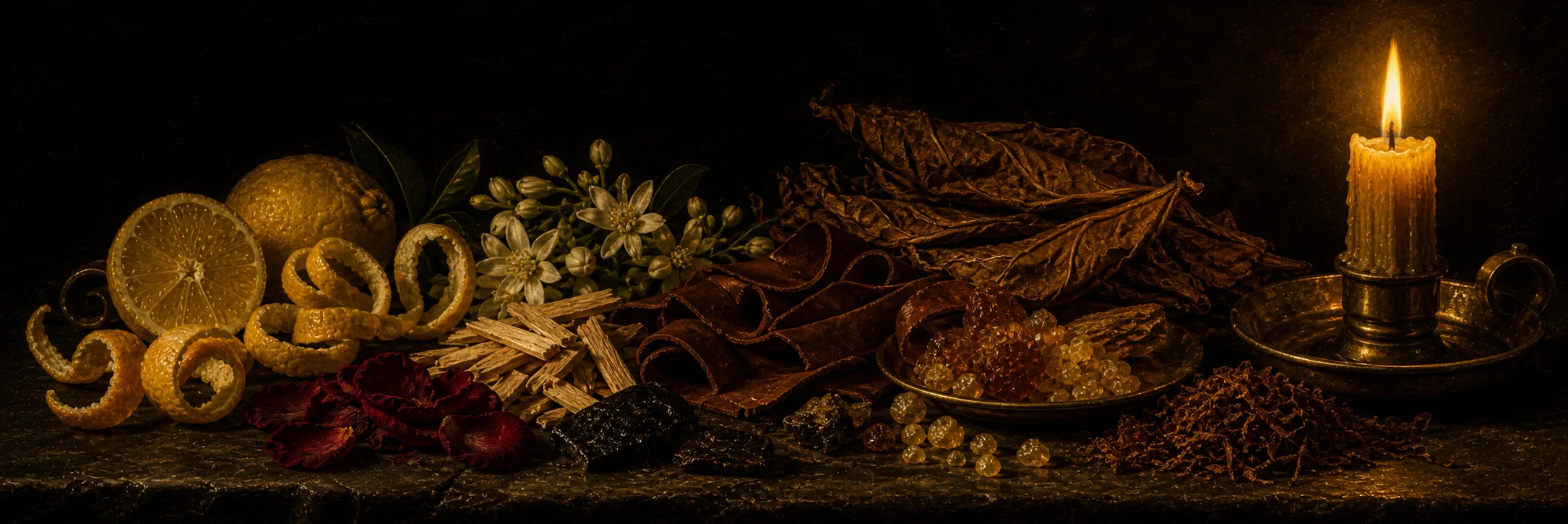
The opening is unmistakably Chanel: a soft “open-handed slap of aldehydes and flowers,” very No. 5-adjacent, with orange blossom that reads “reminiscent of fatty soap,” plus bergamot and mandarin. In the EDP this entry is gentler and soapier than the EDT’s drier, more astringent aldehydic start - the “initial aldehydic astringency” longtime wearers associate with the older versions is softened. For the first ten to twenty minutes it can read as a soapy floral bouquet “where nothing rises above,” with the leather still latent. The heart (one to three hours) brings the classic floral trio forward - jasmine and ylang dominate (one reviewer: “the opening and mid are really dominated by jasmine with a hint of ylang”), with rose and an unlisted-but-clearly-present iris/orris doing heavy lifting. The leather accord emerges roughly ten minutes in and threads through as a “classic powdery” suede rather than a raw hide. Tobacco is subtle, more an idea of warmth than a smoke note in the EDP. The signature accord is this iris-leather-over-soapy-aldehydic-florals - a “supple, almost suede-like leather” that shimmers between facets: “smell it one moment you get the leather, smell it again and you can smell the jasmine.” The drydown (3+ hours) is a soft, powdery, woody-amber leather with a faint resinous smoke and, deep in, a gentle animalic warmth on skin. The birch tar - the defining “Russia-leather” smoky-tar signature - has been progressively toned down across reformulations and is mild here; some find only “the mildest hint of smoke,” and a vocal minority detects a clean “well-maintained outhouse” / horse-manure nuance that is far gentler than vintage. Of the listed notes, orange blossom, bergamot, ylang, jasmine, rose, and leather are clearly perceptible; tobacco and birch are submerged/subtle; iris (unlisted) is arguably the backbone. It evolves gently from soapy-floral to powdery-leather but is relatively smooth and refined throughout rather than dramatic. Bois de Jasmin’s classic evocation - a woman’s black leather handbag holding lipstick, a violet-powder compact, and a silver cigarette case - remains the best image for its character.
Performance
Performance is the EDP’s most-debated trait. Many find longevity very good - one reviewer logged seven hours with decent projection and sillage, others report it lingering with “a whisper when I wake.” wearer discussions testers suspected Chanel added a woody-amber molecule (something norlimbanol-like, “scratchy parched woods”) to extend the EDP’s life. But a significant camp finds it surprisingly fleeting for an EDP - “CLEARLY NOT EDP concentration,” “fleeting, more so than EDTs I own” - and some longtime wearers lament that the modern juice has gone “flat and short-lived” at the boutique. Net: projection is light-to-moderate (an arm’s-length bubble, “contained sillage especially after the opening”), with longevity ranging widely from a disappointing 2-4 hours on some skins to 7+ on others; clothing holds it longer and more reliably. It leans cool-weather and transitional-season; reviewers associate it with spring and autumn, finding it neither too warm nor too cold. The parfum/extrait concentration substantially out-performs and out-lasts the EDP for those who need power. Apply generously and to fabric if longevity is a concern.
Wearing Context
Best in spring, autumn, and cool transitional weather, and well-suited to both day and evening given its refined, soapy-elegant character. It reads “old school money class,” high-society polish - reviewers picture Russian Grand Dukes, opera, smoky jazz clubs, fine leather goods. It shines in dressy, sophisticated, cool-weather settings and on someone comfortable wearing florals; it can feel “too demanding to be versatile for everyday” for some, while others wear it as a refined daily leather. It falls flat in high heat (the soapy aldehydes and ylang can turn sharp) and for anyone expecting a rugged, smoky, animalic “biker-jacket” leather - the EDP is genteel, not growling. Socially it is genuinely unisex and frequently leans masculine in the heart-to-base despite its feminine catalog listing; blindfolded, many would call it unisex or masculine. It is a connoisseur’s leather, more likely to earn “smells expensive” than overt compliments.
Comparisons & DNA
The essential internal comparison is across its own concentrations. The vintage parfum/extrait is the reference standard - richer, smokier, more animalic, with the birch-tar bite intact (“Pavarotti at full volume”); the older Eau de Cologne is the most leathery and animalic (“growls”); the Les Exclusifs EDT (2007) is drier, hay-like, more austere and birch-forward; and this 2016 EDP is the softest, soapiest, most floral and “supple-suede” reading - “a jasmine-based leather” versus the EDT’s drier profile. Externally, the canonical floral-leather neighbors are Knize Ten (the classic, with a gasoline/petrol edge CdR lacks), Parfum d’Empire Cuir Ottoman (more balsamic-styrax, subtle), Dior Cuir Cannage (sweeter, lipsticky, more “luxury handbag,” explicitly inspired by CdR), Serge Lutens Cuir Mauresque (spicier, more angular), and Lancome Cuir de Lancome. Reviewers consistently rank CdR as the most aldehydic and “chic” of this cluster, with Cuir Cannage sitting “halfway between Knize Ten and Cuir de Russie.” Musc Ravageur (Frederic Malle) is named by some who detect a shared clean-animalic “pissoir” warmth. Tom Ford Tuscan Leather is a louder, more masculine modern leather cousin. Lineage: CdR (Beaux, 1924/1927) was among the first widely-released leather chypres - beaten to market only by Knize Ten (1924) - born of Chanel’s affair with Grand Duke Dmitri Pavlovich and Beaux’s Moscow training. It was reorchestrated by Jacques Polge in 1983 (leather softened, iris brought forward as the Chanel signature). It earned five stars from Turin/Sanchez and is frequently called one of the greatest perfumes ever made. Its DNA echoes through essentially every refined floral-leather since, and Dior Cuir Cannage is the most direct documented descendant/homage. For this artisanal-grade Chanel classic, no true “clone” exists - Cuir Cannage and Cuir Ottoman are the closest in-genre alternatives, not dupes.
Reception
Reverence shadowed by reformulation grief. The fragrance commands near-mythic status - wearer reports call it “the greatest scent profile ever made,” “old school money class,” “the best leather easily found on the market.” But the 2016 EDP specifically is the most contested incarnation. Critics of it find it a “soapy No. 5 with a hint of birch tar… no leather, no horse, no whip, just a sad reflection of former glory,” and mourn the discontinued EDT it replaced (“the EDT had more light and shade… dryer and a little more animal”). Defenders argue it’s simply a different, equally valid composition - “two versions of equal quality but distinctly different fragrances,” more like flankers than concentration siblings - and praise its creamy, supple, classy refinement. The axes of polarization: EDT-versus-EDP loyalty, the toned-down birch tar, the soapiness, and the unreliable longevity. Bois de Jasmin (Victoria Frolova) wrote the definitive enthusiast review of the Les Exclusifs CdR, lovingly cataloguing its handbag-and-cigarette-case imagery; her comment threads also document longtime fans’ shock at how “flat and short-lived” the boutique juice became. Blind-buy verdict: experienced leather lovers can blind-buy the EDP with eyes open to its soft, soapy, modern character - but anyone chasing the legendary animalic-smoky CdR of lore should seek the parfum or vintage, not this.
Versions & Reformulation
This is a heavily-versioned classic, and the concentrations differ as much as flankers. Original 1924/27 Beaux composition Polge reorchestration (1983), which softened the leather and emphasized iris. Within Les Exclusifs: the 2007 EDT (drier, more austere, birch-forward, lighter-wearing) was discontinued and replaced in 2016 by this EDP (softer, soapier, more floral/suede, with suspected woody-amber molecules added for longevity, and necessarily reformulated since any EDTEDP shift requires reworking). The pure parfum/extrait remains the richest, smokiest, most animalic and longest-lasting form and is still sold (small flacon). Across all modern versions the birch tar has been progressively reduced versus vintage; wearer discussions side-by-sides confirm “a pretty major reformulation took place” between vintage and modern. Bottom line in wear: parfum > EDC (vintage) > EDT for leather/animalic intensity; the 2016 EDP is the gentlest and most floral-soapy.
Acquisition Notes
Luxury tier, Les Exclusifs pricing: sold as 75 ml and 200 ml EDP (with the 200 ml the value size), plus a small (~15 ml) parfum flacon at premium pricing. The discontinued 2007 EDT now trades secondhand and is “as rare as rocking horse droppings” per one collector; vintage parfum/EDC command high prices and require seller vetting. Decant ecosystem: historically Surrender to Chance / The Perfumed Court carried Chanel decants (now constrained as Chanel has pressured decanters), and splits circulate in wearer discussions - decants are the smart way to test before committing to the 200 ml.
Notable Facts & Lore
- The fragrance’s origin is one of perfumery’s great romances: Chanel’s 1920 encounter with the exiled Russian Grand Duke Dmitri Pavlovich (cousin of Tsar Nicholas II) brought “echoes of imperial grandeur, the aroma of leather and birch,” and it was through Pavlovich that Chanel met Ernest Beaux, Moscow-trained, who became her house perfumer.
- Cuir de Russie translates that affair - furs, the steppes, Byzantine embroidery - into scent, and Chanel’s own copy frames it explicitly around Dmitri.
- A persistent historical debate (raised by wearer discussions historians) concerns the launch year: Chanel and many sources cite 1924, but others argue the leather-focused release properly dates to 1927, hot on the heels of Bois des Iles (1926) - making the “first commercial leather perfume” claim contestable given Knize Ten (1924).
- The perfume also carries a period-feminist charge: it was created for the scandalous modern woman who dared smoke cigarettes in public, an “encouragement and approval” of emancipation.
- Turin’s five-star A-Z Guide entry cemented its critical canonization, and its supposed reformulation decline is itself a running lore-thread in enthusiast circles.