Chanel — Chanel N°5 L'Eau
Essence
N5 L’Eau (2016) is Olivier Polge’s transparent, citrus-forward reinterpretation of Chanel N5 - his first major work on the house’s keystone fragrance after succeeding his father Jacques. It strips N5 of its dense aldehydic powder and animalic weight, rebuilding it as a fresh, soapy, eau-de-cologne-light floral aimed explicitly at a younger generation. Distinctive as “N5 reinterpreted for minimalists”: instantly recognizable as N5 DNA, yet linear, luminous and easy where the original is grand and abstract. Widely praised by critics as a respectful, intelligent modernization rather than a watered-down cash-in.
Scent Profile
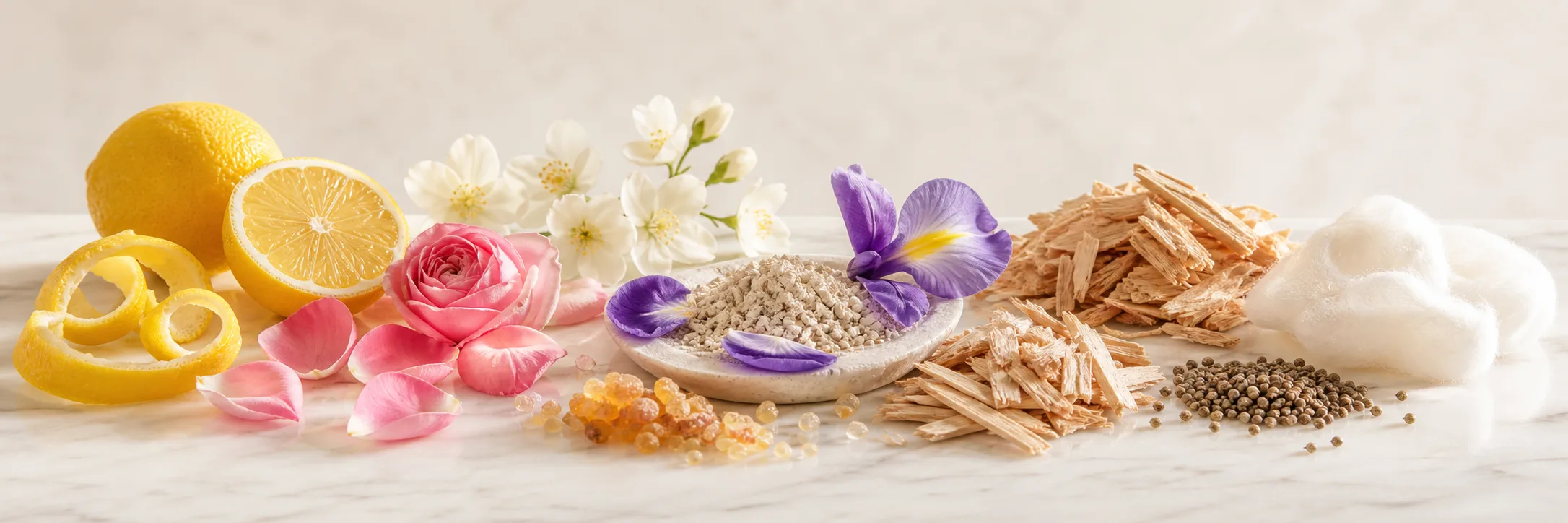
Listed notes: aldehydes, lemon, neroli, bergamot, mandarin, lime and orange up top; ylang-ylang, jasmine and may rose in the heart; white musk, orris, cedar and vanilla in the base. The opening (first 10-20 minutes) is the headline achievement: a “vibrant blast of pure sunshine” in which Polge replaced N5’s heavy 13-carbon metallic aldehyde (2-methylundecanal) with lighter citrus-facing aldehydes (the 8- and 10-carbon range, per Colognoisseur’s Mark Behnke), matched to real lemon, mandarin and orange - the aldehydes act “like champagne bubbles” lifting the citrus. The effect is effervescent, soapy-bright and noticeably more transparent than any prior N5, with critics likening it to a barely-sweet “lemon meringue.” Neroli adds a misty floral lift. The heart (1-3 hours) keeps N5’s floral spine - rose (the prominent may rose/Rose de Mai from Grasse), jasmine and ylang-ylang - but lightened: the emphasis shifts from heady tropical ylang toward “watery rose and weightless, misty neroli,” soft and plush rather than imperious. May rose is the most perceptible floral; jasmine is present but restrained. The drydown (3+ hours) is the most polarizing part: a soft, “cottony” white musk over light orris, cedar and a touch of vanilla, with the iris, patchouli, vetiver, oakmoss and animalic notes of classic N5 essentially absent. The cedar and (per Cafleurebon) a fractional ylang distillate give a bracing, “watercolor impression of cedar and musk” finish. Critics and wearer split on this musk: some find it elegant and skin-like, others detect the sharp “cottony”/woody-amber musk found in contemporary releases (compared to Narciso Rodriguez For Her and to the “bug spray” musk some dislike in Chance Eau Tendre and Allure Homme Sport). The fragrance is deliberately more linear and less abstract than the original - Polge’s stated approach was to change “tones and accents” rather than the structure. The signature accord is sparkling citrus-aldehyde over a sheer N5 floral and soft white musk. Octavian Coifan (wearer discussions) summarized it as keeping the aldehydic accord “close to the classic one but smartly decorated with modern materials.”
Performance
As an intentionally cologne-light, fresh interpretation, performance is modest by design and a common point of complaint. Projection is light-to-moderate with a bright, radiant opening - Victoria Frolova (Bois de Jasmin) noted “the radiance of L’Eau took both me and the sales assistant by surprise” even amid competing smells - that settles fairly quickly to a close skin scent. Sillage is good early, then intimate. Longevity is heavily musk-dependent and divisive: Frolova reported it lasting “the entire day” on her skin, while many others report it fading to a faint skin scent within roughly 3 hours, and some say it “doesn’t last at all” after ten minutes. Expect roughly 3-6 hours on skin for most wearers, longer for those who don’t go anosmic to the base musks, and notably longer on clothing. Critically, people who can’t smell certain musks will perceive it as weak and complain about sillage and longevity - Frolova explicitly predicted this. It performs best in warm weather, where its citrus-cologne character is meant to shine (reviewers call it a daylight, summer-day version of N5); it can feel thin in cold. Application strategy: it is built for generous application - wearers report needing roughly 10 sprays to fill a room, and Chanel offers it in larger EDT spray formats “for a more generous application.” Treat it as a refresh-friendly cologne rather than an all-day powerhouse.
Wearing Context
This is a spring/summer, daytime, warm-weather scent first - versatile from casual to dressy but happiest as elegant-but-relaxed daywear. Critics frame it precisely: Persolaise called it “10 in the morning on a Saturday… a simple, short-sleeved linen blouse… ivory”; Frolova reaches for it “on days when I want something elegant but casual, polished but versatile.” It shines for office, daytime events, hot weather, and as an approachable everyday alternative to the grand original - and it functions as a “gateway” or “bridge” that makes the heavier N5 EDP/Eau Premiere feel more accessible to new or younger wearers. It falls flat for grand evening occasions where the original N5’s depth and projection are wanted, and in cold weather where its transparency reads thin. Social perception skews “clean, fresh, classy, expensive” rather than “unique” or “seductive” - it is widely read as a polished, inoffensive, “old money”/“clean girl” elegance. It is marketed feminine but is easily unisex; the wearer discussions columnist noted “there is no rejection for men… I wear it with great pleasure.” Frolova’s verdict captured the strategic skew: marketed to young women, “as good as I would have hoped,” and a potential “good introduction to the grand dame herself.”
Comparisons & DNA
The entire comparison set is the N5 family itself. Chanel N5 Eau Premiere (2007, Jacques Polge) is the closest relative and the constant point of reference - Eau Premiere is a lighter, vanilla-smoothed but still recognizably classic N5; L’Eau is fresher, brighter and more citrus/cologne-forward, less “classic-feeling.” Multiple critics (Frolova, A Tea-Scented Library) prefer Eau Premiere’s depth while conceding L’Eau is the more modern, versatile daytime option. Chanel N5 EDP is the denser, powdery, aldehyde-and-floral standard; Chanel N5 Parfum/Extrait is the richest, most animalic and vintage-leaning; Chanel N5 EDT is the brighter classic concentration. L’Eau is the lightest, most transparent and most linear of all of them, and the only iteration with a clear citrus facet. Within Polge’s own work, L’Eau belongs to his “modernize the house for today” mode alongside the Les Eaux de Chanel (Paris-Deauville, Paris-Biarritz, Paris-Venise; 2018), which Persolaise explicitly tied to “the same… update job… as he was tasked to do with No. 5 L’Eau.” wearers comparisons outside the house: one reviewer called it like “N5 crossed with Coco Mademoiselle sans the patchouli,” and several detect a kinship to Narciso Rodriguez For Her in the cottony-musk drydown. No true designer clone is typically cited - it is itself the “accessible” version of an icon. Lineage: it is the latest major flanker of the most influential floral-aldehyde in history (Ernest Beaux, 1921), and Polge has said creating it “allowed me to reflect and somehow position myself in relation to the house’s signature.”
Reception
Unusually well-covered by critics, and the consensus is positive-with-reservations - relief that a risky N5 flanker was handled respectfully. Bois de Jasmin (Victoria Frolova) approved of reworking classics “provided the brand keeps the original intact,” calling L’Eau “sophisticated, with a lighthearted and charming character… fresher and brighter than No. 5 Eau Premiere.” Colognoisseur (Mark Behnke) was effusive - it was his most-anticipated 2016 release and exceeded expectations: “I don’t think I have ever been as impressed with M. Polge,” praising his “astute decisions” in substituting lighter aldehydes, and memorably describing it as taking N5’s “famous society lady… armed her granddaughter with an iPhone, a Chanel purse and sent her out into the world.” Persolaise framed it as “N5 stripped back, toned down, made more transparent, more linear and… less abstract,” noting it is “probably as unlike No. 5 as a scent could be” while still earning the name, and predicting it would be a gateway to the original. Now Smell This (Angela) was more measured - appreciating the “fizzy, fun champagne start” but flagging the “cottony musk” as the weak point and ultimately preferring Eau Premiere. Cafleurebon ran a five-day N5-immersion diary concluding Polge “truly succeeded in putting a fresh new face on the fragrance.” wearer reports echoes this: praise for elegance, freshness and “class,” criticism for performance/value (some calling it “terrible value,” “homeopathic”) and for the divisive musk. Polarization axes: classic-vs-modern N5 loyalty, and musk-perception (longevity complaints track anosmia). “Blind buy?” verdict: low-risk for anyone wanting a fresh, elegant, versatile daytime citrus-floral and unbothered by light performance - but those seeking the depth, projection or “real” N5 experience should sample first or choose the EDP/Eau Premiere.
Versions & Reformulation
N5 L’Eau (2016) is a distinct flanker, not a reformulation of N5, and is offered as an Eau de Toilette in 35, 50 and 100 ml (launch pricing roughly $64/$100/$132). It sits within the broader, much-reformulated N5 line: N5 Parfum/Extrait (richest, most animalic, closest to the vintage Marilyn-era scent before natural civet was restricted), N5 EDP (powdery floral-aldehyde standard), N5 EDT (brighter classic), and N5 Eau Premiere (2007, the prior lighter reinterpretation). In wear, L’Eau is the lightest, brightest, most transparent and most citrus-forward; the EDP and Parfum are progressively denser, powderier and longer-lasting. The classic N5 EDT itself was reworked by Polge (a version dated 2024 in databases), separate from L’Eau. No significant reformulation of L’Eau itself is widely reported since 2016; it has been reissued in limited-edition “drop” bottles. Note one wearer caution: databases conflating launch years across the N5 line cause confusion.
Acquisition Notes
Designer/luxury-designer pricing tier (Chanel mainline, not niche-exclusive). EDT in 35/50/100 ml at the launch prices above; widely available and frequently in larger generous-spray formats. It is sold authentically through Chanel boutiques and Chanel.com, department stores (Nordstrom, etc.) and Sephora; discounters (FragranceNet, Jomashop, Maxaroma) carry it at lower prices. The decant ecosystem covers it well (Surrender to Chance, Scent Split, MicroPerfumes), and sampling is wise given the polarizing musk and modest performance.
Notable Facts & Lore
- This was Olivier Polge’s first mass-market release and first N5 work as Chanel’s in-house perfumer, having succeeded his father Jacques in 2015 - a high-stakes debut on the house’s most sacred fragrance.
- His documented intent is specific: he set out to make “the freshest version of Chanel N5,” bringing “a new and vibrant transparency” while preserving the “olfactory heritage” of (then) 95 years, working with a new fractional distillate of ylang-ylang and deliberately replacing the metallic aldehydes, removing powder, lightening jasmine and decreasing vanilla.
- He has said the project “allowed me to reflect and somehow position myself in relation to the house’s signature,” and has spoken of N5 as “the spine” that must always remain the spine.
- He reportedly worked on the composition since around 2013.
- The fragrance was marketed under the tagline “You know me and you don’t,” with a campaign squarely targeting millennial/younger consumers - a strategic move Behnke tied to data showing millennials outspending boomers in prestige beauty (especially fragrance) by 2015.
- The original N5’s own lore - Ernest Beaux’s 1921 aldehyde “overdose,” Coco Chanel’s love of soap/clean smells (her mother worked in laundering) - is frequently invoked by reviewers as the heritage L’Eau both honors and updates.