Chanel — Chanel N°5 Eau de Toilette
Essence
Chanel N5 is the most famous perfume in the world - the 1921 Ernest Beaux aldehydic floral that defined the genre. The Eau de Toilette is its brightest, sparkliest, most “peachy” interpretation: a crisp, soapy, aldehyde-lifted bouquet of ylang-ylang, rose, jasmine, and iris over a woody-powdery base, generally regarded by critics as the concentration closest in spirit to the vintage parfum. This catalog entry reflects the current/2024 EDT, with the long-running EDT lineage and a fresh 2026 reformulation both addressed below.
Scent Profile
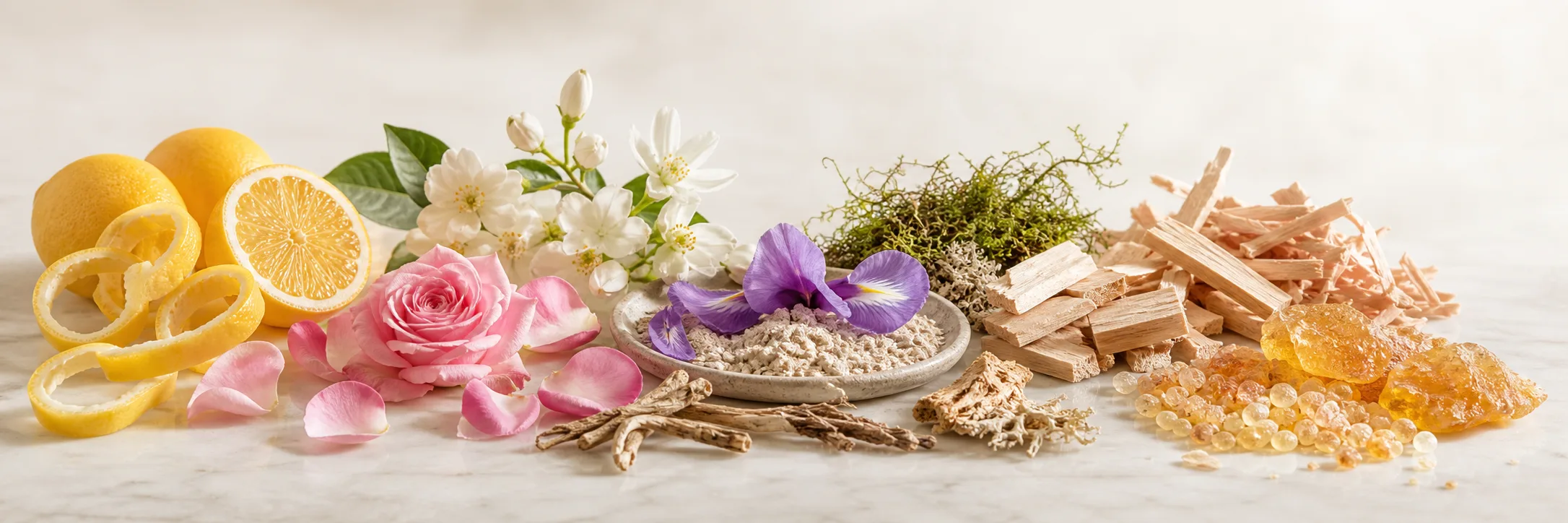
The opening (first 10-20 minutes) is the signature N5 event: a burst of soapy, fizzy, slightly metallic-starchy aldehydes - “expensive face cream,” fresh laundry, the smell people either find sublimely elegant or “old-fashioned.” Beneath them ylang-ylang and neroli give a warm, faintly banana-creamy floral lift, with amalfi lemon and bergamot adding sparkle. Bois de Jasmin’s Victoria Frolova characterizes the EDT as having “a joyful, sparkling quality,” “like a chiffon wrap to the parfum’s heavy silk.” The heart (1-3 hours) is the great abstract floral accord - rose, jasmine, ylang-ylang, and iris/orris blended so seamlessly that, in classic Chanel fashion, no single flower dominates; the iris adds a dry, powdery coolness and lily-of-the-valley a green transparency. The EDT keeps the florals “toned down considerably” versus the parfum but, per Bois de Jasmin, retains “all of the surprising juxtapositions that make No 5 so memorable,” reinforced by woody-violet and sheer green facets. The drydown (3+ hours) is a soft, clean, powdery-woody base: sandalwood, vetiver, a whisper of civet and musk, oakmoss, amber, vanilla, and patchouli, giving a surprisingly dry, faintly masculine woody underpinning beneath the powder. The EDT reads soapier, crisper, and more transparent than the EDP’s rounder, sweeter, more sandalwood-and-vanilla profile. Signature accord: sparkling aldehydes over an abstract rose-jasmine-ylang bouquet on clean woods. Evolution is present but the character is recognizably continuous; perceptible: aldehydes, ylang, rose, powder. Submerged: civet (a faint animalic underbase only some detect), individual florals (deliberately abstracted).
Performance
The EDT is the lightest and most “fleeting” of the classic concentrations - Wearer response is that it projects moderately and sparkles up close but does not last as long as the EDP or parfum. Projection: moderate in the first 1-2 hours (a bright, diffusive, soapy aura at roughly arm’s length), then close. Longevity on skin: commonly 4-6 hours, frequently described as needing reapplication; on clothing and hair it lasts substantially longer (aldehydic-musky bases cling to fabric). Behavior: the bright aldehydes and citrus lift beautifully in warmth, making it a strong spring/warm-weather choice; in cold it stays closer. Best application strategy: apply generously (it comes in spray for “more generous application,” per Chanel) and re-up through the day; spritzing on clothing markedly extends it. Note that the current formula draws longevity complaints from long-time wearers who recall stronger vintage batches.
Wearing Context
The EDT is the most versatile, daytime-friendly, all-occasion N5. Best seasons: spring and warm weather especially, though it’s a year-round classic. Time of day: excellent daytime and office wear given its lighter, crisper profile (the EDP and parfum skew more evening/formal). Occasions: from everyday to dressed-up; it carries enormous cultural “occasion” weight while remaining wearable casually. Where it shines: as an elegant, recognizable, “put-together” signature; on those who find the EDP too heavy. Where it falls flat: with younger wearers who read aldehydic florals as “granny,” “mature,” or dated, and for anyone seeking heavy projection/longevity. Social-perception skew: strongly feminine and generationally coded as classic/sophisticated, though the EDT is the most unisex-leaning of the set (its aldehydic crispness is shared with many vintage masculines).
Comparisons & DNA
N5 is the archetype from which an entire aldehydic-floral lineage descends. Within Chanel’s own house, the most direct relatives are the flankers: N5 Eau Premiere (2008, Polge) - a softer, sheerer, more modern and “velvety” redraw that many find the easiest N5 to wear; and N5 L’Eau (2016, Olivier Polge) - the citrusy, light, “younger-audience” version, which Bois de Jasmin praised for surprising radiance. Bois des Iles (Chanel) is described by wearer reports as essentially “No. 5 reworked for the male market” with a richer sandalwood. Among the original genre descendants, Lanvin Arpege and the vintage “dupe” Liu are repeatedly named as close stylistic kin; reviewers of the new 2026 EDT even note its similarity to “Liu, which is a vintage fragrance issued as a ‘dupe’ to N5 back in the day.” Clones/cheaper alternatives genuinely exist for the aldehydic-floral idea broadly, but N5 itself - built on expensive Grasse rose and jasmine - is generally considered un-clonable at quality; budget aldehydic florals approximate the genre, not the specific juice. Lineage verdict: N5 didn’t just join a trend, it created one (the modern aldehydic floral) and remains its defining reference.
Reception
N5 is simultaneously the most revered and most “love-it-or-find-it-dated” fragrance in existence. Critical reception is decisive here: in Perfumes: The Guide, Luca Turin awarded the N5 Eau de Toilette five stars (a “masterpiece”), with the headword “peachy floral,” describing it as “Fifties work, with woody-violet notes up top and a lactonic peach dry-down,” and noting it was “the one I associated with No. 5 all along.” The parfum likewise earned five stars (“powdery floral”). Critically, the Eau de Parfum was rated lower - four stars, headword “aldehydic interrupted” - and explicitly criticized: per the Guide, the EDP “was composed in the 80’s” and contains “Polysantol (synthetic sandalwood),” and “such a latecomer synthetic has no business being in a 1920 idea… there seems no point in buying this if you want the real thing.” This is the crux of the connoisseur’s case for the EDT (and parfum) over the EDP. wearer reports on wearer discussions echoes this split - the EDT is loved for being “closer to the vintage formula,” “sleek and slender, very direct,” sparkling and soapy; criticisms center on weak modern longevity and the perennial “smells like my grandmother / luxury-hotel soap” reaction. “Blind buy?” verdict: safe for those who appreciate classic aldehydic florals (it is the most foundational fragrance in existence); sample first if you’re younger or unsure about aldehydes/powder.
Versions & Reformulation
N5’s concentration lineage is genuinely distinct, not merely strength-graded. The Parfum (1921, Ernest Beaux) is the original and remains closest to the historical formula - richer, deeper, with real Grasse florals and a smooth, radiant, animalic-tinged base. The Eau de Toilette dates to the 1920s (Beaux; a 1924 launch and a 1952 Henri Robert reworking are both cited) and is the crisp, sparkling, “peachy,” daytime version - long considered the EDT closest to the parfum’s spirit. The Eau de Parfum (1986, Jacques Polge) is a 1980s recomposition - rounder, sweeter, more sandalwood/vanilla, and the one Turin criticized for its synthetic Polysantol. Flankers Eau Premiere (2008) and L’Eau (2016) are modern, lighter redraws. IFRA-driven reformulations over the decades have altered all versions (notably oakmoss and the natural materials). Most relevant to this catalog: a NEW N5 EDT reformulation launched 2024 and was further reworked for 2026 (promoted by Margot Robbie as “more luminous”); the 2026 version drew sharply divided wearer reviews - some call it warmer, sweeter, and “stripped of its soul”/“granny-aged,” others argue it is actually a more faithful rendering of the vintage EDT. Long-time wearers should test the current batch, as it differs from older EDT bottles.
Acquisition Notes
Pricing tier: designer (premium/iconic). The EDT is sold in multiple sizes; recent pricing cited by wearers runs roughly $140 (35ml) to higher for larger formats, with EDP around $295/100ml. Bottle sizes commonly available: 35, 50, 100ml (plus 1.5-3.4oz EDT formats). Decant ecosystem: universally available - Surrender to Chance, Scent Split, MicroPerfumes and others carry all concentrations, making side-by-side EDT/EDP/parfum comparison easy and advisable.
Notable Facts & Lore
- N5’s lore is foundational to modern perfumery.
- The name origin is canonical: Beaux presented Gabrielle “Coco” Chanel a series of samples and she chose the fifth - “I show my collections on the fifth of May… so let’s leave the number it bears.”
- Its aldehyde overdose was revolutionary, deliberately abstract rather than soliflore, and (per Turin/Sanchez and historians) it broke the courtesan-vs-respectable scent divide.
- The Marilyn Monroe “I wear nothing but a few drops of N5 to bed” line is the most famous fragrance endorsement in history and has been reused in Chanel campaigns.
- Modern campaign faces span Catherine Deneuve, Nicole Kidman (Baz Luhrmann’s 2004 mini-film), Lily-Rose Depp (L’Eau, 2016), and Margot Robbie (current N5).
- Bois de Jasmin and the Osmotheque note that current IFRA regulations make it “impossible for Chanel to offer No. 5 as Beaux intended,” with the Osmotheque preserving the original formula.