Chanel — Bois Des Iles Parfum
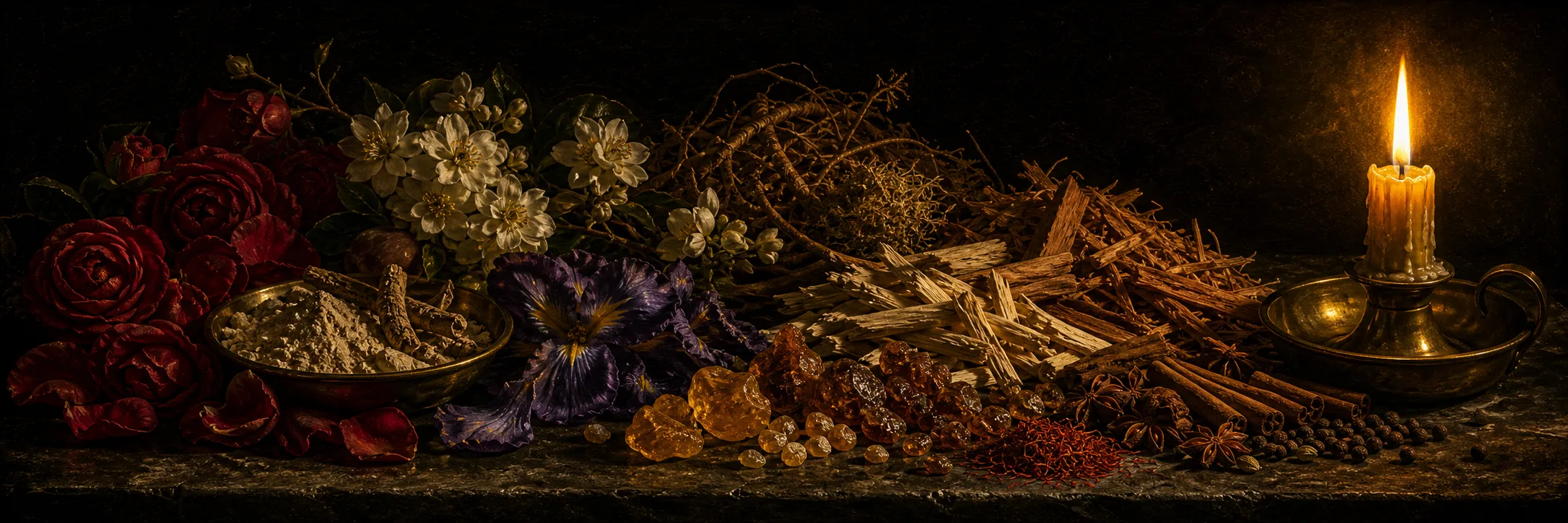
Essence
Bois Des Iles Parfum is the 1926 Ernest Beaux composition Chanel still treats as the crown jewel of its sandalwood vocabulary - a creamy, faintly aldehydic floral-woody that arrives like warm gingerbread dusted over polished sandalwood and bitter almond. In the extrait concentration it abandons the slight aldehydic chill of the eau de toilette/EDP and slides into something closer to a cashmere-lined Christmas biscuit: pipe-tobacco-adjacent, vanilla-edged, with a deep, lacquered wood at the floor. It is the rare classic that smells simultaneously aristocratic and edible.
Scent Profile
The first five to ten minutes are the most “Chanel” portion: a faint aldehydic shimmer over ylang-ylang and a hint of damask rose, lifted by what reads as bergamot and a soft almond-marzipan note even though those aren’t on the published parfum pyramid. There is no citrus burst - the parfum opens warm, low, and immediate, less prelude than overture. By twenty minutes, the bitter-almond and gingerbread accord becomes the central character: not literal molasses sweetness but the spiced, browned-butter feel of a baked good cooling on a board, married to creamy ylang. Tania Sanchez, in Perfumes: The A-Z Guide, called this phase a “dark, close, velvety warmth, sleepy and collapsingly soft,” and gave the parfum five stars; her line “Chanel says it smells like gingerbread in the drydown, and so it does, sweet with vanillic balsams and spice” is essentially the most accurate description in print. The heart (roughly one to three hours) is where the signature accord locks in: sandalwood + tonka + ylang + a whisper of jasmine, with the rose acting as glue rather than soloist. Damask rose is perceptible but not the lead - anyone hoping for a rose-forward Chanel will find it submerged. Jasmine and ylang are the visible florals, the jasmine cleaner and less indolic than in vintage Cuir de Russie, the ylang reading as banana-cream-yellow rather than tropical. Iris is not listed on the current parfum pyramid but its powdery, root-vegetable feel does seep through, smoothing edges. The drydown (three hours onward) is the gingerbread-sandalwood-vanilla-tonka core, with vetiver giving the wood a dry, slightly tarry counterweight so it never tips fully gourmand. Modern Mysore sandalwood is unobtainable at any commercial scale; Mark Behnke at Colognoisseur put the technical achievement bluntly: “When Jacques Polge brought it back for the Exclusif line it is said there isn’t a drop of sandalwood at all in the reformulation. I’ve smelled vintage and the Exclusif side by side and accounting for age M. Polge has pulled off one of the great olfactory illusions, ever.” The signature accord is therefore not “sandalwood” per se but a sandalwood-amber-tonka-ylang fugue that reads as creamy Mysore. Linearity is moderate - the structure evolves through three legible phases but the overall character (warm, woody, spiced-sweet) is consistent.
Performance
Projection is intimate-to-moderate; this is a parfum that sits within an arm’s length for the first hour, then collapses to a skin scent. Sillage rarely exceeds 30-40 cm and is almost nonexistent past hour two. Longevity on skin is genuinely variable: many users (Kafkaesque, multiple wearer discussions, Persolaise’s Love at First Scent video) report 4-6 hours of clear presence, with traces lingering 8 hours; some skin types report it vanishing in two hours. On clothing, scarves and wool especially, it lasts 24-48 hours and develops a softer, more vanilla-tonka cast. Cold dry weather is its best friend - the gingerbread accord blooms beautifully at 5-10C and against winter wool. Hot, humid conditions blunt the wood and amplify the ylang almost to fattiness; spring/autumn are the sweet spot. Best application strategy is dabbing rather than spraying (the parfum is sold as a 15 ml splash bottle with a stopper), with three small dabs to pulse points and one onto a scarf or sweater seam to seed the longer-tail clothing wear that this composition rewards.
Wearing Context
Best in autumn through deep winter, late afternoon into evening - this is a fireplace fragrance, not a beach one. Excellent at the office in colder months for anyone whose office allows soft, close-wearing perfumes; superb for dinners, recitals, museums, holiday gatherings. Falls flat in sweat, gym contexts, sun, and anywhere requiring projection - it is not a “compliment magnet” in any modern sense. Persolaise, reviewing the Chanel extraits in October 2020, described Bois des Iles on that occasion as “a sort of temple-bound” experience - a useful framing: it is contemplative, interior, almost meditative. Socially it reads as quietly expensive rather than seductive; people who notice it tend to be other perfume people, partners at close range, and the wearer themselves. Demographically it is unisex in fact and feminine-leaning by reputation (Tania Sanchez has called it “probably the most feminine in Les Exclusifs”), but men with a taste for Antaeus, Egoiste, or vintage Habit Rouge will find it natural.
Comparisons & DNA
Lineage runs forward from Bois des Iles to Chanel Egoiste (1990; Jacques Polge), which Polge himself acknowledged as a masculine reworking of the same sandalwood-rose-spice idea - Egoiste is louder, more rosewood, more sweet-spicy, less powdered. Guerlain Samsara (1989) sits in the same sandalwood-ylang-vanilla family and historically used more actual Mysore than Bois des Iles ever did, but Samsara reads thicker, more jasmine-creamy, less elegant. Diptyque Tam Dao is a thinner, drier, more abstract sandalwood - Tam Dao is to Bois des Iles as a pencil sketch is to an oil painting. Dries Van Noten par Frederic Malle (Bruno Jovanovic) is the closest modern niche analogue: gourmand-sandalwood-saffron with a similar baked-warmth, slightly more cardamom-spiced. Sonoma Scent Studio Cocoa Sandalwood and Xerjoff Richwood occupy the same sandalwood-comfort niche at different price points. Ormonde Jayne Woman, which Sanchez explicitly placed in dialogue with Bois des Iles (“of the many feminine perfumes since Bois des Iles that have been composed around woody notes…”), is its haunted forest counterpart - same architecture, colder mood. There are no credible Lattafa/Armaf/Maison Alhambra clones of Bois des Iles specifically; the Mideast clone industry concentrates on Bleu, Coco Mademoiselle, and Allure Homme Sport, leaving the Exclusifs largely untouched. Within Chanel itself, Coromandel is the patchouli-incense sibling and 31 Rue Cambon the iris-chypre sibling; Bois des Iles is the warm-wood-gourmand of the three.
Reception
Critical reception is essentially uniform praise at the high end. Turin and Sanchez’s five-star rating in Perfumes: The A-Z Guide is the anchor; Sanchez’s line “It is basically perfect and, though over eighty years old, seems as ageless as everything Chanel did in those inventive years” is the standard quote. Victoria Frolova at Bois de Jasmin has consistently treated it as masterpiece-tier: “Among Ernest Beaux’s compositions, Bois des Iles’s perfection stands out. It is a painting of gilded woods touched by the delicate spicy notes” (Top Ten Favorite Fragrances, November 2005), and elsewhere noted that Edmond Roudnitska named it one of the most original fragrances of all time, surpassing No. 5. Denyse Beaulieu at Grain de Musc, discussing Chanel 31 Rue Cambon, referred in passing to “the crystalline glints of ambrette buried in Bois des Iles’s mouthwatering richness” - a useful technical observation that ambrette musk is doing real work in the base. Robin Krug at Now Smell This has reached for Bois des Iles on her Friday five-star scent-of-the-day exercise more than once, and Kafkaesque’s long-form review subtitled “Out of Africa” framed the EDT version as a “smoldering sensuality that purrs like a languid cheetah.” On wearer discussions the consensus is similarly warm - the rating sits well above across thousands of votes - but two consistent criticisms emerge. First, longevity: a significant minority finds the extrait fades to skin scent within 2-3 hours on their chemistry. Second, the gap with vintage: anyone who has smelled a pre-1980s parfum or eau de cologne reports the current bottle as recognizably less opulent, the sandalwood drier, the animalic styrax/civet bones gone. Polarization centers on the aldehyde-floral opening (some find it grandmotherly) and the gingerbread accord (some find it close to dessert). Blind buy verdict: yes for anyone who already loves Egoiste, Samsara, or vintage Chanel No. 5; sample first if you are coming from modern fresh-musk territory, because the dated registers may not click.
Versions & Reformulation
The lineage is complex. Beaux’s 1926 original was eau de cologne, eau de toilette, and extrait; production largely ceased after Coco Chanel’s death until Polge revived it in 1983 (in modified form). The 2007 Les Exclusifs relaunch reformulated it again for the modern Chanel boutique line, initially as eau de toilette in 200 ml only, with the parfum in 15 ml splash retained as the heritage concentration. In 2016 Chanel restructured Les Exclusifs onto an eau de parfum platform, replacing the EDT with a new 75/200 ml EDP that reportedly thinned the powdery aldehyde opening and pushed the woody-floral heart more forward - wearers describe the 2016 EDP as “lighter… a little green” relative to the 2007 EDT, less aldehydic, with the sandalwood arriving sooner. The 15 ml extrait/parfum (this catalog item) is the most expensive and most concentrated version, and is widely considered the closest current expression to Beaux’s intent, even though Polge constructed it without real Mysore sandalwood. Vintage hunters distinguish three tiers: pre-1980s (true Mysore, opulent, animalic, the standard against which everything is judged), 1980s-2006 (Polge’s first revival), and 2007-onward (the current Les Exclusifs construction). Cross-batch differences within the current parfum exist but are subtle.
Acquisition Notes
The parfum sells at the heritage Les Exclusifs tier - 15 ml splash is a several-hundred-dollar purchase at the boutique and is the only size offered. The 2016 EDP sells at the standard Les Exclusifs tier (75 ml and 200 ml). Decants are widely available - Surrender to Chance, Scent Split, and MicroPerfumes all carry the current parfum and EDP in 1-8 ml splits, and the vintage is occasionally available through The Perfumed Court and Lucky Scent secondary channels.
Notable Facts & Lore
- The fragrance was Coco Chanel’s request, the year after No.
- 5, for “a perfume of woods.”
- Ernest Beaux, the Russian-emigre perfumer who had given her No.
- 5, delivered Bois des Iles in 1926; many sources, including Victoria Frolova summarizing archival commentary, repeat the claim that Beaux considered it his personal favorite of all his creations.
- The opera The Queen of Spades by Tchaikovsky, based on Pushkin’s novella, is sometimes cited as inspiration for the composition’s introspective register.
- The name - “Wood of the Islands” - was Chanel’s poetic license; the actual Mysore sandalwood she used came from India, not islands, though New Caledonian and Comoran ylang-ylang and sandalwood substitutes are now genuinely present in the modern formulations (Chanel’s own boutique copy for the 2016 EDP foregrounds “precious sandalwood from New Caledonia”).
- Polge’s stated intent in the 2007 reissue, per multiple interviews summarized at Kafkaesque and Colognoisseur, was to construct a sandalwood-accord facsimile without using the now-CITES-restricted Santalum album - a brief that Behnke called “one of the great olfactory illusions ever.”
- Bois des Iles is the historical anchor for the entire idea that women can wear woody perfume; before 1926, the woody-feminine genre essentially did not exist commercially.