Chanel — Pour Monsieur
Essence
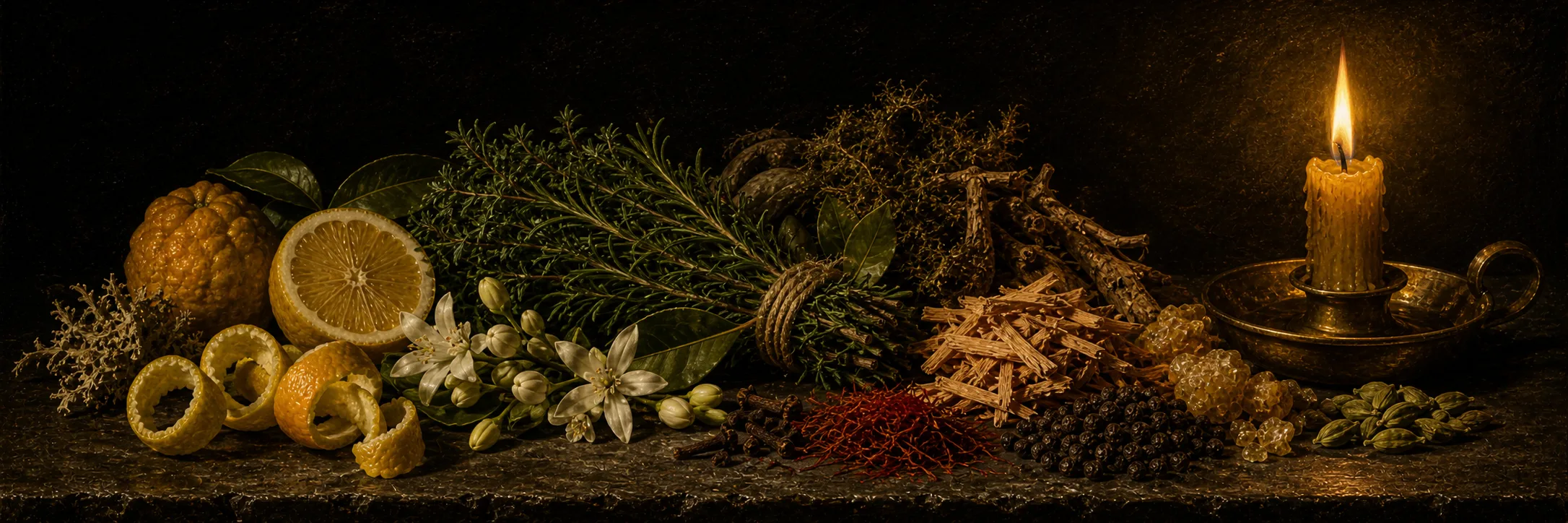
Pour Monsieur is Chanel’s first men’s fragrance (1955) and the benchmark masculine citrus chypre: a lemon-and-neroli sparkle laid over spicy cardamom-ginger-coriander and a quiet oakmoss-vetiver-cedar base. Composed by Henri Robert, it reads as restrained, intelligent, “gentlemanly” - the antithesis of the loud modern designer scent. It is the chypre done in a masculine register where most great chypres lean feminine, and it remains the reference point against which other dapper citrus-chypres (Eau Sauvage, Monsieur de Givenchy) are measured. Discreet, soapy, refined, and almost defiantly understated.
Scent Profile
The opening is genuinely beautiful and the most celebrated phase: a bright, faceted citrus accord where you can pick out lemon, then a neroli/orange nuance, with petitgrain’s bitter, woody-green twigginess underneath. It reads powdery, playful, “ticklish” rather than the sharp, pungent citrus of Eau Sauvage or Habit Rouge. Within the first 10-20 minutes the listed cardamom ushers in the spice heart - a lemony, aromatic facet - joined by coriander and a delicate ginger; the basil is largely submerged, more a green seasoning than a distinct note. The heart “sings” briefly but is where many wearers report the fragrance going quiet: after roughly 15-20 minutes it collapses into a soft, mossy sandalwood-ish skin scent with minuscule sillage. The drydown is a gentle oakmoss-vetiver-cedar chypre base - soapy, slightly earthy, faintly sweet - and notably the current oakmoss is barely detectable owing to IFRA restriction, replaced by a transparent woody-mossy impression. Of the listed notes, the citruses and cardamom are most perceptible; oakmoss (in current formula) and basil are the most submerged. It is not strictly linear but its evolution is subtle - citrus to spice to soft moss - and several long-time wearers note an odd, charming habit of the scent “returning in strength” after a few hours. The signature accord is that bright lemon-neroli citrus sitting on a powdery-mossy, almost barbershop-soapy woody base; Now Smell This’s Kevin compared it to “a straight up, good old-fashioned chypre… vaguely reminiscent of Mitsouko,” and wearer discussions regulars repeatedly invoke Mitsouko-without-the-peach as shorthand for what it does.
Performance
Performance is the consistent Achilles’ heel. Projection is light-to-moderate at best, mostly an arm’s length in the first hour before retreating close to the skin. Sillage is modest by design - admirers frame the quiet nature as part of its refinement, detractors call it “underpowered.” On skin the current EDT typically lasts a meager amount - many report it becomes a skin scent within the first hour and is largely gone in a few hours; even devotees concede roughly 4 hours is common. On clothing it lasts considerably longer; multiple wearers spray fabric or pillow specifically to extend enjoyment. It performs better in cooler-to-moderate conditions and as a fresh-weather scent; the volatile citrus burns off fast in heat, while the soft base is easily lost. Application strategy from the wearer response is blunt: apply generously (several sprays), and spray clothing, not just skin, to get meaningful longevity. If you want presence, the EDP/Concentree lineage performs noticeably better than the 1955 EDT.
Wearing Context
Best in spring and autumn and in moderate temperatures; it’s a daytime, office, and “civilized” scent rather than an evening seducer. It shines as a discreet, dress-shirt-and-blazer signature - the “instant shot of 1950s elegance” wearers describe - and is essentially faultlessly office-safe and versatile. It falls flat where projection and longevity matter: hot clubs, all-day outdoor wear, or anyone expecting compliments-at-distance. Social perception skews “mature,” “old-money,” and gentlemanly; younger noses raised on sweet modern designers may read it as dated or “grandpa,” though admirers argue it’s old-fashioned but not dated. It is widely seen as a scent that whispers rather than shouts - a calling card rather than, as one wearer discussions wit put it, an “olfactory shoulder-check.” Excellent for those who prize smelling expensively understated; poor for anyone who wants their fragrance to enter the room first.
Comparisons & DNA
The closest spiritual sibling is Dior Eau Sauvage (1966), the other landmark masculine citrus-chypre/aromatic - Eau Sauvage is greener, more hedione-jasmine transparent and a touch sharper/more pungent up top, where Pour Monsieur is softer, soapier, and spicier in the heart. Guerlain Mitsouko is the feminine-coded chypre that wearers repeatedly name as Pour Monsieur’s reference DNA (“Mitsouko without the peachy florals”). Monsieur de Givenchy (1959) is a drier, lemon-lavender-sandalwood cousin, even more discreet/fleeting and less spicy. For the Concentree/EDP lineage specifically, wearer discussions consensus lines it up with Parfums de Nicolai New York, Creed Bois du Portugal, Guerlain Heritage, Tiffany for Men (also a Polge composition), Versace L’Homme, and Pierre Cardin Pour Monsieur - all citrus-led, powdery, woody semi-oriental chypres. Within Chanel itself, the EDT is the original chypre, the 1989 Concentree (by Jacques Polge) is a sweeter, vanillic, semi-oriental flanker, and the 2016 EDP is essentially the reworked Concentree. There is no true cheap “clone” of the 1955 EDT; LuckyScent staff and wearer reports point to Parfums de Nicolai New York and Carthusia/Milano Cento as the nearest alternatives rather than dupes. Lineage-wise, Pour Monsieur essentially defined the masculine citrus-chypre template that Eau Sauvage later perfected and popularized, and it stands as one of the genre’s two founding pillars.
Reception
Wearer response is reverent on the scent, frustrated on performance. Across wearer discussions it is praised as “class in a bottle,” a perfectly blended, timeless gentleman’s chypre with a world-class opening; the recurring criticism is weak longevity/projection and, among purists, the loss of real oakmoss to reformulation. Polarization runs along three axes: (1) vintage vs. current (vintage mossier/deeper, current brighter/lemonier); (2) EDT vs. Concentree/EDP (a genuine schism - see below); and (3) whether the quiet discretion is elegance or a flaw. Critical reception is strong here: Luca Turin strongly favored the 1955 EDT in Perfumes: The Guide while damning the Concentree - a split wearers endlessly debate. (No reliable verbatim quote of Turin’s review prose could be located in the documented sources, so it is summarized, not quoted.) “Blind buy?” - yes for the EDT with eyes open about performance; multiple longtime wearers call it one of the few safe blind buys precisely because the scent is so universally liked, but set expectations low on longevity and try before paying full Chanel price.
Versions & Reformulation
This is the crux of Pour Monsieur literature. Three distinct things share the name: (1) the original 1955 Eau de Toilette by Henri Robert - a soft, classic oakmoss citrus-chypre, still sold (Europe/Canada; rarely the US, where it was historically labeled “Chanel for Men”/“A Gentleman’s Cologne”); (2) Pour Monsieur Eau de Toilette Concentree (1989, Jacques Polge) - a sweeter, vanillic, nutmeg-spiced semi-oriental that is effectively its own flanker, not a stronger EDT; and (3) the 2016 Eau de Parfum, which by broad consensus (and a Chanel customer-service reply) is the reformulated/renamed Concentree. In wear: the EDT is brightest, driest, mossiest, and weakest in performance; the Concentree/EDP are rounder, sweeter, more powdery-vanillic and last longer. The EDT itself has been reformulated repeatedly for IFRA oakmoss limits - vintage (golden juice) is mossier and deeper, current (green-tinged) is more citrus-forward and transparent. Vintage hunters prize the pre-1990s cologne formulations for their oakmoss depth.
Acquisition Notes
Designer-luxury pricing (Chanel boutique tier), not niche. The EDT comes in 50 and 100 ml; the EDP in 75 ml (often cited ~$100+). Decant houses Surrender to Chance and The Perfumed Court have historically carried Pour Monsieur and its variants, useful for sampling vintage vs. current and EDT vs.
Notable Facts & Lore
- Pour Monsieur was Chanel’s first masculine fragrance, launched 1955 - a foundational entry in the masculine-chypre canon and, by Turin’s “Best masculine” rating, arguably the finest masculine chypre ever made.
- There is no shortage of romantic owner lore: the Chanel site is full of men who’ve worn it 30, 40, even 46 years as a lifelong signature.
- The most enduring “this is the one that did X” fact is the Turin schism - five stars for the 1955 EDT, one star for the Concentree - which crystallized the wearer evidence view that the original is the masterpiece and the later sweeter versions are dilutions of its character; one wearer famously noted that Turin’s beloved Parfums de Nicolai New York and the panned Concentree are mutually compared, a neat irony.
- The recurring cultural framing is the “gentleman” - review after review (and Chanel’s own copy) leans on dapper, 1950s, understated-elegance imagery, positioning Pour Monsieur as the olfactory opposite of the modern “nightclub” masculine.