Chanel — Gardénia
Essence
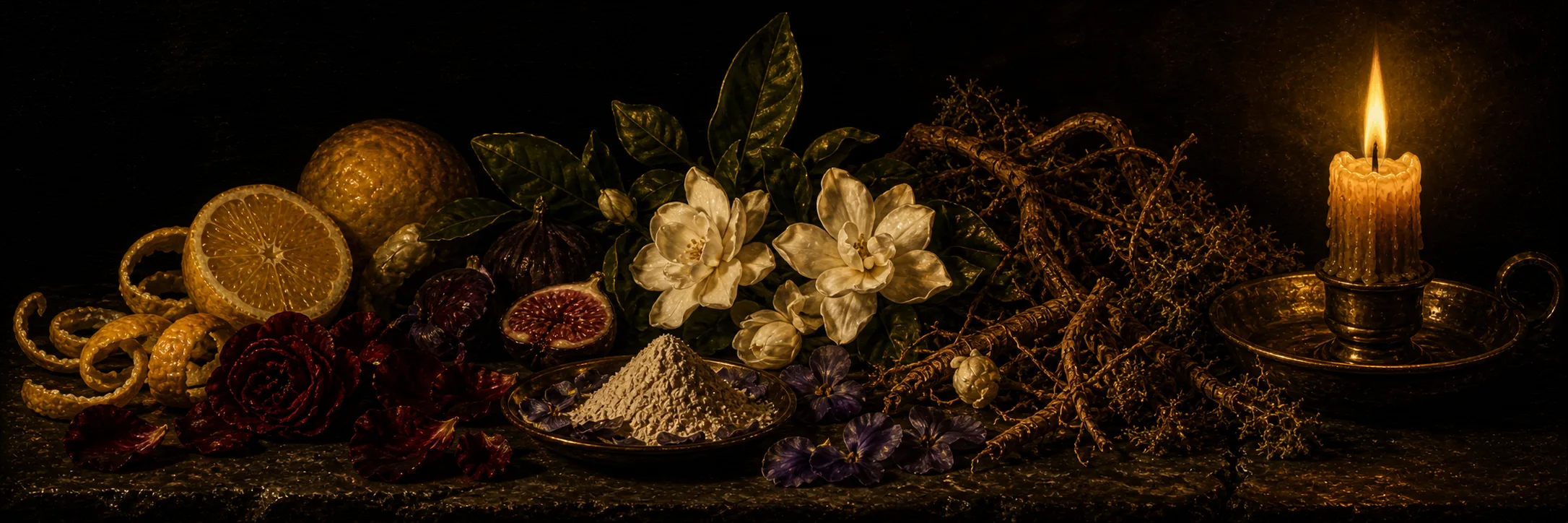
Chanel Gardenia (1925, Ernest Beaux) is one of the house’s earliest fragrances and a member of Les Exclusifs de Chanel. Despite its name it is not a literal gardenia soliflore - natural gardenia cannot be extracted, so Beaux built a “fantasy” gardenia accord from jasmine, orange blossom and tuberose. The modern Les Exclusifs version, re-orchestrated by Jacques Polge (and later Olivier Polge), is a transparent, creamy-green white floral: pretty, polite, “ice-princess” elegant, and famously light. Its character is refined and understated rather than the heady, narcotic gardenia some expect.
Scent Profile
The opening (first 10-20 min) is bright and green: a flash of aldehydes (per several wearers) over green notes and orange blossom, with a fruity facet that reads as strawberry/watermelon-candy to some. wearers descriptions converge on “fresh green and floral” with a dewy sparkle. In the current EDP, the brightness is pink-pepper-and-green sharpness, per Persolaise-tier analysis (“the brightness of pink pepper oil… a kind of green sharpness to suggest the foliage”). The heart (1-3 hours) is the fantasy gardenia accord - but reviewers near-unanimously note it reads more tuberose-and-jasmine than literal gardenia. Olfactoria’s Travels: “Gardenia is dominated by green jasmine, accented by soft orange blossom and underlined by sweet tuberose. Don’t go looking for gardenia in here.” The effect is creamy, lactonic, white-floral, with a powdery veil. A faint clove/pimento spice and sage sit in the background of the EDT formula. The drydown (3+ hours, skin-scent character) is a soft, clean white-musk-and-creamy-sandalwood base with a hint of patchouli/vetiver and, in the modern EDP, noticeable vanilla and a whisper of coconut lending gourmand creaminess. Some find a slight “shampoo”/soapy clean facet. Perceptible vs submerged: gardenia-as-such is largely submerged; jasmine, orange blossom, tuberose and creamy musk dominate; coconut/vanilla are subtle. Linearity: fairly linear creamy white floral with a green-to-creamy arc. Signature accord: green-creamy fantasy gardenia (jasmine + tuberose + orange blossom + lactonic musk).
Performance
The defining performance trait - across virtually every source - is poor longevity and soft projection, especially in the EDT. Wearers repeatedly report the scent “totally disappears” within 20-75 minutes (“basically gone within 75 minutes”; “30 minutes after applying it, there’s no fragrance at all”). Perfume Shrine flags Gardenia as “one of the most fleeting” of Les Exclusifs, “a brief experience that needs to be constantly renewed.” Projection/sillage is soft-to-moderate at best. Many recommend heavy application and spraying clothing to compensate (“I need four sprays applied every four hours”). There is a notable conflict in the data: a minority (and some EDT/extrait wearers) report it “sticks to skin and lasts forever,” and the vintage extrait is described as far more tenacious and concentrated. Net read: light projection, short-to-moderate longevity on skin (often 1-6 hours, skin-dependent), better on clothing; the extrait and vintage perform substantially better than the modern EDT/EDP. It can sweeten and bloom in heat/humidity but risks cloying in cold.
Wearing Context
Gardenia is a spring and warm-weather daytime fragrance - “the cold beauty of early Spring in a bottle,” repeatedly tied to sunny spring days. It is elegant, refined, polite and office-safe; Perfume Shrine notes its “young, ice-princess vibe… classy in its sex-denying way,” well-suited to casual and office wear where more “sumptuous and demanding” vintages would overwhelm. Best for those who find most white florals too heady - this is the rare gentle, transparent gardenia. Where it shines: spring, daytime, refined/understated occasions, white-floral lovers who want restraint. Where it falls flat: anyone wanting a lush, narcotic, projecting gardenia (this isn’t it), cold weather (where vanilla/coconut can cloy), and value-seekers (the price-to-performance is widely criticized). Social-perception skew: feminine, polished, “lady with a string of pearls,” refined to the point of reserved.
Comparisons & DNA
For a literal/lush gardenia, reviewers point elsewhere: Estee Lauder Private Collection Tuberose Gardenia (richer, more tuberose), the Jungle Gardenia lineage, and Guerlain Cruel Gardenia (which, like Chanel’s, is “more musk than gardenia”). The closest stylistic neighbor cited is Van Cleef & Arpels Gardenia Petale - “remarkably similar and of high quality,” and like Chanel’s, fleeting. Within Les Exclusifs, Gardenia is compared to Beige (lighter, more transparent, more ethereal - several prefer Beige) and sits beside 1932 and Misia; Jacques Polge reportedly built later Exclusifs around this historic pillar. The vintage Beaux Gardenia shares DNA with Chanel Bois des Iles and Coty L’Origan/Imprevu-era creamy florals. Because Gardenia is a Chanel boutique exclusive, clone alternatives are limited and generally inferior; budget white-floral substitutes exist (one wearer names L’Occitane neroli/orchidee as “95% similar”) but no faithful dupe is documented. Lineage: descended from Beaux’s earlier Le Gardenia (Rallet, 1920), which he revisited for Chanel; it helped establish the “fantasy gardenia” accord that countless later gardenias would echo.
Reception
Coverage is rich across -2 and wearer sources. Consensus: a high-quality, beautifully blended, elegant transparent white floral that is widely admired but rarely adored - “Gardenia doesn’t get the love or respect that other Chanel Les Exclusifs do.” Praise centers on its refined, joyful, spring-like creaminess and its rare gentleness for a white floral. Criticism is overwhelmingly about (1) longevity/projection - the near-universal “it disappears” complaint - and (2) value, with many noting cheaper white florals smell similar. A third axis is the gardenia-name mismatch: it reads tuberose/jasmine, disappointing those seeking literal gardenia. Polarization: lovers prize its restraint and quality; detractors find it “plasticky,” “soapy,” weak, or “lacking that last bit of Chanel magic.” Luca Turin is documented as disliking the reformulated Gardenia (per The Black Narcissus: “Luca Turin famously hates it”), and the original Beaux version is mourned as “a perfume of its time, now gone forever.” “Blind buy?” verdict: only with eyes open on performance - sample first; the boutique-exclusive price plus poor longevity make a blind full-bottle risky, but white-floral lovers who prize elegance over projection may find it worth it (the extrait especially).
Versions & Reformulation
This is the most version-complex of the five and the section flagged as highly relevant. Original 1925 Ernest Beaux Gardenia was a creamy aldehydic floral built on a narcissus base with a green styrallyl-acetate accent and a violet top note - by all accounts a richer, more “masterful” perfume, now effectively gone. It circulated into the 1950s, faded, then was revived around the late 1980s/early 1990s in the Rue Cambon boutique circuit alongside Bois des Iles and Cuir de Russie - where, per Perfume Shrine, it was “the least resistant link in the chain,” the least faithful reconstruction of the four. It was subsequently rolled into Les Exclusifs, re-orchestrated by Jacques Polge as an EDT (the version most reviewed, lighter and “thinner,” a jasmine-orange-blossom white floral with little true gardenia), and in 2016 an Eau de Parfum appeared (associated with the Polge-era reformulation; Olivier Polge succeeded his father as house perfumer in 2015). wearer verdict on the EDP-vs-EDT shift is pointed: “the entire Les Exclusifs line was better as EDT… The EDP is purely a fruity white floral, heavier on the vanilla,” with the EDT said to have “more bite.” A parfum/extrait also exists and is widely held to be the best, most tenacious and most beautiful form. Vintage extrait vs modern: vintage is greener, woodier, more concentrated and longer-lasting; modern is lighter and more transparent. Status: the catalog lists this entry as discontinued; the Les Exclusifs EDP remained in production in recent years, while EDT/extrait availability has shifted.
Acquisition Notes
Luxury/boutique-exclusive tier - Chanel Les Exclusifs pricing. Sold primarily through Chanel boutiques and chanel.com rather than general retail. Bottle sizes: historically 75ml and 200ml EDT, 15ml parfum/extrait, and the 2016 EDP (commonly 75ml/200ml); the 200ml format is a Les Exclusifs signature. Pricing has risen sharply (wearers grumbling about “ridiculous price increases”).
Notable Facts & Lore
- The founding lore is well-documented and house-stated: Gabrielle “Coco” Chanel’s emblem was the camellia, a flower with no scent; gardenia, which it visually resembles, became the fragrant stand-in, and Chanel reportedly wore gardenias on her lapels.
- Chanel’s own copy frames it as Beaux evoking “its green notes, its creamy heart, and a trail full of fantasy.”
- The technical lore is central: natural gardenia cannot be distilled, so the note is always a reconstruction - Beaux’s “fantasy gardenia” was a pioneering synthetic-era accord in the 1920s.
- Cultural footnote (via Perfume Shrine): American Chanel advertising pitched Gardenia as youthful and Riviera-romantic, and gardenia perfume entered pop culture via the 1936 song “These Foolish Things” (“gardenia perfume lingering on a pillow”), later covered by Bryan Ferry/Roxy Music.
- Lineage detail: Beaux first explored the idea in Le Gardenia for Rallet (1920) before reworking it for Chanel.
- No modern celebrity/viral moments surfaced; the lore is historical.