Chanel — Chance Parfum
Essence
Chance Parfum is the pure-parfum (extrait) concentration of Chanel’s Chance, the house’s 2002 youth-oriented launch by then-head perfumer Jacques Polge - Chanel’s deliberate departure from its aldehydic No. 5 DNA, housed in the brand’s first round bottle (a “wheel of fortune”). Released in 2003, right after the original eau de toilette, the Parfum is the richest, deepest interpretation of the Chance idea: a chypre-floral built on a pink-pepper/citrus sparkle, a jasmine-iris floral heart, and a patchouli-amber-vanilla-musk base. Relative to the EDT and EDP, the extrait is the darkest, most resinous and most skin-close member of the original trio, emphasizing the floral and vanilla facets into something “lush and voluptuous.”
Scent Profile
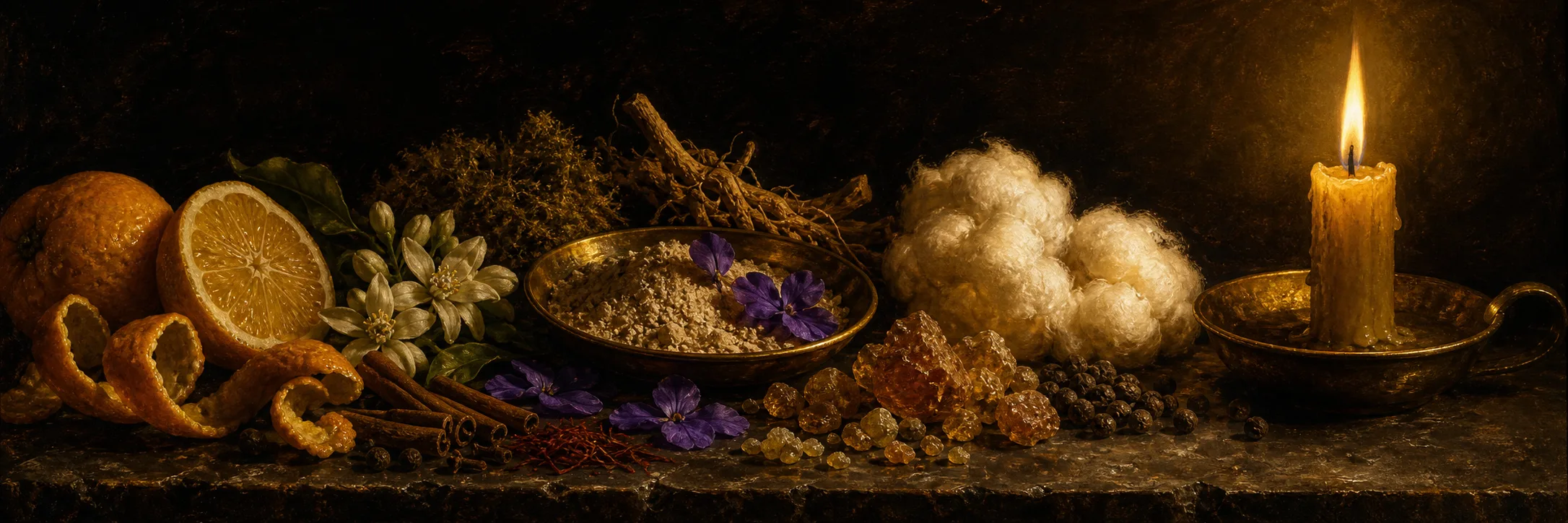
Across concentrations Chance opens with its signature distinctive top - pink pepper with citrus (lemon/citron, and in the EDT a notable pineapple-and-hyacinth facet). In the Parfum specifically, wearers wearers describe the opening as darker with less citrus than the EDP - “Darker, less citrus top notes… a deeper spicier feel even than the EDP, more amber too, deffo a touch more resinous, richer with an orangey note” (wearer discussions). The heart is jasmine and iris (with hyacinth/rose in the lighter versions); in the extrait the vanilla and iris are reported as more prominent while the patchouli is “more tamed” and close to the skin. The drydown is the Chance signature: a soft, powdery patchouli-amber-musk-vanilla base with vetiver and ambrette, here rendered warmer and more enveloping. A wearer who owns all three captures the tiering: “the parfum is ethereal, the EDP seems richer and more sedate, and the EDT is the carefree and dynamic one.” Signature accord: powdery pink-pepper-and-patchouli over creamy amber-vanilla. Note discrepancy: wearer discussions lists the Parfum’s notes minimally (jasmine, iris, white musk, vanilla absolute), but the actual bottle and Chanel’s description include pink pepper, patchouli, amber and vetiver - the catalog’s fuller pyramid is the accurate one.
Performance
The Parfum is the strongest-performing of the original trio on longevity and is the most skin-close in projection. wearer reports cite very long wear - one reviewer reports “about 12 hours on my skin and much more on my hair”; a French reviewer notes “c’est un extrait donc… sillage tres bon… plus soutenu” (very good sillage, more sustained than the EDP). It throws less than the EDP at a distance (it sits closer to the skin) but outlasts both the EDT and EDP. Reviewers note Chance generally clings to clothing for a long time - even “up to two days” on fabric. The trade-off, per multiple users, is that the extrait is so similar to the EDP that owning both is hard to justify; one disappointed buyer felt it “fell flat” for the price and small size. As with the rest of the line, it leans cool-weather and can feel heavy in summer heat.
Wearing Context
A versatile but slightly more “mature/elegant” Chance - reviewers call the original Chance the most sophisticated and grown-up of the line, suited to office, dinner and evening, and to cooler weather where its patchouli-amber depth shines. The Parfum’s richness pushes it toward evening and cold-season wear and intimate, close-contact settings (its skin-close nature rewards proximity). Social perception is classic, polished and unmistakably “Chanel” - versatile, compliment-getting, and described by wearers as serious/elegant rather than fun; some find it skews older or “retro.” It can feel wrong in hot weather and for those who dislike prominent patchouli, a recurring complaint (“patchouli bomb,” “almost headache-inducing”).
Comparisons & DNA
The closest references are within Chanel itself: reviewers repeatedly call Chance “the smaller sister of Coco Mademoiselle” and detect kinship with Allure Sensuelle (“like the EDT version with a little Allure Sensuelle thrown in”). Externally, Marc Jacobs Daisy is a frequent comparison point (cited by wearers as similar, if more conventionally feminine), and some find a Thierry Mugler Angel-adjacent quality “without the sweetness.” DNA: modern fruity-floral-chypre/“fruitchouli” - bright pink-pepper-citrus top, floral heart, patchouli-amber-musk-vanilla base. The Parfum is the deepest, most amber-resinous expression of that template; the later flankers (Eau Fraiche 2007/2023, Eau Tendre 2010/2019, Eau Vive 2015, Eau Splendide) move away from the chypre into fresher, fruitier, woodier territory and should not be conflated with it.
Reception
The original Chance and its higher concentrations enjoy strong, durable wearer affection - wearer discussions call it “poetry in a bottle,” “balanced to perfection,” a timeless classic with unmistakable Chanel DNA, and lament Jacques Polge’s retirement. The Parfum specifically has few reviews (one wearer opens with “why so few reviews on this one?”), but those who own it praise its depth, richness and longevity, with the main caveat being its strong similarity to the EDP. Critically, the picture is more skeptical: Luca Turin and Tania Sanchez were notably unenthusiastic about the Chance line in Perfumes: The Guide; the Eau Fraiche flanker drew a harsh “depressingly banal” verdict from Turin, and wearer discussions reference the original receiving poor marks in the Guide. The Parfum was not separately reviewed there. A persistent minority complaint across the line is a “pink peppercorn plastic patchouli” synthetic quality and, in some batches, weakened longevity.
Versions & Reformulation
Chance exists in a large family: the original EDT (2002), Parfum/extrait (2003), and EDP (2005) form the original chypre-floral trio - the EDP is described by Chanel and by Wikipedia as sharing the Parfum’s composition in spray form, which explains why wearers find the extrait and EDP so close. Later flankers (Eau Fraiche, Eau Tendre, Eau Vive, Eau Splendide) are distinct compositions, several by Olivier Polge after he succeeded his father in 2015. On reformulation, several long-term wearers report the original performed better in older batches than recent ones (“it used to perform great, later not so great”), a common wearers claim though not formally documented by the house. The Parfum/extrait remains in production but is a low-volume, niche member of the line.
Acquisition Notes
The Parfum is the premium/extrait tier - the most expensive and most concentrated Chance. The standard retail format is a small 7.5ml dab/splash bottle with a square-cut glass stopper (the round bottle “banded in silver”), applied to pulse points; a larger 35ml tester format has circulated (referenced by French buyers). The much more widely distributed EDP comes in 35/50/100ml spray and the EDT up to 150ml. The small extrait size and high price are the main purchase considerations; multiple owners conclude the EDP delivers most of the same scent with more projection at lower cost.
Notable Facts & Lore
- Chance was conceived as Chanel’s optimistic, youth-targeted fragrance - “Chance is a way of being,” after Gabrielle Chanel’s notion that one creates one’s own luck (“I saw an opportunity, and I took it”) - and broke house convention with its round bottle (versus the signature rectangular flacons), marketed to women roughly 18-29.
- The 2003 launch film by Chanel (“Venise”) starred model Anne Vyalitsyna.
- Jacques Polge, Chanel’s in-house perfumer from 1978 to 2013, created the original and the Parfum; his son Olivier Polge (head perfumer from 2015) authored most later flankers, including Eau Splendide (2023), whose face was Belgian singer Angele.
- The line has grown to numerous variants, but the original chypre-floral - and its Parfum concentration - remains the most “serious” and Chanel-DNA-faithful of the family.