Chanel — Les Exclusifs de Chanel Cuir de Russie 1924
Essence
Cuir de Russie is the most revered leather in classical perfumery - a 1920s Ernest Beaux composition (dated variously 1924 or 1927) built on the Russian-leather theme of birch-tar boots and blond tobacco, but rendered far more refined than a raw hide. What makes it singular is that it’s arguably more a leathery iris than a leather per se: the Chanel aldehyde-and-florals signature (the same skeleton as No. 5) is overlaid on a smoky birch-and-styrax base, smoothed by orris into suede. The catalog “2007/Beaux” attribution refers to the Les Exclusifs reissue of Beaux’s original, later reworked by Jacques Polge.
Scent Profile
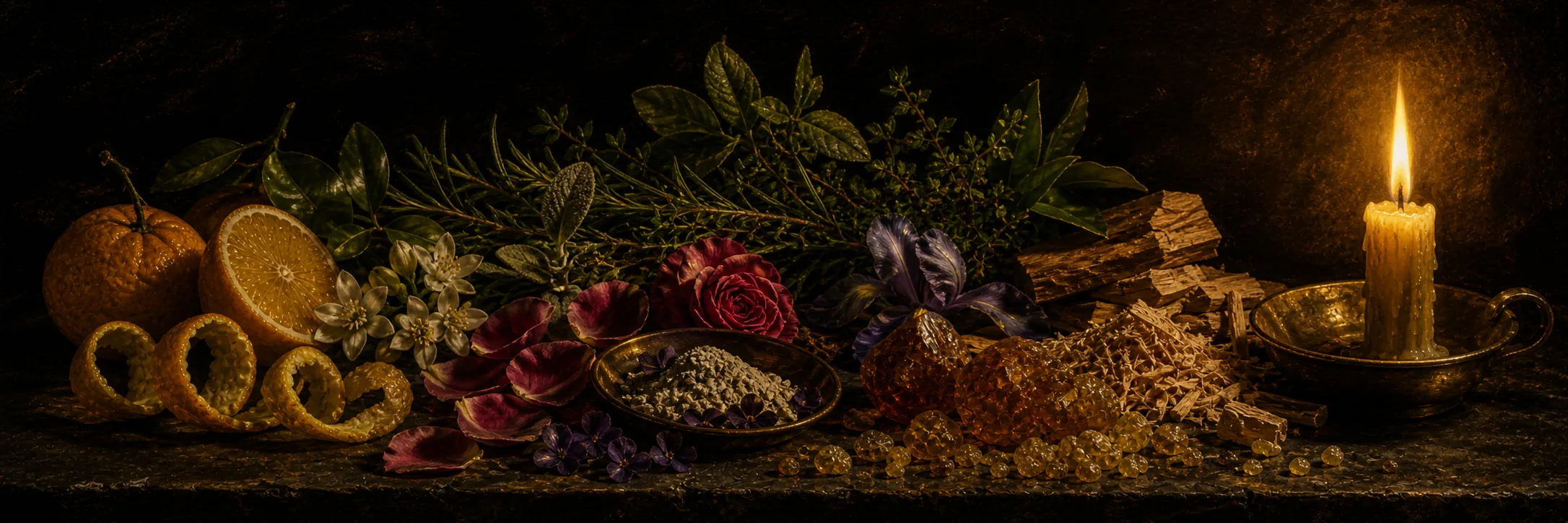
The listed aldehydes, bergamot, clary sage and neroli open with the unmistakable Chanel “slap of aldehydes and flowers” - a waxy, soapy, citrus-floral shimmer that several reviewers say reads almost exactly like No. 5’s overture for the first minutes. Underneath, the leather announces itself fast: a birch-tar-driven accord that in the EDT era could be genuinely animalic, with a “borderline fecal,” horse-manure, saddle facet that polarizes wearers (both Bois de Jasmin and Kafkaesque dwell on this dirty opening).
The listed jasmine, rose, ylang-ylang and orris form the heart, but the defining move - per Luca Turin - is the orris/iris: this is “more of a leathery iris than a leather fragrance as such.” The florals lose individual identity and fuse into the leather, with iris providing a cool, powdery, almost suede-like elegance that Persolaise described as “an iris constructed out of strips of the most luxurious suede.”
In the base the listed styrax, tobacco, amber, musk and cedar resolve into a soft, smoky, faintly sweet leather: blond tobacco warmth, a balsamic styrax smoothness, and a buttery suede texture wearers compare to fine leather gloves or a well-worn armchair. Birch is perceptible as the smoke and tar element, while tobacco and amber are submerged supporting players. It is evolutionary rather than linear - aldehydic-floral, then dirty leather, then a powdery suede drydown - but the overall arc is famously smooth, “almost impossible to identify where one accord ends and the other begins” (Bois de Jasmin). The signature accord: aldehydic florals fused to a birch-smoke-and-iris leather. This is the EDT/Les Exclusifs profile; vintage EDC is markedly more animalic and growling.
Performance
Across versions this is a notably soft performer for its reputation. The Les Exclusifs EDT sits close to the skin with moderate, contained sillage; longevity runs roughly 5-7 hours on skin per wearer reports, longer on clothing where the aldehydes and birch linger. Projection is light-to-moderate - many reviewers note it becomes a skin scent within 30 minutes to a couple of hours and advise generous application (one reviewer tip cited on Bois de Jasmin: you may need to “empty just over half the vial” to get the full drydown). The 2016 EDP is widely reported as softer, sweeter and even shorter-lived than the EDT, with some buyers complaining it’s “clearly not EDP concentration” and “very fleeting.” The parfum/extrait is the richest and most tactile, with the best-behaved leather and a longer, plusher arc. Behavior: the leather and resins deepen and sweeten in warmth (several note it gets “sweeter in summer”), while cold flattens projection. Best in temperate/transitional weather. Best application: spray heavily, and consider hair/clothing where it’s reported as a “compliment-getter.”
Wearing Context
Best in spring, autumn and the transitional seasons - many find it “not too warm or too cold” and associate it with cool, dry days; it also works in winter for its enveloping warmth. Day or evening, leaning evening for the EDP’s deeper sweetness. It shines as an elegant, cerebral statement leather - at the office, in cold weather, on someone who wants quiet luxury rather than loud projection. It falls flat for those who read the opening as soapy “old lady” No. 5 or who can’t get past the animalic top (a recurring “scrubber” complaint). Social-perception skew: marketed feminine and historically a “woman who smokes” provocation, but in modern wear it’s thoroughly unisex and frequently worn by men; the EDT in particular leans more masculine from the heart onward. It carries a sophisticated, mature, “expert nose” connotation.
Comparisons & DNA
Cuir de Russie is a foundational leather and a touchstone the whole genre is measured against, and a few references locate it best. Within Chanel, it shares No. 5’s aldehydic-floral skeleton (as do Bois des Iles and No. 22) and is the leather sibling of that family. Against Caron Tabac Blond (1919), the other great early feminine leather, Tabac Blond is drier and more oriental and carnation-driven via isobutyl quinoline, while Cuir de Russie is smoother and more elegant, with Beaux casting “a soft glow onto its polished form.” Chanel Antaeus and Knize Ten mark the bolder, butcher end of the spectrum - the leathers people reach for when they want it “on steroids” - whereas Serge Lutens Cuir Mauresque is the opulent, spicy-ambery counterpoint to Cuir de Russie’s “elegantly austere” register. Many also liken it to a softened, edited Dior Fahrenheit, “a milder cousin.” Other “Cuir de Russie” perfumes exist, but Chanel’s is the survivor, and no true affordable clone of it exists. Lineage: it descends from the late-19th-century Russian-leather genre and stands as the definitive surviving example, influencing essentially every refined iris-leather since.
Reception
This is one of the most critically adored fragrances in existence. Luca Turin wrote a landmark review, calling it “an undamaged monument of classical perfumery, and the purest emanation of luxury ever captured in a bottle,” and noting “there have been many other fragrances called Cuir de Russie, every one either too sweet or too smoky. This one is the real deal.” Tania Sanchez wrote of being physically stopped in her tracks by it. Bois de Jasmin calls it “among the classical gems,” preferring the parfum’s “tactile butteriness.” Persolaise rhapsodizes over the extrait. Wearer consensus is reverential - repeatedly citing it as “the greatest leather perfume of all time” or even “best perfume of all time.” Common criticisms: the divisive animalic/fecal opening (a real “scrubber” minority who get “horse manure,” “dried drool,” or “dry pissoir”); soft performance/weak longevity relative to price and reputation; and the perception that it’s “basically No. 5 with leather.” Polarization axes: animalic tolerance, and whether the soapy-aldehyde Chanel signature reads as luxurious or dated. Blind buy? Risky given the cost, the soft performance, and the polarizing opening - sample first, ideally on skin (it’s widely noted to smell far better worn than on paper).
Versions & Reformulation
A genuinely complex lineage. The Beaux original (1924/1927) was reworked by Jacques Polge for the 1983 reintroduction - Polge toned down the aggressive smoky leather and emphasized iris/powder. It entered Les Exclusifs in 2007 as an EDT (the catalog “2007/Beaux” entry). In 2016 Chanel converted the Les Exclusifs line from EDT to EDP, discontinuing the EDT; the 2016 EDP is widely described as a distinct, softer, sweeter, more floral and less smoky/animalic reinterpretation - Australian Perfume Junkies’ Portia calls it “a soapy reinterpretation of even the 2007 EdT… what was a lion is now a perfectly trained, gorgeous house cat.” Concentration map per enthusiasts: vintage EDC = most animalic and “growling”; Les Exclusifs EDT = drier, smokier, more birch-tar and iris; 2016 EDP = softer, sweeter, jasmine-leaning, weaker performance; Parfum/Extrait = richest, butteriest, smoothest leather. The EDT itself was tweaked multiple times (progressively less birch tar). Vintage hunters strongly prefer pre-Exclusifs and EDC versions.
Acquisition Notes
Luxury tier - Chanel Les Exclusifs pricing, sold only through Chanel boutiques, chanel.com, and a handful of authorized luxury retailers (historically Saks, Neiman Marcus, Bergdorf, Barneys). Current EDP comes in 2.5 oz (75ml) and 6.8 oz (200ml); parfum/extrait in 0.5 oz. To distinguish the discontinued EDT from the current EDP, check the paper label (it states “Eau de Toilette”) - the EDT juice is also typically paler. Buy authentic only from Chanel directly.
Notable Facts & Lore
- The fragrance is bound to Coco Chanel’s early-1920s affair with Grand Duke Dmitri Pavlovich Romanov, cousin of Tsar Nicholas II, who fled the Bolshevik Revolution to Paris and - per Chanel lore - introduced her to Ernest Beaux, the former perfumer to the Russian Imperial court (house of Rallet).
- Chanel’s biographer Justine Picardie called it the “bottled essence of her romance with the Grand Duke.”
- Beaux, Moscow-born and -trained, drew on the smell of Russian soldiers’ birch-bark-tanned leather boots and blond tobacco; the Ballets Russes and the wave of White Russian emigres in postwar Paris fed Chanel’s broader “Russian period.”
- Grain de Musc’s Denyse Beaulieu frames it as “a whiff of emancipation,” created provocatively for the scandalous figure of a woman who smoked in public.
- Its mythic, hard-to-find “perfume unicorn” status before and after its 1983 return is itself part of the lore; its fame is critical and historical rather than viral.