Chanel — Les Exclusifs de Chanel Beige
Essence
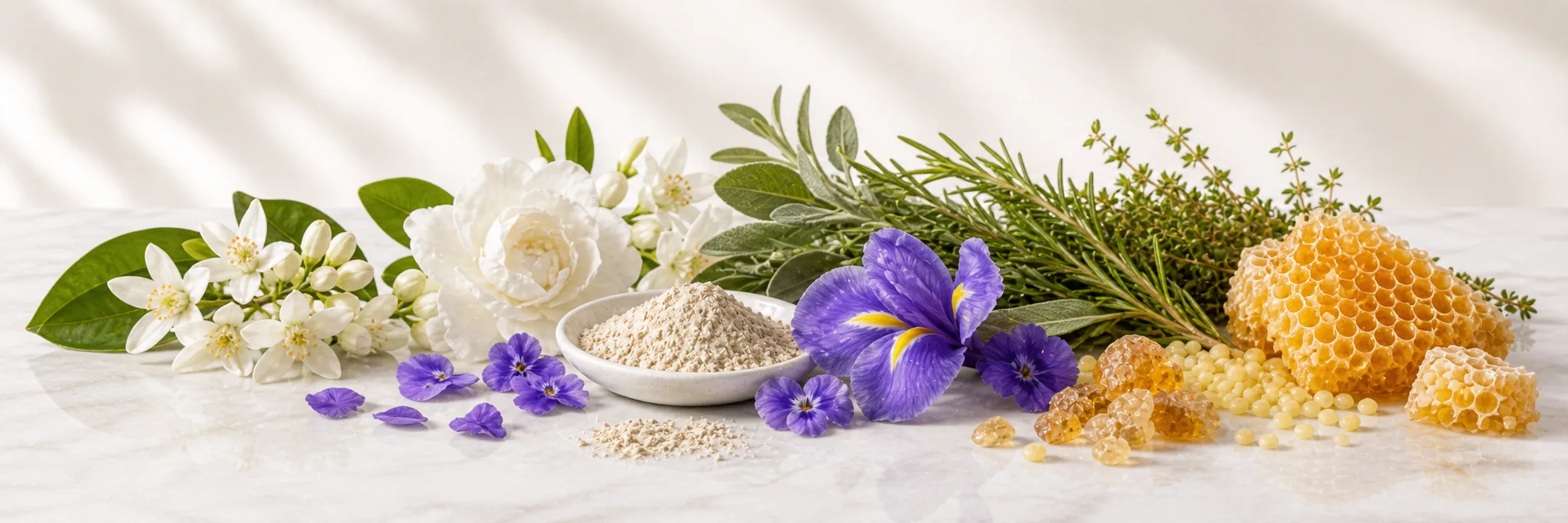
Beige is Jacques Polge’s 2008 entry in Chanel’s upscale Les Exclusifs line: a soft, luminous honeyed white-floral built on a hawthorn-freesia-frangipani accord with shimmering honey. Named for Coco Chanel’s beloved neutral - “I take refuge in beige because it’s natural” - it aims for understated, sunlit elegance rather than statement perfumery. The result divides opinion sharply: admirers find it a warm, golden, effortlessly classy floral; detractors find it the blandest, most “conventional luxury” entry in an otherwise daring collection. A polished, honey-tinged floral that lives up to (or down to) its name.
Scent Profile
Beige has genuine critical coverage. The opening, per the blog Now Smell This (and echoed by Scented Hound and Chanel’s own framing), brings bright aldehydes that quickly give way to a soft, cottony mix of delicate flowers - freesia and frangipani that are “wonderfully muted.” There’s a combination of warmth and coolness, like sunshine with a cool breeze underneath. The hawthorn is the most distinctive top-note player: it carries an almond-like, faintly bitter green-woody facet that some love and some (per wearer discussions) find dusty or off-putting in the first hour before it dissipates. Through the heart (first 1-3 hours), frangipani emerges as the star for many wearers - creamy, plumeria-like, sometimes described as slightly plasticky/rubbery on certain skins. Freesia adds a peppery-cool, slightly aquatic sparkle and a soapy “clean Chanel” facet. After roughly 10-20 minutes the whole thing powders down - wearers describe a light talcum veil and a balsa-wood texture entering. Around the 20-minute mark, honey arrives: a restrained, golden sweetness that, per Scented Hound, is “just the right amount of light sugar to make the perfume sparkle” without flooding the florals. In the drydown (3+ hours), Beige settles into a smooth, lightly honeyed, powdery floral with a soft woody underlay. Chanel’s EDP base lists iris and musk contributing a powdery richness. The skin-scent is gentle, creamy and close. Perceptibility: honey, frangipani and hawthorn are the dominant trio; freesia is present as sparkle; the florals are deliberately muted rather than narcotic. Linearity is the key structural fact - multiple critics (including Persolaise and wearer discussions) call it essentially linear, “doesn’t transform much,” just warms slightly in the sun. The signature accord is the honey-frangipani-hawthorn “golden white floral,” and the defining character is softness and restraint - what Chanel calls hidden depth beneath apparent simplicity.
Performance
Performance reports are mixed and version-dependent. For the EDT (the 2008 original), Now Smell This commenters and wearer reports generally found longevity good-to-strong for the profile - better than typical for such a soft floral - with low-to-moderate, close-to-skin sillage. wearers describe getting all-day wear from a few sprays with gentle wafts on movement. Projection is light to moderate: this is a refined, intimate scent, not a projector, and that’s by design. However, there’s a notable dissent on fixation: one widely-cited reviewer of the parfum/extrait complained the base notes are poorly fixed and the scent is “gorgeous but fleeting,” explicitly invoking a Luca Turin criticism about the composition not being properly anchored in the base. So reports range from “great longevity for the genre” to “fades too fast.” Behavior by climate: as a soft honeyed floral it leans cozy and is often called a cold-weather/“winter” scent by those who find the honey sweet, while others wear it as a sunny spring/summer floral - it performs across seasons but reads warmest and sweetest in cool air. Best strategy per wearers: apply generously (3-4 sprays), and layering with the matching Beige body creme/oil markedly extends and deepens it - a frequently recommended move.
Wearing Context
Beige is a daytime, dressy-but-understated fragrance. Wearer and critical consensus position it as office-appropriate, refined and “always appropriate” - wearers describe it as suiting essentially every occasion with a slight tendency to read too elegant for very casual settings. It’s frequently called a bridal or “mother of the bride” scent: Now Smell This commenters likened it to something a bride would wear, and Persolaise’s parfum review framed Beige as “the mother of the bride” who “doesn’t feel the need to prove anything.” Seasonally it’s flexible but splits opinion: some file it firmly as cool-weather/winter because of the honey’s coziness; others (and Chanel’s marketing) treat it as a spring/summer sunlit floral. It shines in elegant daytime contexts - work, lunches, weddings, anywhere quiet sophistication is wanted. Where it falls flat: anyone seeking complexity, drama or projection. Its harshest critics (multiple wearer discussions voices) find it dull, stuffy, “conventional luxury,” dated, or like wearing a layer of makeup foundation - too safe and faceless next to Les Exclusifs heavyweights like Coromandel or 31 Rue Cambon. Social perception skews mature/elegant rather than youthful or sexy.
Comparisons & DNA
Within Chanel, Beige is consistently ranked the most mainstream and least adventurous of Les Exclusifs - wearers say it “wouldn’t be out of place as a Cartier non-exclusive or a Givenchy exclusive” and is incomprehensible alongside 31 Rue Cambon or Coromandel. The most useful in-house comparison is Chanel Gardenia (a cooler, “purple/blue” white floral where Beige is “green/yellow and warm,” per a wearer reviewer) and Chanel No. 22 / No. 5 Eau Premiere (sharing the aldehydic-floral sparkle). Wearers often layer Beige with Chanel Gardenia. External comparisons from critics and wearers: Guerlain Apres L’Ondee (cited for a similar hawthorn character, “without the Guerlainade”); Guerlain Mahora and Serge Lutens La Dompteuse Encagee (similar tropical-floral profiles, more muted/simple in Beige); Frederic Malle Carnal Flower (a wearer discussions/blogger comparison - both share a smooth floral drydown, but Carnal Flower is a high-voltage tuberose while Beige is sweeter, lighter, freesia-and-honey); Kenzo Flower (a hint of); and Elie Saab Le Parfum (honey-and-flowers family). Chloe Love and Chloe EDP are also named for the soft-floral kinship. As a luxury-house exclusive, Beige has no meaningful clone ecosystem - its appeal is bound to Chanel materials and the brand’s polish, and nobody has produced a notable dupe. Lineage: it sits in the lineage of soft, honeyed-floral Chanels and didn’t start a trend so much as represent the safe, commercial end of the Exclusifs project - Persolaise read the whole 2014 parfum trio (Beige, Jersey, 1932) as evidence Chanel was no longer “rocking the creative boat.”
Reception
Beige is genuinely polarizing, and the split runs right through critics. On the positive side: Now Smell This’s contributor called it “unassuming, elegant, effortless,” admitting the name had caused her to overlook a beauty; Scented Hound praised the sunlit honey-frangipani as quietly lovely (“Who knew beige could be so beautiful?”). Persolaise, reviewing the 2014 parfum, called it the most intriguing of its trio - rescuing the “wan facelessness” of the EDT with “moments of unexpected beauty,” a jasmine, a rose, mimosa and ylang-ylang and a green hawthorn note that gives it “circumspect authority.” wearer discussions carry many admirers who call it sunshine in a bottle, a quality wildflower-honey floral, and uniquely un-powdery. On the negative side: wearer discussions critics repeatedly call it linear, dated, boring, “Beige as in dull,” the weakest Exclusif, and “Conventional Luxury” with good materials but no spirit or risk-taking. Luca Turin is paraphrased by a reviewer as criticizing its base fixation. Axes of polarization: refined-vs-boring, and warm-honey-floral-vs-synthetic-frangipani (some get a Johnson’s Baby Shampoo or rubbery plumeria effect). “Blind buy?” verdict: sample first. At Chanel Exclusifs pricing it’s too expensive to blind-buy on a coin flip, and reactions genuinely diverge between “effortless Chanel elegance” and “expensive blandness.” If you love soft, honeyed, understated white florals and Chanel’s polish, it’s a likely winner; if you want the complexity the Exclusifs name promises, you’ll probably be let down.
Versions & Reformulation
Beige exists in three concentrations across its history, and the timeline matters. The original 2008 release was an Eau de Toilette (the catalog-facts version here). A Parfum/extrait was added in 2014 (Polge’s trio with Jersey and 1932) - reviewed by Persolaise as the most rewarding form, giving the “faceless” EDT a backstory and more legible jasmine/rose/green facets. In 2016 Chanel converted the entire Les Exclusifs line from EDT to Eau de Parfum (the lone exception being Eau de Cologne), so Beige EDT was discontinued and replaced by Beige EDP - same perfumer, same stated notes, but with the higher concentration and a price increase, and fans suspected minor tweaks. In wear, the EDT is the lightest/most transparent and the version critics found “wan”; the EDP is fuller and the current standard; the extrait is the richest, creamiest and most close-wearing (described as a cool, happy daytime floral with low sillage). The original 2008 EDT is the discontinued form.
Acquisition Notes
Luxury tier - Les Exclusifs is Chanel’s premium boutique line, priced well above the mainstream Chanel range. Bottle sizes historically include 75 ml and 200 ml (and a 6.8 fl oz/200 ml flagship), with the 200 ml the signature large format; a smaller 2.5 fl oz/75 ml has also been sold. Distribution is deliberately limited: Chanel boutiques, Chanel counters at retailers with Beaute studios (e.g. Neiman Marcus, Bloomingdale’s), and Chanel.com.
Notable Facts & Lore
- The perfumer’s stated intent is documented: Jacques Polge built Beige to interpret Mademoiselle Chanel’s own words, “I take refuge in beige because it’s natural” - translating her cherished neutral (the suede sofas and wheat-toned curtains of her 31 rue Cambon apartment, the color of sand, soil, skin and honey) into a floral of apparent simplicity hiding “discreet sensuality.”
- The hawthorn-freesia-frangipani-honey accord was Polge’s vehicle for that idea.
- The launch story is essentially a color-as-concept exercise, part of Chanel’s Les Exclusifs project to answer the niche boom with a luxury in-house line.
- A notable bit of inside-baseball: when Polge chose Beige (alongside Jersey and 1932) for the 2014 parfum upgrades, the fragrance press was openly surprised, having expected richer candidates like Coromandel or Sycomore - Persolaise read the choice, and the whole “ultra-safe” trio, as a sign of Chanel playing it safe as Polge prepared to hand the house perfumer role to his son Olivier.
- No celebrity or viral moment of note; Beige’s lore is entirely about Coco’s color philosophy and its status as the quiet, divisive middle child of Les Exclusifs.