Chanel — Paris – Édimbourg
Essence
Paris - Edimbourg is the fifth entry in Chanel’s Les Eaux de Chanel travel collection, an eau-fraiche-strength woody-aromatic built by in-house perfumer Olivier Polge around a juniper-cypress-lavender spine over cedar, vetiver, musk and a wisp of vanilla. It is the most overtly masculine-leaning and “anachronistic” of the line - a cold, gin-like, foresty green that evokes the Scottish Highlands and a borrowed tweed jacket. Where its siblings (Venise, Riviera) court softness and sweetness, Edimbourg trades on austere citrus-and-wood contrast. Distinctive for being a recognizably classical barbershop/cologne idea rendered with Chanel’s airy, almost effervescent signature.
Scent Profile
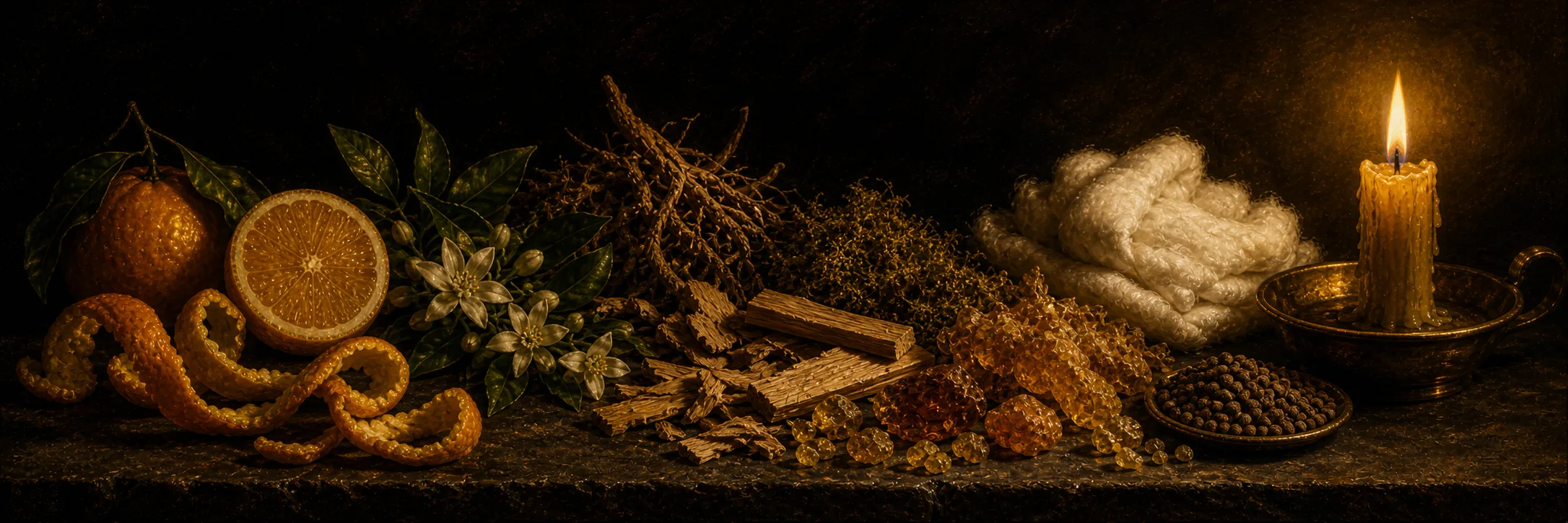
The opening is the loudest and most-discussed phase: a bracing, fizzy, gin-and-tonic burst that almost everyone reads as citrus-forward even though no citrus is officially listed in the catalog facts (Chanel’s own site does list citruses; wearer discussions omits them). Juniper berries and cypress dominate - dry, coniferous, slightly resinous and “tingling,” with reviewers repeatedly invoking gin, tonic water, lemon-candy fizz, and crushed juniper/cypress needles. There is a pronounced aldehydic/effervescent sparkle that reads as unmistakably “Chanel.” Lavender, though listed in the heart, is detectable almost immediately, lending a clean, soapy, aromatic edge. Through the first one to three hours the citric/coniferous brightness recedes and the composition settles into its aromatic core. Lavender moves forward and turns soft and “washroom”-clean; cypress quiets while vetiver and cedar surface, giving a cool, earthy, faintly smoky-mossy woodiness. Several reviewers (and Chanel’s own copy) describe a warm vetiver accord “with earthy undertones and smoky accents.” The Candy Perfume Boy perceived a cypress-and-frankincense/incense core - “golden, smouldering incense crystals drizzled with glowing sap” - plus a soapy, clove-tinged facet he likened to Guerlain Aqua Allegoria Ginger Piccante. The mid-stage character is cold, well-groomed, and “business casual”: dressy but at ease. The drydown (3+ hours) is a musky lavender-and-woods skin scent with a discreet vanilla that stays woody rather than edible - “never a favorite note of mine, stays woody enough to sidestep edibility,” as one reviewer put it. Cedar, vetiver and white musk carry it out quietly and close to the skin. Linearity: largely linear with gentle evolution - the arc is bright/fizzy soft aromatic-woody musky-woody skin scent, without dramatic turns (“some may complain about its lack of drama,” Persolaise noted). The signature accord is the cold juniper-cypress-lavender “gin in a pine forest” aromatic, given a faint vanilla-musk Chanel finish. Perceptible notes: juniper, cypress, lavender, cedar, vetiver, musk, the woody vanilla. Submerged/abstract: the “green” reads as abstract rather than literal; vanilla is a whisper.
Performance
Consensus: light-to-moderate projection and moderate-to-modest longevity - exactly what an eau fraiche promises and what its critics lament. Per bestmenscolognes.com: “It doesn’t project huge on my skin or even a t-shirt. Maybe 4-6 feet, at its maximum… It sticks on me for 6-7 hours, depending on the day. The longevity isn’t amazing, but this Chanel is quite serviceable.” A wearer reported “nice projection in the first hour and then sits close to the skin for a further 5 hours.” Performance is genuinely skin-dependent at the bottom end - one wearer found “the longevity on my skin is not there lasts three hours maximum with a poor projection.” Clothing holds it markedly longer (a recurring point - it leaves a “comforting trail” on fabric). Sillage is intimate-to-moderate; a minority find it “intoxicating.” It performs best in cool weather - multiple reviewers call it a favorite winter or cool-spring/autumn scent, where the icy juniper-conifer effect shines; in heat the citric/coniferous top can read thin and the musk turns slightly “rotting” on some skins. Application strategy: this rewards generous spraying and spraying onto clothing/tweed, since the conifer-lavender lingers far longer on fabric than skin. Persolaise framed complaints about longevity as “missing the point of its existence.”
Wearing Context
Best in cool, crisp conditions: late autumn through early spring, and cool summer evenings. Time of day is flexible but it skews daytime and “well-groomed” - Old Herbaceous (Serenity Now/CounterPoint) called it “the scent equivalent of male or female ‘business casual’ - a fragrance that goes with a crisp collared shirt and neatly pressed, tailored pants.” It shines in office, smart-casual, outdoor/countryside and cool-climate settings, and as a clean, inoffensive, “quiet luxury” signature. It falls flat as a hot-weather projection scent, as a “club beast,” or for anyone seeking sweetness, drama or strong sillage. Social-perception skew: although marketed and sold as unisex (and Chanel’s own SAs stress this), the wearers overwhelmingly reads it as the most masculine-leaning of Les Eaux - “leans masculine but a woman could pull it off.” Several women name it their favorite of the line precisely for that borrowed-from-the-boys tweediness. It reads refined, conservative and unobtrusive rather than seductive.
Comparisons & DNA
Within Chanel, the most-cited internal reference point is Chanel Sycomore (Les Exclusifs) - both are green-aromatic Polge/Chanel woods, but Sycomore is a darker, vetiver-driven, more serious and longer-lasting composition, while Edimbourg is lighter, fresher, gin-fizzy and juniper-led. Reviewers also liken it to vintage Chanel like Bois des Iles and Bel Respiro in spirit (classical, refined), and to Chanel Egoiste Platinum for its aromatic, slightly soapy lavender-and-woods feel. One reviewer described the vanilla-twist drydown as “Penhaligon’s Blenheim Bouquet given the Allure Homme Edition Blanche treatment.” The dominant external comparison is to the genre of classic aromatic colognes: one reviewer placed it explicitly in the lineage of Green Water (Jacques Fath), Acqua di Selva (Visconti di Modrone), and Pino Silvestre (Vidal) - “you already know what to expect,” i.e., a deliberately anachronistic old-school pine-aromatic splash. The juniper/gin angle invites comparison to Juniper Sling (Penhaligon’s), but a reviewer judged Edimbourg “remarkably better… real juniper with woody aromatherapeutic quality” versus Juniper Sling’s G&T sweetness. Versus Dior Sauvage EDP, reviewers call Edimbourg “far more aromatic and spicy and fresh… a far better choice.” A wearer found a roughly 90% match layering Jo Malone Pomegranate Noir + English Oak & Hazelnut, and others cross-shop it against Acqua di Parma Colonia/Cipresso di Toscana. No true designer “clone” of Edimbourg exists; it occupies the affordable-classical-cologne niche itself.
Reception
Critical reception is positive but measured. Colognoisseur (Mark Behnke, June 2021) praised it as evidence Polge is “creating his own space,” noting “Paris-Edimbourg doesn’t smell like any other Chanel ever made. Yet it is constructed with the same precision the brand is known for.” Persolaise called it “another commendable piece of work” and pre-empted complaints about “longevity and lack of drama” as “missing the point of its existence,” elsewhere describing its “austere, old-school contrasts between citrus and wood.” Editorial coverage (Sergey Borisov) framed it as “an echo in a juniper forest,” highlighting its unsweetened, foresty green character and noting the lavender is “not floral… not as polite or sterilized as in other lux lavender fragrances.” wearer discussions (wearer discussions) frequently names it “the best of the Eaux de Chanel” and a “true gem”/“quiet luxury,” with particular love for the gin-like fizzy opening and the natural, misty-cold-forest conifer effect. Axes of polarization: (1) performance - a large faction finds longevity/projection too weak for the price; (2) the synthetic-citrus/fizz facet, which a minority find “nondescript,” “rotting musk,” or “unremarkable, soapy lemon”; (3) gender read. Blind-buy verdict: reasonably safe for fans of green/aromatic/conifer scents and Chanel’s house style, but sample first if you prize longevity - its eau-fraiche performance is its single most divisive trait.
Versions & Reformulation
Single composition, released 2021 in EDT (eau-de-toilette-labeled but eau-fraiche in character) at standard Les Eaux concentration. No higher-concentration variant exists, though multiple reviewers explicitly wish for an EDP/Exclusif-strength version (“would gladly pay Chanel Exclusif prices for the same fragrance in higher concentration”). No significant reformulation reported as of 2026.
Acquisition Notes
Luxury-designer pricing in the Chanel boutique tier - well below Tom Ford/Creed/niche, above mall designers. Per From Squalor to Baller’s review, the line is “priced at $90 for the 50ml and $140 for the 125ml… roughly in the middle of the range for fragrances.” Reviewers also report a 2024-era European price increase (one wrote it rose from 83 to 98 for 50ml). Common sizes: 50ml, 100ml and 125ml.
Notable Facts & Lore
- Olivier Polge’s stated intent is documented and specific: “Both fresh and woody, Paris-Edimbourg could be the fragrance of a tweed jacket borrowed from the men’s wardrobe that was such an inspiration to Gabrielle Chanel,” and elsewhere, “it could be the scent of a tweed jacket worn during a walk in the wild Scottish countryside… steeped in the odors of the wild landscape.”
- The launch narrative ties to 1924, when Coco Chanel met Hugh Grosvenor, 2nd Duke of Westminster, and retreated to his Highland estates (Stack Lodge among them) - salmon fishing and playing cards with Winston Churchill - an episode that famously inspired Chanel’s adoption of tweed and Fair Isle knitwear into womenswear.
- The bottle’s flattened, rounded shape deliberately recalls a traveler’s waistcoat hip-flask.
- The fragrance got a notable mainstream tastemaker boost when it was recommended in Rachel Tashjian’s “Opulent Tips” newsletter, cited by at least one reviewer as their reason for a blind purchase.