Chanel — Beige Eau de Parfum
Essence
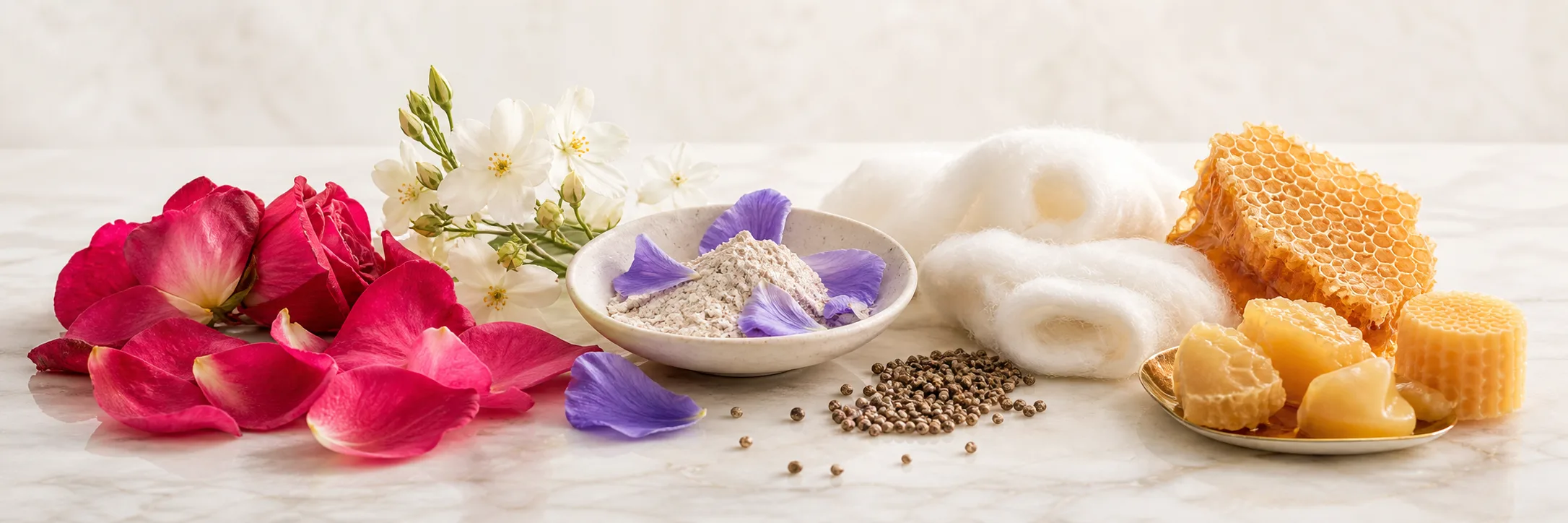
Beige is Chanel’s “honeyed white floral as a neutral color” - Jacques Polge’s olfactory translation of Coco Chanel’s famous line “I take refuge in beige because it’s natural.” Originally launched in 2008 as part of Les Exclusifs, reformulated and re-released as an Eau de Parfum in 2016 when the entire Les Exclusifs collection moved from EDT to EDP concentration. Built around hawthorn, freesia and frangipani with a honey through-line, Beige is the most consumer-friendly and least cerebral of Les Exclusifs - a soft, sunlit, unobtrusive white floral with deliberate quiet. Not aldehydic, not chypre, not powdery in the No. 5 sense; just radiant.
Scent Profile
The opening is gentle rather than assertive - a soft burst of freesia’s slightly peppery, almost rubber-stem greenness over the first hint of honey. Hawthorn arrives within minutes, contributing a faintly almond-rubbery facet that some readers love and others find clinical (Ted Hughes once called hawthorn “nauseous, sweet aniseed”; that vein is just barely present here, dialed down). The Chanel aldehyde shimmer is restrained - Beige is the least aldehydic of the Les Exclusifs - but you can sense it as a soft, lifting brightness above the florals rather than as a distinct soapy presence. By twenty minutes, frangipani comes forward and the fragrance opens into its main accord: warm white petals dipped in pale honey. The frangipani reads tropical-creamy rather than indolic-heavy - closer to the smell of plumeria in mid-afternoon sun than to the suffocating density of a Fracas or Carnal Flower. Honey is the through-line; it’s golden, slightly waxy (beeswax-adjacent), never the syrupy or urinous honey of Miel de Bois or Aoud Honey. It anchors the florals without sweetening them aggressively. The middle stage (one to three hours) holds steady. Beige is more linear than evolutionary - the heart accord just continues, slowly drying down, with the freesia receding first and the frangipani-hawthorn-honey trio sustaining. There’s a powdery undertone that surfaces around the ninety-minute mark, contributed by the floral structure and a subtle musk rather than by iris. Some wearers detect a soft jasmine and orange-blossom in this stage; they’re not listed but are easily read into the white-floral cloud. The drydown is a clean, lightly powdered floral-honey skin scent. There is no obvious wood, leather, or spice base - Beige stays in the “white petals and yellow gold” register from start to finish. Signature accord: hawthorn-and-honey-warmed frangipani with a freesia lift. Steve at The Scented Hound’s “Central Park, NYC - Upper East Side social set meets the tranquility of the park” captures it as well as anything. The 2016 EDP reformulation deepened the honey and pushed the frangipani slightly forward versus the 2008 EDT, with one reviewer noting the EDP feels “warmer and more dimensional” than its predecessor.
Performance
Projection is light to moderate for the first hour - a soft scent bubble at arm’s length, never the kind of presence that fills a room. Sillage is gentle: people seated next to you will notice, people across the room won’t. Longevity on skin in current EDP form is approximately six to eight hours, with the last two as a quiet skin scent. On clothing - particularly cotton or silk - Beige stretches significantly, twelve to eighteen hours easily, and is noticeably louder on fabric than on flesh. Warm weather suits it best. In heat the honey-floral accord opens up and feels appropriate; in cold weather Beige can read thin and detached, almost spectral. Humidity helps it bloom; dry desert air mutes it. Application strategy: spray generously to the hair and clothing rather than just the wrists, since the formulation projects much more efficiently from fabric. Three to four sprays is the right dose; one or two reads as a vague accident.
Wearing Context
Best in spring through early autumn, daytime more than evening. Beige is purpose-built for daytime social wear - lunches, garden parties, daytime weddings, the office in a creative or low-key sector, walks, brunches. Multiple reviewers (Bois de Jasmin, The Scented Hound) describe it as “bridal” or “Mother’s Day” - that’s not a put-down; it’s accurate positioning. The fragrance projects youth-to-middle-age elegance without sex appeal, which is its defining social signal. Settings where it falls flat: clubs and bars (too quiet), heavy winter wear (gets lost in wool and outerwear), strong-perfume contexts like opera or formal evening (underpowered). Skews feminine in marketing and reception, though men who enjoy white florals can wear it. The social perception is invariably “polite, expensive, restrained” - Beige reads “Chanel” to people who recognize the bottle and “subtle good taste” to those who don’t.
Comparisons & DNA
Within Les Exclusifs, Beige is the white-floral counterpart to Gardenia (heavier, more singular floral) and shares some sweet-floral territory with No. 18 (which is iris-ambrette rather than honey-frangipani - different character entirely). It is structurally unrelated to the woody-aromatic exclusifs (Bois des Iles, Sycomore) and the resinous-balsamic ones (Coromandel, Cuir de Russie). Outside Chanel: Frederic Malle Carnal Flower (Dominique Ropion) is the maximalist tuberose to Beige’s gentle frangipani - both share the white-floral-in-sunshine vibe, but Carnal Flower is loud where Beige is quiet. Annick Goutal Songes is the closer comparison for those who like heady frangipani-tuberose-vanilla; Beige is the cleaned-up, brighter, less narcotic version. Michael Kors Michael (the original) has the same frangipani-suntan-lotion DNA at a fraction of the price, and a wearer discussions commenter explicitly cites it as the mass-market analog. Chloe Love is sometimes mentioned as a wedding-aesthetic peer. Estee Lauder Beautiful shares the honeyed-floral structure but is more aldehydic and complex. There is no known Lattafa, Armaf or Maison Alhambra clone - Beige is too specific and too quiet to be a profitable clone target. The clone market favors heavier white florals (Mancera Pink Flowers Pomelo, dupes of Carnal Flower). Beige inspired no trend; it sits within the late-Polge “civilized minimalism” mode that also produced No. 5 L’Eau and Misia.
Reception
Wearer response is “lovely but expensive for what it is.” Praise centers on: blending quality, restraint, wearability, the honey-frangipani accord done with rare subtlety. Criticisms: priced at Les Exclusifs level (~$300-$400 for 200ml in current rollout) for a fragrance many describe as “department-store nice” rather than “niche-essential.” Several reviewers compare it directly to Michael Kors Michael and ask whether the Chanel quality premium is justified. Among critics, Now Smell This (Robin Krug, 2008) treated Beige as a soft launch - interested but not effusive, noting the honey-frangipani-freesia structure as competent Polge work. Bois de Jasmin (Victoria Frolova) reviewed Beige in 2009 and again the 2014 extrait, describing the 2014 parfum extrait as adding orange blossom and jasmine over a richer peach, and concluding that Beige is a “delicate white floral that feels like a comfortable silk slip… a well-made fragrance for understated elegance.” Frolova considers it a staple. The Scented Hound called it “unassuming, elegant, effortless.” There is no documented Luca Turin or Tania Sanchez review of Beige in Perfumes: The Guide - it postdated the 2008 book, and the 2018 update did not cover it. Persolaise has discussed Beige favorably in his Les Exclusifs rankings but has not given it a dedicated full review. Blind buy verdict: defensible at decant level but risky at full bottle if you don’t already love honey-floral; the price is real. Polarization axis: lovers find it the most wearable of Les Exclusifs; detractors call it “the boring one” or “Michael in a Chanel bottle.”
Versions & Reformulation
The original 2008 Eau de Toilette ($190 for 200ml at launch) was the first iteration. In 2014, Chanel released a Parfum (extrait) version alongside Jersey and 1932 - Bois de Jasmin’s Frolova considered the 2014 extrait a significant improvement over the EDT, with deepened florals and the addition of rose, jasmine and orange blossom. In 2016, as part of the line-wide Les Exclusifs reconcentration, the EDT was discontinued and replaced by the current Eau de Parfum, which retains the 2014 extrait’s slightly fuller character but at EDP concentration. The EDP feels denser and warmer than the original EDT but is not the equal of the 2014 extrait.
Acquisition Notes
Luxury tier within Chanel: approximately $300 for 75ml EDP and $400+ for 200ml at Chanel boutiques and chanel.com as of 2026. Distribution is restricted to Chanel boutiques, chanel.com, and a handful of luxury department stores (Saks, Bergdorf Goodman, Nordstrom flagships) - Beige is not sold at general fragrance retailers. The 200ml bottle is the iconic Les Exclusifs format; 75ml is the more common purchase. Decants are widely available from Surrender to Chance, MicroPerfumes, Scent Split and The Perfumed Court.
Notable Facts & Lore
- The name Beige derives directly from Coco Chanel’s frequently-quoted assertion: “I take refuge in beige because it’s natural” (“Je me refugie dans le beige parce qu’il est naturel”).
- Polge built the fragrance to translate that aesthetic position into a scent - the beige as Chanel meant it: not drab, but elegantly neutral, expensively understated.
- There was an earlier discontinued Chanel fragrance called “Le Beige” from 1931, but Polge’s 2008 composition is not a reissue.
- The fragrance launched in 2008 exclusively at Saks Fifth Avenue’s NYC flagship, which had recently installed Chanel’s “Olfactive Bar” - a guided sampling concept that pushed customers through the entire Les Exclusifs line.
- This boutique-only launch positioning was deliberate, signaling Beige’s place in the luxury hierarchy.
- No celebrity ambassador, no TikTok virality (Beige is too quiet for TikTok-era fragrance discourse, which favors loud sweet-amber bombs).
- No controversy.
- The most notable cultural moment for Beige came in 2014 when Chanel released the extrait alongside Jersey and 1932 - a move many reviewers read as Chanel acknowledging that Beige had become a quiet bestseller within Les Exclusifs despite its under-the-radar profile.