Chanel — Les Exclusifs de Chanel 1932 Parfum
Essence
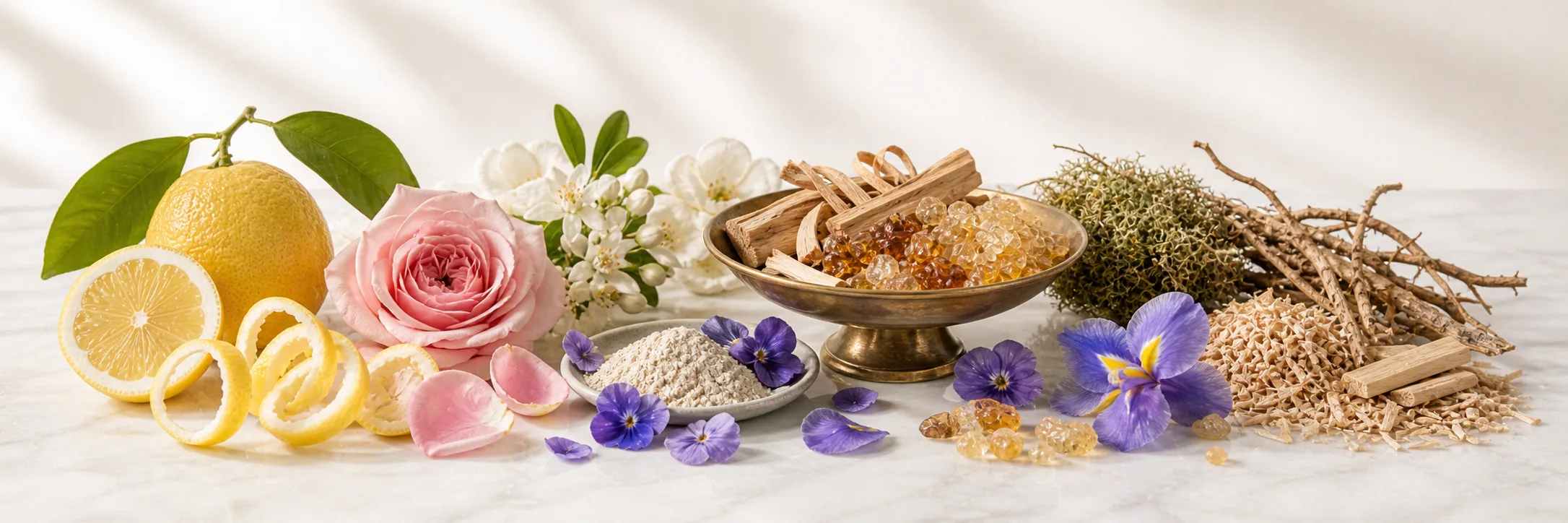
The 2014 extrait reading of 1932 - a denser, rounder, longerlasting iteration of the aldehydic jasmineirismusk EDT, with audibly more sandalwood, ambrette and coumarin and a perceptibly woodyoriental drydown. Released in May 2014 in 15ml extrait bottles alongside parfum versions of Beige and Jersey, this was Jacques Polge’s final major creative gesture for Les Exclusifs before retiring in favor of his son Olivier. The brief was clear: the same 1932 idea - Coco Chanel’s diamondjewelry sparkle - rendered in the most concentrated, “noble materials” register Chanel offers.
Scent Profile
Open the small Decoshouldered bottle and the first impression is immediately denser, slower and warmer than the EDT - the aldehydes hum rather than fizz. Cafleurebon’s Nancy Knows put it well: a “burst of signature Chanel aldehydes that sparkle like the witty conversation from a 1930s screen comedy,” with bergamot and neroli sitting closer to the skin. There is none of the EDT’s chilly platinum shimmer; the same elements are present but lacquered. By minute twenty, jasmine asserts itself with notably more lift than in the EDT, but here it is the multifloral heart that grows richer - rose, lilac, carnation and ylang are individually more detectable, rather than vanishing into the jasmine accord. Cafleurebon’s read of this stage is precise: “in the extrait version, the flower’s simple, clean lines are softened by perceptible additional florals of rose, lilac, carnation, and ylangylang, in effect transforming the hardness of a diamond into the smoothness of a bias cut white satin evening gown.” The iris/iralia powder is still present but quieter, less lipsticky and more buttery; orris reads more like real orris than the EDT’s violet powder. From roughly fortyfive minutes onward, the parfum makes its decisive divergence from the EDT: the base notes step forward in a way they never quite manage in the EDT. Opoponax and sandalwood thicken into a warm resinous cushion; vanilla becomes audible (not just a structural sweetness but a recognizable accord); coumarin’s hay note crosses with the ambrette to produce an almost animalic skin warmth; vetiver darkens the floor. A reviewer with both formats described the transition concisely: “a very slightly animalic, smells like real skin only better, scent with coumarin, stronger vetiver and a soupcon of incense entering and taking over the party.” The dominant signature accord across the parfum’s wear is creamy jasmine over hayandsandalwood balsam, with the aldehydes faintly persistent as a high note. Evolution is more linear than the EDT - the parfum settles into its base accord faster (within ninety minutes) and holds there for the duration. Cafleurebon’s verdict that “towards the end of its cycle, the perfume presents more like a woody oriental than a floral” is accurate; this is functionally a soft semioriental drydown attached to a 1930s aldehydicfloral opening.
Performance
In dab format from the 15ml stopper bottle, projection is restrained but legible - the parfum is not a sillage bomb in the No. 5 extrait tradition. Expect a tight personal aura of one to two feet for the first three hours, then a close skin scent. Longevity on skin is genuinely longer than the EDT: six to twelve hours is achievable, with Nancy Knows at Cafleurebon reporting “14 hours and counting” from her test bottle, and “sillage is soft but noticeable.” On wool and silk it lasts a full day plus. A small subset of wearers report only four to five hours of skin wear, which tracks with reports across Chanel parfums - skin chemistry matters more at this concentration. Heat brings out the sandalwoodopoponax base and softens the aldehydic opening into something almost gourmandadjacent. Cold weather is its natural home: the parfum holds together below 15C in a way the EDT cannot. Humidity makes it lusher; dry air thins it. Application strategy: this is a dab parfum, not a spray. Apply sparingly to pulse points - inner wrists, behind ears, throat hollow - and let body heat do the work. Overapplication risks crowding the jasmine with sandalwood. Layering the matching Les Exclusifs body cream (recommended by Frolova for these “fleeting” Chanels) extends wear by an extra two to three hours. Avoid layering with other Chanel parfums; the aldehydic profile clashes with No. 5 and Coromandel.
Wearing Context
The parfum shifts 1932’s wearing window decisively into evening and coolweather territory. It works yearround but is at its most beautiful in autumn and winter - between roughly 5C and 18C - and after dark. Occasions: formal dinners, theater, intimate evenings, weddings, anywhere a denser register of Chanel polish is wanted. As daywear it is overdressed unless the day in question is formal. Where it shines: coldweather evenings, formalwear, anytime you want a quietly luxurious Chanel signature with the warmth that the EDT lacks. As a date fragrance it works very well - it is sensual without being overt, and the skinmusk drydown is the part that lingers near another person. Where it falls flat: hot summer afternoons (the sandalwoodopoponax base goes heavy), athletic or casual contexts (it announces effort), and offices with fragrancesensitive coworkers (the projection, while moderate, is persistent). The socialperception skew is unambiguously feminine and reads “mature,” “polished,” “establishment” - not edgy, not youthful. It is closer to wearing a vintage couture suit than a current readytowear.
Comparisons & DNA
The parfum’s most useful comparisons differ from the EDT’s because the base accord is so much more prominent: - Chanel No. 5 Parfum - the obvious lineage. Both are aldehydicfloral parfums with sandalwood depth; No. 5 is grander, more iconic, with more pronounced ylang and civet; 1932 Parfum is softer, more jasmineforward, less rich. - Chanel Bois des Iles Parfum - closer in drydown texture than the EDT ever was; Bois des Iles has more pronounced sandalwood and less floral heart, but the warm woody base accord is in the same family. - Chanel 31 Rue Cambon Parfum (2015) - released a year later; the two parfums make a coherent set, 31 RC being the chypric/iris counterpart and 1932 the aldehydicfloral counterpart. - Lanvin Arpege (vintage extrait) - the historical reference point Polge clearly had in mind: an aldehydic floral built around jasmine with a soft sandalwood drydown. Arpege is mossier and more melancholic; 1932 Parfum is cleaner and brighter. - Caron Fleurs de Rocaille (vintage extrait) - same Depressionera aldehydicfloral genre; Fleurs de Rocaille is more violetmimosa and more oldfashioned, 1932 Parfum more polished and modern. - Frederic Malle Iris Poudre - comparable powderfloral structure; Iris Poudre is more vanillasandalwood heavy and reads more retro, but the genre overlap is strong. - Guerlain Mitsouko Parfum - referenced occasionally by wearer reports for its dry chypric depth; 1932 Parfum is gentler and less peachy but shares the “old French parfum” gravitas. No clone alternatives exist at the Armaf/Lattafa/Alhambra tier. The fragrance is too niche, too lowvolume, and too specifically a Chanel parfum technical exercise to have generated commercial dupes. Layering Chanel No. 19 Poudre EDP with a touch of Bois des Iles approximates the spirit at a fraction of the cost. Lineage: 1932 Parfum descends most directly from the Ernest Beaux aldehydicfloral lineage (No. 5, Bois des Iles, No. 22) filtered through Polge’s late style. It is the most explicit revival of that style in the modern Chanel canon.
Reception
Reception is decisively warmer than the EDT’s, especially among Chanel completists. Wearer response to the parfum is that it is the version that should have been released first - richer, longer-lasting, and more justifiably an “Exclusifs” price point. Wearer discussions treat it as a hidden gem for serious Chanel collectors. The niche-heavy wearer base tends toward “beautiful but optional” - the same crowd that prefers 31 Rue Cambon and Coromandel finds 1932 Parfum pretty but not essential. Critical verdicts split along the line drawn by the EDT. Bois de Jasmin’s Frolova was direct: “Of the three new extraits de parfum in Chanel’s Les Exclusifs collection, 1932 seemed most promising, but it turned out that Beige and Jersey held more surprises… if you didn’t like the Eau de Toilette, the parfum isn’t going to change your mind.” Persolaise’s framing was that the choice of Beige, Jersey and 1932 for extrait conversion was itself surprising (rather than Coromandel or Sycomore) and that the extraits were “wrongfooted and treated to three gems worthy of standing next to their august cousins.” Cafleurebon’s Nancy Knows was the most positive: “If one cannot afford diamonds, 1932 Parfum makes a splendid substitute.” Praise centers on: richer florals, audible base notes, longer wear, and the perceived value of the extrait format. Criticism centers on: still underprojecting for a Chanel parfum, and not radically different enough from the EDT to justify the price step. Blind-buy verdict: only for confirmed Polge-era Chanel devotees. Anyone uncertain should sample the EDT first; if the EDT charms you, the parfum will deepen that charm - if it does not, this will not change your mind.
Versions & Reformulation
Single composition launched in May 2014 in 15ml extrait bottles only. No widespread reformulation is documented; production was limited and discontinuous. The 2016 broader Les Exclusifs reformulation that converted EDTs to EDPs did not affect the parfum extraits directly - they remained available in parfum form, though distribution narrowed substantially after 2016. Current availability at Chanel boutiques is intermittent at best; many boutiques have stopped stocking the extraits entirely as the 2016 EDP line took priority. There is no documented IFRAdriven reformulation of the parfum specifically. The 15ml bottle, with its Decostyle square shoulders, has been the only format ever released.
Acquisition Notes
Pricing at 2014 launch was 155 / approximately $200 for 15ml in the UK and France (per Alison Kerr’s Film & Style Matters reporting after her Polge interview). Current secondarymarket prices for sealed 15ml extrait bottles run $300-600 depending on completeness of packaging. Decant availability is thinner than for the EDT - perfUUm and Surrender to Chance carry samples sporadically; expect to pay $20-40 for a 2ml decant. Authentic boutique acquisition is now nearly impossible outside of Paris flagship locations (31 Rue Cambon) or via Chanel customer service direct request - a small allocation may still be available at the Espace Parfums in Paris and at the New York 57th Street boutique.
Notable Facts & Lore
- The 2014 release of the three extraits (1932, Beige, Jersey) was Jacques Polge’s stated farewell project before handing the perfumer role to his son Olivier.
- Persolaise observed at the time that the choice of these three fragrances for extrait conversion - rather than the more obviously deserving Coromandel or Sycomore - was itself a kind of signature: an act of perfumer’s vanity about his most underrated work, or perhaps a commercial choice favoring the bestsellers of the line.
- As Frolova put it directly on Bois de Jasmin: “the truth is that Beige, Jersey and 1932 are the best sellers in the collection, and it made more business sense to focus on them first.”
- The inspiration thread remains “Bijoux de Diamants” (see preceding dossier): Coco Chanel’s November 1932 sole highjewelry collection, the celestial motifs of comets and stars, the Aubazine abbey childhood memory of Byzantine mosaics under the stairwell.
- Polge in his 2006 interview with Alison Kerr - held in Coco Chanel’s own preserved 31 Rue Cambon apartment - made clear that the Exclusifs line was a curatorial project, drawing on Mademoiselle’s biography object by object.
- The 1932 Parfum extends that project into its most ornamental register: not Coco Chanel’s everyday life but the moment of her most theatrical selfpresentation, the November 1932 charity exhibition during the Depression.
- No celebrity association attaches specifically to the parfum.
- Within Chanel’s own corporate narrative, it stands as the most concentrated formal expression of the “1932” idea - diamonds, comets, stars - before that idea was diluted (or modernized, depending on view) in the 2016 fruityfloral EDP reformulation.