Chanel — Allure Eau de Parfum
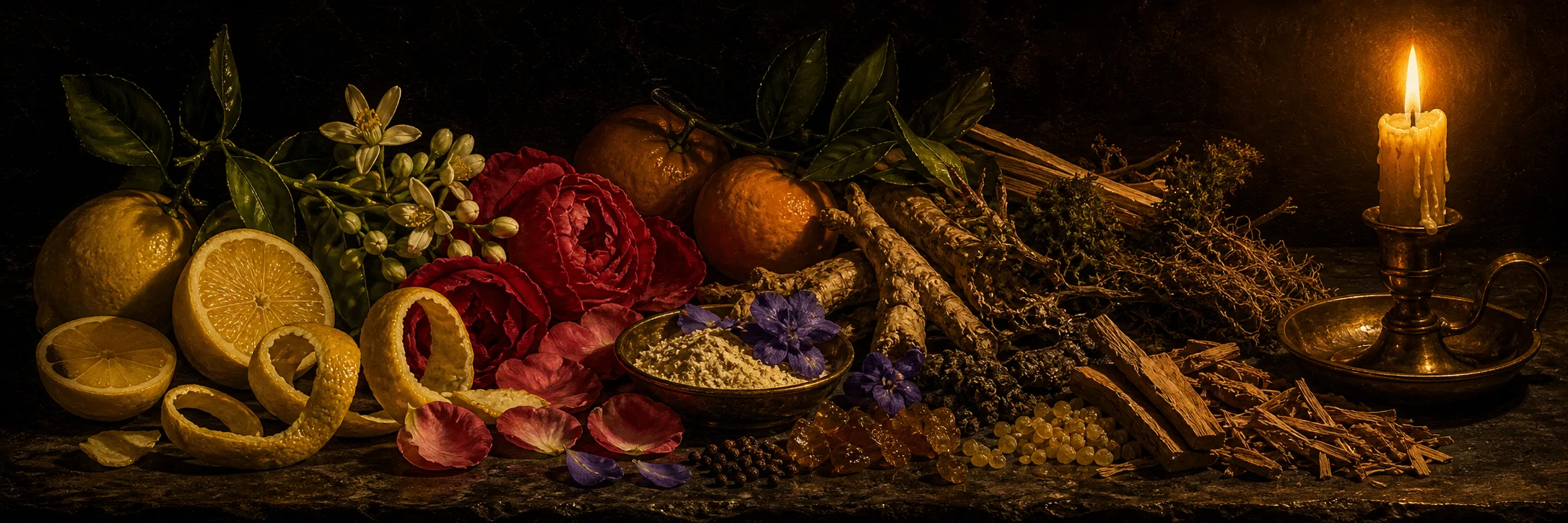
Essence
Allure EDP is the warmer, plusher sister to the 1996 Allure EDT - a peach-and-vanilla-anchored floriental that takes the EDT’s bright cosmopolitan structure and pours it into a duvet. Where the EDT sparkles, the EDP smolders. Jacques Polge designed it to be unclassifiable: not exactly a floral, not exactly an oriental, not exactly a fruity. The result is one of the late-1990s’ definitive “office-to-evening” mainstream Chanels - quietly affluent, recognizably Chanel in its powdery aldehydic finish, but without the museum-piece formality of N5.
Scent Profile
The opening 10-20 minutes lead with mandarin and peach more than bergamot. The peach here is the signature note - not the sticky candied peach of Mitsouko or J’Adore, but a ripe, faintly fuzzy stone fruit, slightly creamy, with the mandarin lending a sun-warmed edge. Bergamot is structural rather than expressive: it polishes the top but doesn’t sing. Anyone expecting a sharp citrus burst will instead get something rounder and already faintly powdery, because the vanilla base is pushing up from underneath almost immediately. This is one of the defining traits of the EDP versus the EDT - the vanilla is in the room from minute one. Through the heart, 1-3 hours in, the white-floral bouquet does its work in a sfumato. Rose and jasmine are dominant but blurred together rather than distinct; orange-blossom adds a cool, slightly green facet that prevents the composition from going syrupy. Magnolia, peony and lotus are catalog flowers - perceptible only as a collective creamy-petal effect, not individually nameable on skin. This is intentional: Polge is using flower notes as texture, not as soloists. The signature accord is the peach-jasmine-vanilla triangle, riding on a faint aldehydic shimmer that gives Allure its unmistakable Chanel handwriting. The drydown, from about 3 hours on, is where the EDP earns its name - it goes from “floral perfume” to “skin.” Vanilla becomes more obvious but never gourmand; it’s the dry, slightly woody Chanel vanilla, more akin to the base of Coco Mademoiselle than to anything Mugler or Guerlain would do. Cedar provides backbone; vetiver adds a thread of clean greenness that keeps the whole thing from going cloying. Patchouli, listed in some pyramids, is barely detectable - a structural drop, not a feature. Linearity is moderate: there is genuine evolution from peachy top to powdery floral heart to creamy woody-vanilla base, but it’s a slow, blended evolution rather than a three-act play. Compared to the EDT, the EDP is denser, sweeter, and more autumnal; it doesn’t sparkle, it glows.
Performance
Projection in current batches (post-2014 reformulation era) is moderate at arm’s length for the first hour, then settles into a roughly 30 cm scent bubble. Sillage is restrained and refined - this is not a fragrance that announces itself across a conference room. On skin, expect 5-7 hours of clear wear from three to four sprays, with a soft musk-vanilla skin scent lingering past that. On clothing, particularly wool and silk, longevity stretches to 24+ hours; many wearers report opening a sweater drawer weeks later and recognizing the scent. Heat treats Allure EDP well - the warmer the day, the more the vanilla blooms, though the peach can edge sticky in true humidity. Cold and dry conditions actually flatten it; this is not a winter beast like Coco or Coromandel. The best application strategy is two sprays at the pulse points and one to clothing (scarf, sweater hem) for the diffusion. Heavy spraying is counterproductive; Allure EDP rewards restraint and goes brash when over-applied. Note the well-documented post-2014 reformulation complaints - wearer discussion thread “Chanel Allure EDP reformulation so weak” features buyers who purchased directly from chanel.com describing it as “almost definitely a post-IFRA reformulation batch,” with multiple users saying current sillage is “so weak I am using [it] as a light body mist for the office.” Older bottles (pre-2010) perform measurably stronger.
Wearing Context
Allure EDP is autumn-and-winter coded - September through March is its home. Spring works in cooler temperatures; high summer makes it claustrophobic. It is fundamentally a daytime-into-early-evening fragrance rather than a nightclub or formal-gown perfume. Where it shines: the office, brunch, dinner, a wedding you’re attending (not officiating in), holiday gatherings, layered under cashmere. Where it falls flat: gym, beach, summer cocktails, anything requiring a fragrance to read across a room. Socially, the perception skew is decidedly “polished adult woman, 30s-60s.” It reads as financially comfortable without screaming wealth, as elegant without screaming effort. It does not read as young - Gen Z fragrance discussions consistently characterize it as “mature” or “my mom’s perfume.” This is not pejorative; it is a recognition that Allure EDP belongs to a different fragrance era than the gourmand sugar-bomb genre dominant since 2018. It is the fragrance equivalent of a Burberry trench: classic, dignified, and a little out of fashion in a way the wearer doesn’t care about.
Comparisons & DNA
Closest in DNA is Guerlain L’Instant de Guerlain (2003), which wearers discussion repeatedly cites as “uncannily close” - same peach-magnolia-vanilla core but with more honey and ylang. Dior Joy (2018) is the modern cousin: similar peach-jasmine-musk skeleton but cleaner, less powdery, with stronger sandalwood and weaker vanilla. Dolce & Gabbana The One (2006) shares the peach-amber gestalt at a lower price and louder volume. Within the Allure line: Allure EDT (1996) is the daytime, citrus-forward version of the same skeleton, much lighter on vanilla. Allure Sensuelle (2005) takes the same base and amplifies patchouli - Allure EDP is the “warm” Allure, Sensuelle is the “spicy” Allure. The discontinued Allure Parfum (extrait) is reportedly the platonic ideal - Victoria Frolova of Bois de Jasmin has described the Allure extrait as “golden peaches and an armful of jasmine,” and wearer response is that the extrait makes everything else look like a sketch. Cheaper alternatives are surprisingly scarce because the peach-floral-vanilla combo is hard to clone cheaply without going gourmand. United Colors of Benetton Hot is the perennial recommended Allure EDT dupe and works adjacent to the EDP. Lancome Tresor (1990) is the genre predecessor - Allure EDP is essentially Tresor’s sleeker, less mumsy descendant. Allure as a fragrance did not start a major trend. It arrived at the tail end of the big 1990s peachy-amber florals (Tresor, J’adore, Jean Paul Gaultier Classique) and modernized rather than redefined the category. Its lineage is firmly Chanel-internal - straight line from N5 (1921) through Coco (1984) to Allure (1996/1999) to Coco Mademoiselle (2001).
Reception
Wearer response is consistent: Allure EDP is loved by its devotees and dismissed by trend-chasers. Praise centers on its quiet sophistication, its peach-vanilla balance, and its identifiable Chanel handwriting. Criticism centers on three axes: post-2014 performance degradation, perceived “datedness” versus current sweet-gourmand trends, and the relatively high price for what some describe as a “skin scent.” Polarization is generational - older perfumistas and Chanel collectors rate it 8-; younger wearer reports tend to rate it 6-7 and describe it as “office-mom.” Luca Turin and Tania Sanchez do not appear to have given Allure EDP a starred review in widely circulated excerpts from Perfumes: The Guide (2008) or Perfumes: The Guide 2018; their take on the broader Allure line was famously cool. Turin’s only star-rated Allure entry that has been verbatim quoted is Allure Homme (1999), which received one star and was, per a wearer review citing the Guide, “competent, utterly dull, and unworthy of Chanel.” That sets the tone for the brand’s reception in serious critic circles, even where Allure EDP itself was not specifically panned. On Bois de Jasmin, Frolova has commented in passing that “Allure doesn’t get much love on the blogs” while affirming her own affection for the line. Blind buy verdict: only if you are an established Chanel wearer or have tested EDP from a sample. The performance issues post-reformulation make this a riskier blind buy than other Chanels; many enthusiasts recommend tracking down a pre-2010 bottle on eBay or Marketplace if you want the “real” Allure EDP experience.
Versions & Reformulation
Allure exists in EDT (1996, the original), EDP (1999, this dossier), Parfum/extrait (discontinued in most markets, occasionally reappears), Eau Premiere (a brief flanker), and the Sensuelle line. The EDT-EDP relationship is genuinely different rather than concentration-only: the EDT is brighter, more citrus and floral, with vanilla as background; the EDP is denser, peach-and-vanilla-forward, with citrus as background. Reformulation history is significant. The 2014 IFRA-driven reformulation is the most-discussed inflection point; vintage bottles (pre-2010) project measurably harder and sit warmer on skin, with what wearers describe as a richer peach and a denser vanilla. Subsequent batches in the 2018-2024 window have continued the trend toward lighter projection - Chanel’s modern house style favors close-to-skin elegance, but Allure EDP suffers more from this than something like N5, where the aldehydic structure compensates.
Acquisition Notes
Pricing is designer-luxury tier: roughly $135 for 50 ml and $190 for 100 ml at full retail through chanel.com or department-store counters as of 2026. The 35 ml travel size occasionally surfaces around the holidays. There is no extrait currently in standard distribution. Decant ecosystem: Surrender to Chance and MicroPerfumes both carry Allure EDP in standard 1 ml, 3 ml, 5 ml and 10 ml decants.
Notable Facts & Lore
- Allure was the first Chanel fragrance launched by Jacques Polge that was conceived from the ground up as Polge-era house DNA rather than continuation of Ernest Beaux’s archive.
- Polge described Allure’s intent broadly as a “multi-faceted” scent that would express itself differently on each wearer - Chanel’s own marketing copy across the years framed Allure as “Difficult to define, impossible to resist,” and that ambiguity was the point.
- The EDP was added in 1999 to address customer requests for a warmer, longer-wearing version of the 1996 EDT.
- The campaign face history is itself a piece of Chanel marketing lore: Allure was originally fronted by anonymous models and later, in 2002, Karl Lagerfeld and Artistic Director Jacques Helleu chose Anna Mouglalis as the face of the Allure line - Mouglalis became Chanel’s second-ever house ambassadress after Carole Bouquet, and would later play Coco Chanel in Coco Chanel & Igor Stravinsky (2009).
- She would also become the face of Allure Sensuelle in 2005-2008.
- There is no significant viral TikTok moment associated with Allure EDP - it has resisted the social-media compliment-getter cycle that has elevated Coco Mademoiselle and Chance to perpetual best-seller status.
- This is part of its quiet appeal among older Chanel devotees, and part of why younger fragrance enthusiasts overlook it.
- No celebrity has publicly claimed Allure EDP as a signature.