Chanel — Les Exclusifs de Chanel Coromandel
Essence
Coromandel is Chanel’s grand patchouli oriental: a smooth, ambered, faintly chocolate-y patchouli wrapped in frankincense and powdered vanilla, named for the lacquered Chinese screens Gabrielle Chanel collected. Built by Jacques Polge and Christopher Sheldrake as the “Chanel” answer to Serge Lutens’ Borneo 1834 (also Sheldrake’s work), it takes head-shop patchouli and renders it luxurious - clean, rounded, and refined rather than dirty. It is simultaneously cozy and austere, a “white-chocolate patchouli” that reads as unisex despite its feminine marketing, and it became one of the most beloved entries in Les Exclusifs.
Scent Profile
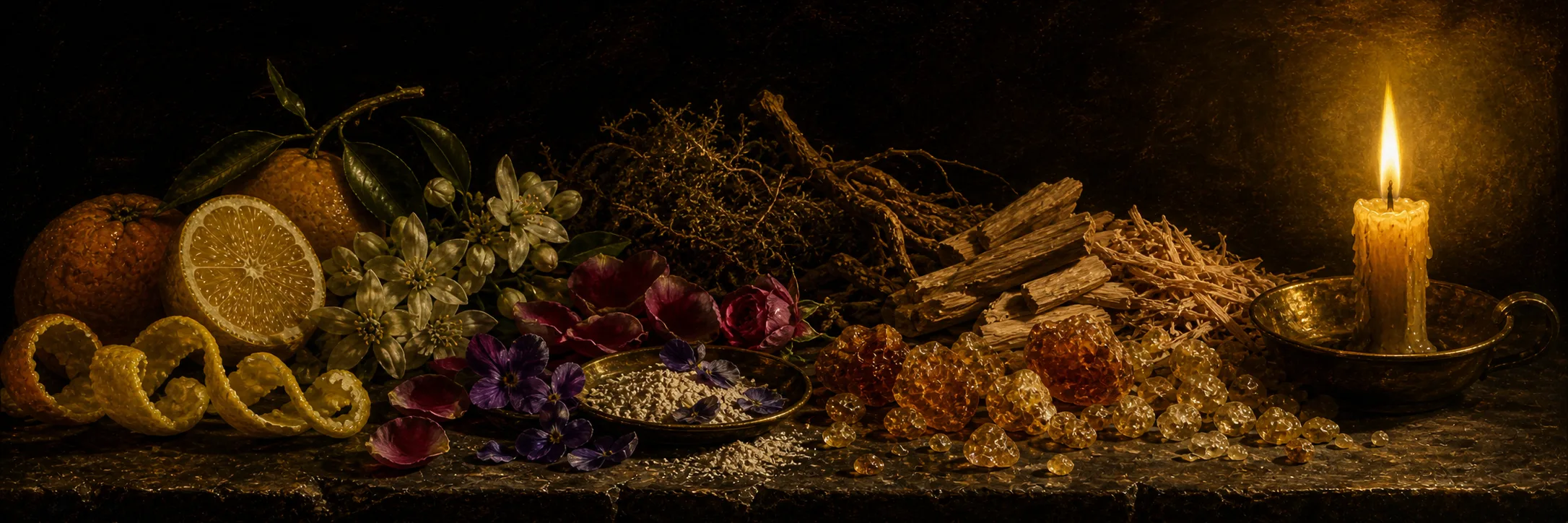
The opening is the most overtly “perfumey” stage: a bright, slightly sharp citrus-aldehyde flash (bitter orange and neroli) over an immediate surge of cold, terpenic patchouli. This is real patchouli with its camphor and green edges intact, not the fractionated “clean” patchouli of cheaper blends, so for the first ten minutes the effect is heady, almost soapy, with a sour-green spike some find challenging. Within the first half hour the citrus recedes and the composition warms. The heart is where Coromandel earns its reputation: patchouli softens and turns “chocolate-y,” its earthiness sweetened by benzoin and the famous white-chocolate accord, while orris lends a powdery, lipstick-like floralcy and rose and jasmine appear as delicate, supporting brushstrokes rather than a true floral heart. The rose-violet-orris facet is what gives some wearers a vintage-cosmetic impression. Frankincense and olibanum run through the middle as a dry, churchy smoke that keeps the sweetness in check - several wearers actually find the incense dominates the amber. The signature accord is this interplay: smooth sweet patchouli + powdery white chocolate + dry incense, an effect repeatedly likened to a milky cocoa or chai latte set against cold stone. The drydown (3+ hours) is a warm, balsamic, lightly spiced amber-woody haze: benzoin, Tahitian vanilla, soft woods and musk, with the patchouli surfacing and dissolving in cycles. It is not strictly linear - there’s a real arc from sharp citrus-patchouli to creamy cocoa to ambered drydown - but the core patchouli-benzoin signature persists throughout. Perceptible notes: patchouli, incense/olibanum, white chocolate, benzoin, orris, vanilla. Submerged: the rose and jasmine (whisper-level), the citruses (gone within the hour).
Performance
For an EDT, Coromandel performs robustly - historically noted as stronger than its concentration would suggest. Projection is moderate to strong in the first two hours, throwing an arm’s-length-plus cloud, then settling to moderate. Sillage is rich and noticeable without being a screamer; it leaves an elegant wake rather than filling a room. Longevity on skin runs roughly 6-10 hours depending on the wearer, with reports of patchouli-vanilla remnants past 8-12 hours on luckier skin; on clothing it can persist a day or more. It blooms dramatically in heat and humidity - desert-heat wearers report it turning rosier and more floral, and humidity amplifies the patchouli - while cold weather keeps it cozier and closer. Best application: restraint. One or two sprays is plenty; over-application in heat tips the rose-patchouli into something cloying. It rewards skin application at pulse points where its warmth can develop.
Wearing Context
Coromandel is a cool-weather, evening-leaning fragrance, though its admirers wear it year-round. Fall and winter suit its ambered, incense-laden warmth best; it shines at dinners, formal occasions, the theater, and any dressed-up cold-weather setting. It reads as sophisticated, “grown,” and quietly confident - a “night on the town” scent more than a desk fragrance. It can feel heavy or overdressed in a hot office or a casual daytime gym context, and its incense-patchouli core is too serious for breezy summer use for many. Despite Chanel’s feminine classification, Wearer response treats it as genuinely unisex - plenty of men wear and are complimented on it. The only social-perception risk worth flagging is the orris-rose-powder facet, which a minority read as slightly “matronly” or old-fashioned; most find it elegant rather than dated.
Comparisons & DNA
Coromandel’s defining lineage is its kinship with Serge Lutens Borneo 1834 (2005), also composed by Christopher Sheldrake: both are patchouli-cocoa orientals, but Borneo is drier, darker, dustier - raw cocoa powder and earthy patchouli, “monolithic” and masculine-leaning - whereas Coromandel is smoother, sweeter, lighter, with white chocolate instead of bitter cacao and more floral-incense polish. The wearer shorthand: Borneo is flannel, Coromandel is angora. Frederic Malle Portrait of a Lady and Musc Ravageur are frequently invoked as richer, more expensive rose-patchouli and ambered-musk relatives. Dior Patchouli Imperial is a drier, more masculine patchouli alternative. Sonoma Scent Studio Champagne de Bois has been cited as Coromandel-adjacent without the Sheldrake link. As a designer-priced “dupe” target, there’s no precise clone - vintage Giorgio for Men is cited as sharing the addictive patchouli-amber-chocolate-iris DNA at a fraction of the cost, but it’s its own beast. Coromandel sits in the oriental-woody patchouli lineage descending from Davidoff-era cocoa-patchouli ideas, and it effectively defined the “luxe clean patchouli” template that designer houses chased afterward.
Reception
Wearer response is strongly positive, often reverent - it’s repeatedly called a masterpiece and one of the best patchoulis in mainstream perfumery, with a love-it-or-hate-it streak driven by the divisive patchouli and the sharp opening. Common praise: smoothness, elegance, the white-chocolate-patchouli accord, compliment-generation. Common criticisms: the price, the sometimes “screechy” or soapy opening (especially in the EDP), the orris powder reading “old lady” to some, and a sense it’s “not truly groundbreaking” given the hype. Bois de Jasmin’s Victoria Frolova reviewed it warmly (Nov 2011), describing the patchouli as “taken into a dark, luscious direction, someplace between the fun fair exuberance of Thierry Mugler Angel and the dusky bitterness of Serge Lutens Borneo 1834.” Now Smell This’s Kevin called it cozy and almost edible, and pushed back on the “matronly” label. Persolaise, reviewing the extrait, noted how much “dirt” Coromandel smuggles under the Chanel logo. Luca Turin and Tania Sanchez praised it in their Guide, framing it explicitly as a Chanel reorchestration of Borneo 1834. Blind buy? Reasonably safe for patchouli lovers given the universal quality, but sample first - patchouli is polarizing and the price is steep.
Versions & Reformulation
Three concentrations exist and they genuinely differ. The original 2007 EDT (this catalog entry, now discontinued) is the perfumista favorite: the most vibrant and dynamic, with a robust terpenic-leather patchouli, a sharp green-sour citrus opening, and a relatively dry, “cashmere” finish. The 2016 EDP (which replaced the EDT) is sweeter and more balsamic - as one widely-cited wearer discussions comparison put it, “If EDT is a bar of white chocolate, EDP is melted white chocolate syrup… EDT micro sugar, EDP full sugar” - smoother and more amber-forward but, by frequent consensus, having lost some of the EDT’s spark and spike; some find it more synthetic or “screechy.” The 2019 Parfum/Extrait (reworked by Olivier Polge, with heightened musk and Andalusian labdanum for a deeper, smokier amber) is widely regarded as the best successor to the EDT - richer, rounder, less gourmand, with extraordinary longevity but softer projection and more skin-close behavior. Note also batch-to-batch variation in the EDT is documented, with older batches described as smoother white-chocolate/benzoin and newer ones heavier patchouli.
Acquisition Notes
Luxury tier (Chanel boutique-exclusive line). The discontinued EDT was sold in 200ml ($200 era) and 75ml; the current EDP comes in 75ml and 200ml, the Parfum in a 15ml stoppered bottle. Coromandel is sold almost exclusively through Chanel boutiques, Chanel.com, and select department stores (Bergdorf Goodman, Harrods, Nordstrom) - Chanel does not allow discounters, so deep discounts signal caution. The decant ecosystem is robust: it’s widely available through Surrender to Chance/The Perfumed Court and similar splitters, which is the smart way to test before a full-bottle commitment.
Notable Facts & Lore
- The name and inspiration are well documented: Coromandel honors the dark lacquered Chinese Coromandel screens that lined Gabrielle Chanel’s apartment at 31 rue Cambon.
- She is quoted in Claude Delay’s “Chanel Solitaire”: “I’ve loved Chinese screens since I was eighteen years old. I nearly fainted with joy when, entering a Chinese shop, I saw a Coromandel for the first time. Screens were the first thing I bought.”
- Sheldrake and Polge built the fragrance on patchouli specifically to evoke the screens’ blend of opulence and austerity, dark sheen and gold embellishment.
- The most persistent piece of lore is the Borneo 1834 connection: Sheldrake composed Borneo for Lutens in 2005 while serving in an R&D directorship at Chanel, then co-created Coromandel two years later, leading Luca Turin and much of the wearers to frame Coromandel as the “Chanel-ified” sibling of Borneo - a framing some wearers reject, noting Coromandel is far more floral and incense-forward.
- It also became a cult layering partner (notably with Sycomore) among Chanel devotees, and is frequently cited as a “gateway” patchouli that converts patchouli skeptics.