Chanel — Antaeus
Essence
Antaeus is the 1981 woody-chypre masculine that defined Chanel’s late-classical men’s wardrobe between Pour Monsieur (1955) and Egoiste (1990). It’s a dense, herbal, leather-and-moss creation built around castoreum, labdanum and oakmoss, with a green-aromatic top that runs on clary sage and bitter myrtle rather than the citrus brightness common to its era. Mythologically named, sonically loud, structurally tight - Antaeus is the closest Chanel ever came to a “powerhouse,” and the only masculine in the line that wears like a chypre rather than a fougere or cologne. Polarizing, dated to some, untouchable to others.
Scent Profile
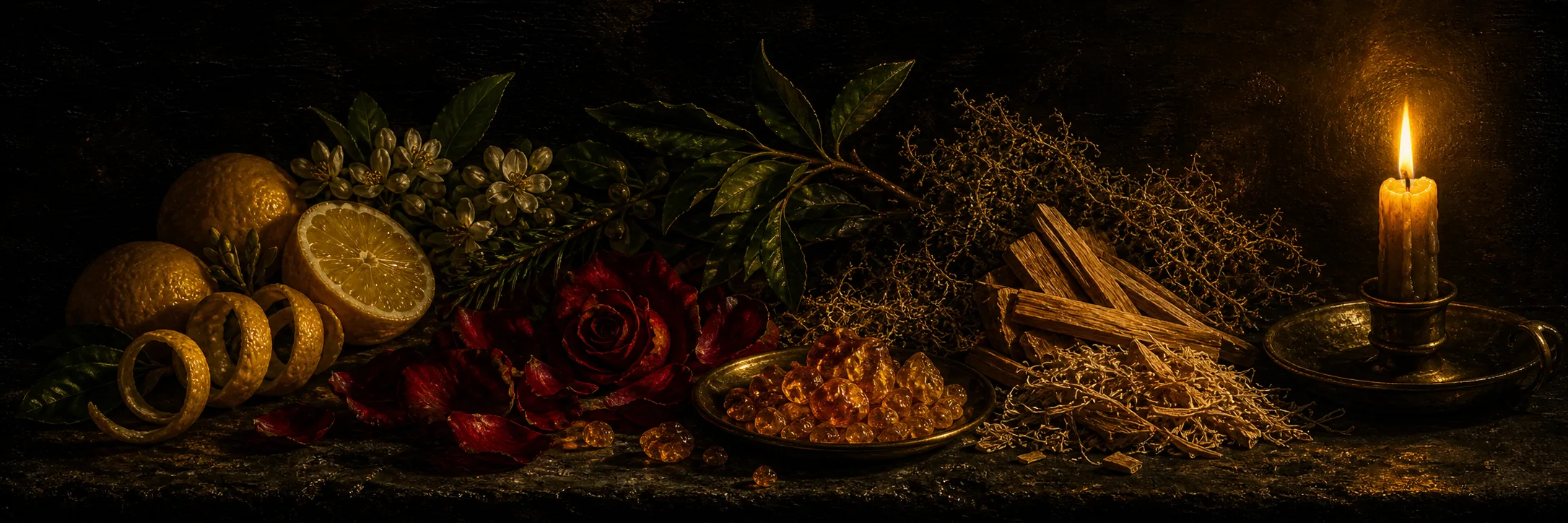
The opening is a cold, herbal smack rather than a citrus burst. The listed bergamot, lime and Amalfi lemon read more as a structural lift than as an obvious “citrus accord” - they’re a wash that buoys the much louder clary sage, coriander seed and myrtle. Within five minutes the sage’s salty, sweat-edged greenness dominates, with thyme and a touch of basil sharpening the herbal column. Aldehyde-adjacent soap shimmer hangs above, the Chanel signature, but it never tips into “barbershop.” Castoreum is already pushing through from the base - buttery, animal, slightly resinous - and that’s the tell that this is not going to behave like a classic eau de cologne. The heart (45 minutes to roughly three hours) is where the chypre architecture clicks into place. Rose and jasmine are present but submerged - they function as floralcy to soften the masculine spine, not as discrete notes you can name on the skin. What rises forward instead is the castoreum-labdanum-myrrh triad: a smoky, dirty-leather warmth shot through with church-incense resin. Reviewers in wearer discussions consistently call this stage “Athonite incense over leather,” which is accurate. Oakmoss is decisively present - earthy, bitter, dry - and provides the chypre’s mossy floor. There’s a real signature accord here: dirty herbal greens fused with smoky leather and damp moss, sweetened almost imperceptibly by beeswax and labdanum. Modern formulations have softened the castoreum’s animalic edge versus 1980s vintage, but the structure remains. By the four-to-six hour mark Antaeus is a skin-close leathery-mossy drydown: patchouli surfaces alongside the labdanum, the herbal notes recede, and a slightly powdered, ambered warmth takes over. It is not linear - there is real evolution from green-herbal opening through animalic heart to ambered chypre base - but the journey is integrated rather than dramatic. Vintage bottles read deeper, creamier, and more castoreum-forward; current production trades some of that animal richness for a cleaner patchouli-labdanum register.
Performance
Projection is moderate, not stadium-loud - about an arm’s length for the first hour, retracting to half that by hour three. Sillage is present but disciplined; this is not a fragrance that announces itself across a room the way contemporaries like Kouros did, despite Antaeus’s reputation as a “powerhouse.” Longevity on skin runs eight to ten hours with two sprays in current EDT; vintage bottles routinely went twelve-plus. On wool, cashmere or a scarf, Antaeus has serious cling - twenty-four to thirty-six hours easily, sometimes longer. Cold, dry weather is its best environment: the resins and leather feel substantial, the herbs read crisply against the chill. In hot humid weather Antaeus can turn loud and slightly fecal - the castoreum-labdanum becomes assertive rather than refined. Application strategy: two sprays maximum, applied to chest and the nape rather than wrists, to keep the resins close. Multiple sprays will tip Antaeus from “well-tailored” to “overpowering” quickly; the formula is rich enough that it doesn’t need over-application.
Wearing Context
Cold-weather scent first and foremost: late autumn through early spring, evening rather than daytime. Antaeus shines in formal-traditional contexts - wool suits, leather, dim lighting - and on the kind of evening where Pour Monsieur would feel too polite and Egoiste too sweet. It works for opera, restaurants, weddings, the office of a senior partner. It falls flat in summer offices, gyms, casual streetwear, and beach environments; the resinous-animalic core reads as miscalibrated against linen or athletic gear. Social-perception skew: Antaeus is widely received as a “mature” scent. Younger wearers using it report being read as confident or eccentric; older wearers report it being recognized as a Chanel by people of their generation. There’s a documented gay-wearers association with the fragrance in 1980s urban centers - Luca Turin makes the historical claim explicitly. Today it reads as classical-masculine rather than gendered in any narrow sense, and contemporary wearer reports note it flirts with floralcy more than most “powerhouse” 80s frags.
Comparisons & DNA
In the Chanel line, Antaeus sits between Pour Monsieur (1955, drier and more chypre-aromatic, no animalics) and Egoiste (1990, sweeter with sandalwood and rosewood rather than leather-moss). It shares almost nothing with Bleu de Chanel and is the structural opposite of Allure Homme Sport - where those are clean and aquatic-fresh, Antaeus is dirty and resinous. Across the wider 1980s masculine canon, the obvious comparison is YSL Kouros (1981) - same year, similar animalic ambition, but Kouros is honeyed-sweaty civet over honey and incense rather than green-herbal over leather and moss. Antaeus is more refined, less feral. Jacques Bogart pour Homme (1975) shares the leathery-aromatic structure at a fraction of the price; wearer discussion users repeatedly cite it as the closest cheap analog. Van Cleef & Arpels pour Homme (1978) is in the same family but greener and more transparent. Knize Ten is the leather neighbor - closer to pure leather, less herbal-mossy. Ferragamo Tuscan Creations Testa di Moro is a modern parallel that comes up among wearer discussions connoisseurs. There is no successful clone. Armaf, Lattafa and Maison Alhambra have not attempted Antaeus - its profile is too herbal-animalic for the modern clone market, which prizes sweet-amber and fresh-blue templates. A Dua Brand “vintage Antaeus” attempt is widely panned by users who’ve compared it directly. Herban Cowboy Dusk shares the clary-sage opening but lacks the leather-moss base. Functionally, if you want Antaeus, you buy Antaeus. Lineage: Antaeus is the late inheritor of the chypre-leather tradition that runs through Bandit (1944), Aramis (1966) and Bel Ami (1986) - but it animates that tradition with a notably herbal, almost Provencal palette rather than the smoky-tobacco or pure-leather palettes of its cousins. It defined what a chypre masculine could be in the 1980s and is now treated as a touchstone.
Reception
Critical consensus is strongly positive. Luca Turin gave Antaeus four stars in Perfumes: The Guide (2008), classifying it simply as “woody masculine” and writing: “I confess I missed the point of Antaeus when it first came out in 1981, partly because it became the first gay masculine fragrance, and several years had to pass before the guys learned to use less than half a bottle per day. In retrospect, it is the best of the cigar-box woody fragrances of the time… It feels a bit dated and would probably fare better on a woman than on a man today, but still smells really good.” In the 2018 update Turin reaffirmed Antaeus as a benchmark, using it as a price-quality reference point against overpriced niche (“if you sell a fragrance as an artisan for more money than Antaeus or Shalimar, you should be judged accordingly”). wearer discussions are split on a single axis: vintage versus current. Owners of 1980s-early 2000s bottles consider Antaeus a masterpiece (frequent and, descriptors like “gothic,” “leather-rose-myrrh,” “the most masculine Chanel”). Owners of post-2015 batches report a thinner, cleaner, less animalic experience and longevity dropping from “all day” to “six hours.” Common praise: complexity, refinement, distinctiveness, herbal-leather signature, no clones exist. Common criticisms: dated, “smells like a hospital” or “like a barber shop” on the wrong skin, performance loss in current formulation, polarizing for women in casual contexts. Blind-buy verdict: yes for anyone who already enjoys Pour Monsieur or chypres broadly; no for someone whose collection is Sauvage and Bleu de Chanel.
Versions & Reformulation
Antaeus has been quietly reformulated multiple times since 1981, with the most significant changes tracking IFRA oakmoss restrictions in the mid-2000s and a further softening around 2015. Vintage (pre-1995) bottles have a substantially more pronounced castoreum and beeswax-leather character; mid-period (1995-2014) bottles retain most of the chypre depth but with reduced animalic loudness; current production (2015+) is thinner and more patchouli-labdanum-driven, with the castoreum noticeably tamed and oakmoss reduced. Concentration: Antaeus is sold today only as Eau de Toilette. A parfum/extrait existed historically but is not in current production on Chanel’s official catalogue as of 2026 - only the EDT spray and the deodorant stick are listed on Chanel’s US site. Vintage extrait bottles surface occasionally on auction sites and are prized.
Acquisition Notes
Designer-luxury pricing: $130-$160 for 100ml EDT and $115-$140 for 50ml at Chanel boutiques and authorized retailers as of 2026, with steady upward price drift. Available sizes are 50ml and 100ml; older 200ml and 25ml refill formats are out of regular distribution. Decant ecosystem: well-served by Surrender to Chance, MicroPerfumes and Scent Split, all of whom carry both current and selected vintage batches.
Notable Facts & Lore
- Per Luca Turin, the fragrance was named “by the great publisher Dan Halpern, who at the time ran a literary magazine of the same name, during a conversation with Chanel’s owner, Jacques Wertheimer” - a literary-mythological provenance rather than a marketing brief.
- Antaeus in Greek myth is the half-giant son of Poseidon and Gaia, invincible while in contact with the earth - strangled by Heracles when lifted off the ground.
- Turin’s other notable claim is that Antaeus “became the first gay masculine fragrance” in the early 1980s - a claim that has been disputed (commenters who lived through the period argue Aramis in the 1970s preceded it), but the gay-urban association in major American cities in the 1981-1986 window is well documented in wearer memory.
- The fragrance still surfaces in oral histories of the era.
- There is no celebrity ambassador, no TikTok viral moment, no Scorsese campaign.
- Antaeus has remained, deliberately, a quiet sibling to Bleu de Chanel - Chanel has chosen not to flanker it, modernize it or relaunch it.
- It is the only Chanel masculine that has run continuously since 1981 without a flanker line, which is itself a statement about the house’s relationship to the composition.
- Polge created it; his son Olivier inherited Chanel’s perfumery chair in 2015 and has not touched Antaeus.