Chanel — Égoïste
Essence
Egoiste is Jacques Polge’s 1990 attempt to translate Ernest Beaux’s 1926 Bois des Iles - the most opulent sandalwood fragrance Chanel ever made - into a masculine register, and then make that translation louder, fruitier, and more flamboyant. It is a spicy creamy-sandalwood-and-rose composition: rosewood and cinnamon over a Mysore-leaning sandalwood-vanilla-ambrette base, with a damask-rose backbone unusual in masculine perfumery. Polge has named it his favorite Chanel creation. It is the rare designer “men’s” fragrance that is essentially a rose extrait in drag.
Scent Profile
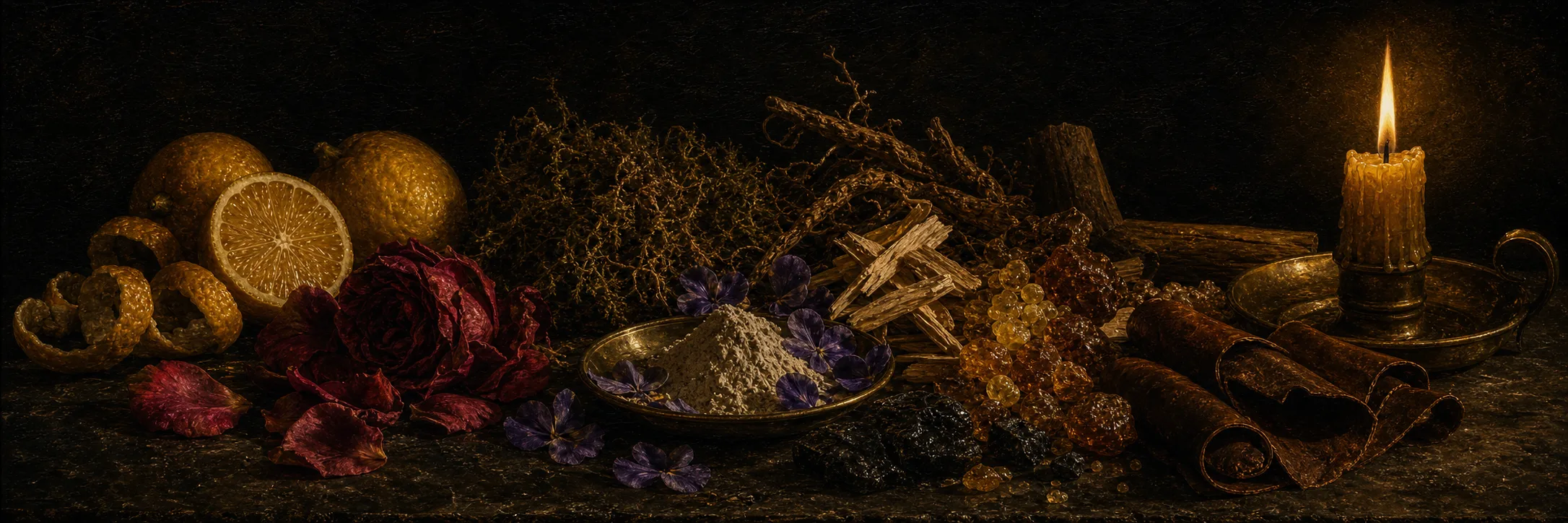
The opening ten to twenty minutes are spicy-fruity and instantly recognizable: tangerine and mandarin briefly sparkle (under five minutes), then coriander pushes forward as a hot-peppery, almost sweaty herbal lift, with rosewood acting as a clear, linalool-rich, pencil-shaving brightener. Now Smell This (Robin Krug) describes the opening as “classic potpourri” - “oily citrus peels, soft rose petals, pungent cloves and Ceylon cinnamon bark.” There is a faint plum/apricot facet that Bois de Jasmin (Frolova) calls “candied apricots.” This is not a fresh fragrance in any modern sense - it reads immediately warm, dry, and dense. Through the heart (one to three hours), the damask rose and cinnamon dominate. Ayala Moriel calls it “the younger and louder brother of the demure, soft-spoken and old-fashioned Bois des Iles.” The rose here is the perceptible signature note; carnation contributes a clove-eugenol spice rather than appearing as a discrete floral. Cinnamon is structural, not decorative - a warm dry sweetness that holds the rose. Mahogany and rosewood persist as a chambered woody backdrop. The listed ambrette is perceptible as a muskier-vegetal smoothing agent rather than as a discrete note. The drydown (three hours onward) is where the Bois des Iles inheritance shows most clearly: a creamy, milky sandalwood, vanilla absolute (more animalic-woody than cupcake-frosting), benzoin balsam, and a quiet leather-amber finish. Tonka and oakmoss are submerged. Vetiver appears as a bitter-chocolate facet that, according to Frolova, “heightens the baroque richness.” The signature accord is rose-cinnamon-sandalwood, and the whole composition is unusually linear once past the first half hour - it doesn’t so much evolve as deepen. Listed leather is barely perceptible; oakmoss, ditto. This is a sandalwood-rose oriental in masculine clothing, not a chypre and decidedly not a fougere, despite Chanel’s marketing language sometimes labeling it as such.
Performance
Projection is moderate to moderate-strong in the first two hours - within roughly an arm’s length and a bit beyond. Sillage is impressive for an EDT and disproportionate to its quiet, “polite” character: Persolaise notes the current version “remains seriously combustible.” Longevity on skin: 7-10 hours typical, 12+ hours on some chemistries; on wool and cotton, 24+ hours is documented. Vintage 1990s formulations were stronger and creamier (real Mysore sandalwood); current reformulations are slightly thinner, with a brighter, crisper top. In cold weather it sings - winter and damp autumn evenings are ideal. In high heat it can read cloying; the cinnamon-rose combination amplifies in humidity to almost dessert-like density. Best applied two to three sprays to chest and neck; overspray is a real danger because the composition is so dense. Skin-temperature variation matters: dry skins struggle with longevity, oily skins amplify the sandalwood drydown beautifully. Avoid applying to clothing in any quantity - the leather/vanilla residue lingers for weeks.
Wearing Context
Strict cold-weather, evening, and formal wear. October through February is the natural window; spring and summer applications need restraint. It excels at dinners, theatre, low-lit bars, holiday gatherings, dates where the wearer is meant to make a statement of confidence rather than youthfulness. Black-tie compatible. It dies in fluorescent light, in gyms, in casual wear, and at midday. It is too sweet and floral for the post-2015 “fresh masculine” expectation set by Sauvage and Bleu de Chanel. Social-perception skew: Egoiste is read by most under-30 noses as either an “old man” scent or an unexpectedly compelling unisex rose-spice - Bois de Jasmin commenters and wearer reports consistently note that women receive compliments on it more than men do. It works on women; Polge built it from a “feminine” formula and the unisex reading is structurally inevitable. Persolaise ranks it in his top-three Chanel masculines alongside Pour Monsieur and Antaeus. It fails on younger men in club settings and shines on confident wearers in indoor formal contexts.
Comparisons & DNA
The lineage is explicit and confirmed by Polge himself: Egoiste is descended from Chanel Bois des Iles (Beaux, 1926/1928), which Polge mined from the Chanel archives. Polge: “I found an old formula by Ernest Beaux of a women’s fragrance called Bois des Iles… sandalwood had never been used as the main note in a male perfume. Egoiste is built around that.” The immediate predecessor was Chanel Bois Noir (1986/1987), a Chanel-boutique-only limited edition with the same DNA but smoother and less spicy. Bois Noir is now a unicorn on the resale market. Bois des Iles itself is the unavoidable comparison: smoother, more aldehydic, more floral, less spicy, creamier and more cozy (“less woods and more soft materials” per wearer discussions consensus). Egoiste is, as one Bois de Jasmin commenter put it, “a roughed-up Bois des Iles.” Chanel Antaeus (1981) is the macho older cousin: more chypre, more leather, less rose, more aggressive. Chanel Coromandel (Les Exclusifs, 2007) shares the spicy-warm-balsamic family but with patchouli-incense-chocolate rather than rose-sandalwood. Beyond Chanel: Yves Saint Laurent Opium pour Homme (1995) and Guerlain Habit Rouge (1965) sit in the same dressy spicy-oriental masculine family but are sweeter and less rose-forward. Tom Ford Noir de Noir is a rose-oud-truffle that overlaps in the rose-amber territory but is sweeter, oudier and gourmand-leaning. Frederic Malle Une Rose is more leathery-rose-wine and more austere. Etat Libre d’Orange Rossy de Palma is a similar damask-rose-spice but cheaper-feeling. Clone alternatives are sparse. Lattafa Khamrah Qahwa (2023) has overlapping cinnamon-coriander warmth but is gourmand-coffee. Maison Alhambra Layali chases the spicy-rose-sandalwood vibe at a fraction of the cost but lacks the dense rosewood backbone. The most-recommended budget approximations in wearer discussions are vintage Avon Mesmerize and Roja Parfums Enigma pour Homme (which is dramatically more expensive, not cheaper). Egoiste defined no trend per se - its commercial failure in 1990s America (versus the simultaneous aquatic boom) meant that no major house followed it; instead Chanel walked the trend itself with Egoiste Platinum in 1993.
Reception
Critical reception is positive but conflicted. Turin’s Perfumes: The Guide review recalls it as “a beautiful but slightly watery pastel confection of candied fruits and low-key woods,” concluding it is “a perfect alternative to Mouchoir de Monsieur, sprightlier and less dandified… this is strong stuff” - and noting an explicit “Bois des Iles in the drydown” connection. Bois de Jasmin (Frolova) calls it “inspiring,” “plummy-woody,” and explicitly identifies the Bois des Iles DNA. Persolaise: a top-three Chanel masculine, “the most heavenly of scents.” Now Smell This (Krug): “Egoiste makes me purr.” Wearer response is split along generational and geographic lines. European fragrance enthusiasts on wearer discussions regard Egoiste as a masterpiece - wearer reports consistently rate it among Chanel’s finest. American wearer discussions voters are more divided: many find it dated, “feminine,” or “headache-inducing”; younger wearer reports frequently report it reads as “old man.” Common praise: uniqueness, depth, sandalwood quality, projection, sense of dressed-up occasion. Common criticisms: dated cinnamon-rose register, lack of “freshness,” perceived femininity, polarizing first ten minutes. Blind-buy verdict: yes if you love Bois des Iles, Opium pour Homme, or vintage sandalwood orientals; emphatic no if you wear Sauvage or Y EDP.
Versions & Reformulation
Three commercial versions: vintage Egoiste (1990 through approximately the mid-2000s) used real Mysore sandalwood and had a smoother, creamier, more vanillic drydown; the 2014 reformulation (current standard bottle) is brighter at the top, with synthetic sandalwood substitutes and a slightly drier, less plush base; Egoiste Cologne Concentree (1992) was a rarer, more vanilla-and-spice-forward variant now discontinued and a collector item - closer to Bois des Iles than the standard EDT. Persolaise notes the 2013/2014 version’s drydown was a casualty of sandalwood scarcity: “you can blame any deterioration on the current price and scarcity of sandalwood.” The Bois Noir (1986/1987) predecessor was never widely distributed and is now essentially impossible to find authentically. Distribution itself has changed: from 2013 onward, Egoiste was finally available at all Chanel counters in the UK and Europe, having previously been boutique-restricted in some markets.
Acquisition Notes
Designer-luxury tier. Current Egoiste EDT retails in line with comparable Chanel masculines - approximately $115 for 50 ml (1.7 oz) and $155 for 100 ml (3.4 oz) at Sephora and Chanel counters, per Sephora.com’s current listing for the comparable Platinum Egoiste (verified May 2025). Widely available at department-store Chanel counters, Sephora in some markets, and through authorized retailers; no longer boutique-restricted. The Perfumed Court, Scent Split, and MicroPerfumes carry decants ($3-$8 for 1 ml; ~$25 for 5 ml).
Notable Facts & Lore
- The Jean-Paul Goude commercial “Le Carlton,” released in 1990 to launch Egoiste, is the single most celebrated perfume advertisement of its era.
- Filmed at the Hotel Carlton in Cannes, choreographed to Prokofiev’s “Dance of the Knights” from Romeo and Juliet, it depicts beautifully dressed women on the hotel’s balconies opening and slamming shutters while shouting “Egoiste!” at an unseen target, with the perfume’s bottle visible briefly on a ledge.
- The campaign was, per a September 11, 1991 Baltimore Sun report, the largest ever for a Chanel men’s fragrance to that point; Chanel executive Arie Kopelman justified the provocative name by reframing the “egoist” as “a doer, makes things happen, a person that has visions of dreams he wants to accomplish.”
- A New York “Egoiste apartment” stunt - complete with Lifecycle bike, free weights, Henri Rousseau paintings and an Aubusson carpet - was a tied PR vehicle.
- The name was acquired from the French photography magazine Egoiste (founded 1977 by Nicole Wisniak) for a documented payment.
- Polge has repeatedly named Egoiste his favorite of his own Chanel creations - striking given that his portfolio includes Coco, Allure, and Coromandel.
- Despite the legendary campaign, the perfume was a commercial flop in the United States: the aquatic-dominated early-1990s American market rejected it, prompting Chanel to commission Egoiste Platinum in 1993 as a fougere course-correction.