Chanel — Coco
Essence
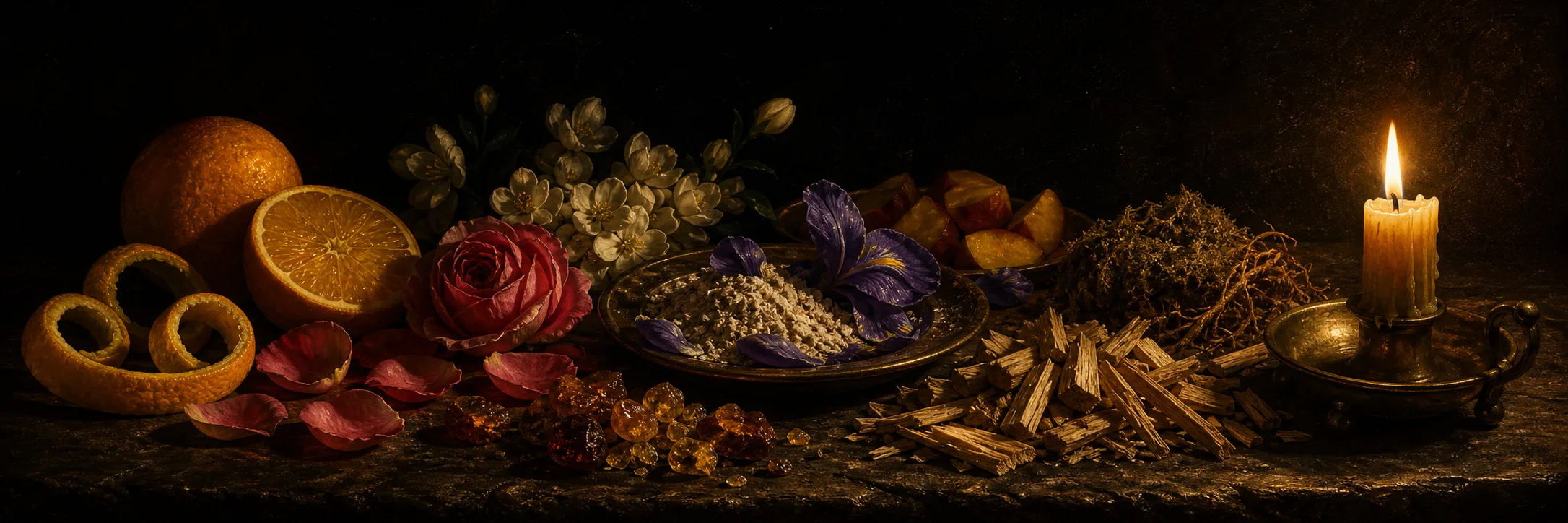
Coco is Chanel’s grand 1980s spicy-oriental - Jacques Polge’s opulent, clove-and-amber answer to the decade’s blockbuster orientals, conceived as the house’s entry into the rich, brash territory pioneered by YSL Opium. Built on a warm-spicy core of clove and labdanum-amber, dressed with rose, peach and orange-blossom and grounded in sandalwood, opoponax, vanilla and (originally) civet, it is dramatic, baroque and unapologetically “perfume-y.” It is frequently mistaken for an old-fashioned relative of Coco Mademoiselle; in fact the two smell almost nothing alike, and Coco is the far richer, more classical composition.
Scent Profile
The catalog pyramid - Bulgarian rose, coriander, peach, jasmine, mandarin up top; clove, rose, mimosa, orange-blossom, clover in the heart; amber, sandalwood, opoponax, tonka, civet, vanilla, labdanum in the base - manifests in wear as a remarkably cohesive, golden spicy-oriental rather than a sequence of distinct notes. In the first 10-20 minutes, even though no aldehydes are listed, many wearers (including the Tea-Scented Library review) report an “almost aldehydic, very Chanel” warm-floral shimmer over the opening, alongside a much-noted fizzy, spicy “Coca-Cola” effect - a bright orange-and-spice accord that is one of Coco’s signatures. The peach is present but “non-juicy,” more a velvety dry-skin nuance than a fruit; mandarin and rose give warmth rather than zest. By the heart (1-3 hours) the composition’s true character dominates: clove is the star, “spicy, slightly sweet,” in lockstep with a warm abstract rose “dipped in orange liqueur” and a powdery orange-blossom that harmonizes the spice. Bois de Jasmin and other critics identify the spicy-woody clove-sandalwood-tonka axis as the core accord that defines Coco. The florals (jasmine, mimosa, clover) are blended and largely abstract - they keep the spice from turning masculine rather than reading as individual flowers. This is the dominant mid-stage: a “baroque, amber-tinted” spicy floral. The drydown (3+ hours) is smoky, resinous and sweet: labdanum (leathery-smoky), opoponax (sweet balsamic), amber and vanilla, lightly dusted with powdery tonka over sandalwood. In vintage and current parfum, a “pungent, subtle trail of civet” gives an animalic warmth and a “too personal” intimacy; in modern reformulations this is muted to near-absent. The signature accord is the clove-amber-sandalwood spicy-oriental heart. Coco is not linear - it genuinely evolves from fizzy-spicy opening through spicy-floral heart to smoky-ambery resinous base - but it is coherent throughout. Perceptible: clove, amber, rose-orange, vanilla, labdanum, sandalwood, (vintage) civet. More submerged: individual florals, coriander, clover.
Performance
Coco is a strong performer by reputation, though reformulation has softened it (see Versions). In its prime and in current EDP it projects moderately-to-strongly in the first hours - a clear arm’s-length-plus aura - with respectable-to-generous sillage; Tea-Scented Library rates its lasting power “above Chanel’s usual solid performance.” Multiple long-time wearers report it lasting overnight on skin (“sleep the whole night and wake up with Coco still lingering quite strongly”), and on clothing/coats it is famously tenacious - “lasts all day on clothes or weeks on coats.” Vintage versions are described as near-nuclear: “two sprays are almost too much, and it lasts and lasts… 12 hours at least,” with reports of it “clearing a room.” Current batches draw frequent complaints of weaker projection and longevity (“smells like Safeguard soap,” “weak performance due to reformulation”), though some users note Chanels benefit from a few months’ rest/maceration after purchase before judging performance. Realistic current-formulation longevity: roughly 6-9 hours on skin, much longer on fabric. Behavior in heat: the spice-amber richness can become heavy and somewhat nauseating in warm, stuffy environments (several wearers report this specifically); it performs best in cool, dry autumn/winter air. Best application strategy per users: apply sparingly - one spray per pulse point of EDP is plenty; the EDT and parfum reward different hands (see Versions).
Wearing Context
Coco is an autumn/winter, evening, cold-weather fragrance par excellence - a “smouldering,” dramatic oriental for occasions where presence is welcome. Wearer and critical consensus place it alongside the great 1980s “big” perfumes (Samsara, Knowing, Opium, Cinnabar) as eveningwear, dinners, holidays, and dressed-up cold-weather settings. It “claims the room’s attention by pausing haughtily at the entrance,” per the Tea-Scented Library framing - elegant, mature, confident. It falls flat in heat, in tight indoor/office spaces, and in casual daytime contexts where its richness reads as overdressed or “too much.” Several wearers report it becoming cloying or headache-inducing in warm rooms. Socially it carries an unmistakable “1980s/grown-up/department-store-classic” perception - adored by some as timeless glamour, dismissed by younger or fresh-scent-oriented noses as “grandma” or “old-school.” Notably, despite its feminine marketing, Coco has a meaningful unisex following: reviewers repeatedly note men wearing it well, and one famously recounts it being a grandfather’s signature scent. There’s a persistent “compliment magnet / male-attention” lore around the vintage parfum specifically. Best deployed by someone comfortable wearing a deliberately classical, opulent oriental rather than something modern and inoffensive.
Comparisons & DNA
Coco’s defining lineage is the 1980s spicy-oriental boom kicked off by YSL Opium (1977): Coco is widely understood as Chanel’s bold, brash answer to Opium’s success, and Turin/Sanchez frame it within that Opium/Cinnabar family. Versus Opium (YSL), Coco is less soapy-resinous and less loud - gentler and more floral-elegant where Opium is sharper and more aggressively spicy. Versus Cinnabar (Estee Lauder), Coco is brighter and more refined; Cinnabar is warmer and more comforting/rounded. Versus Youth-Dew (Estee Lauder), Coco is less densely honeyed-ambery and more “serious.” Versus Guerlain Samsara, Coco is gentler and more feminine where Samsara is crisper and more sandalwood-woody. Critically important distinction: Coco Mademoiselle (2001) and Coco Noir (2012) are entirely different fragrances that share only branding. Coco Mademoiselle is a bright citrus-patchouli-white-musk floral that “smells nothing alike” - it is the loud, fresh, garconne flanker, and was (per Turin) a quickly assembled flanker whose success surprised Chanel and which helped popularize the woody-musky “fruitchouli” trend Coco itself did not start. Coco Noir is a darker, rose-patchouli modern oriental, again separate. Within Chanel, devotees who love Coco often cluster it with the house’s richer classics (Bois des Iles, Cuir de Russie, 31 Rue Cambon, Coromandel) rather than the mainstream pillars. Coco’s own influence is felt in subsequent “sheer rich glamour” orientals, but its primary historical role is as one of the defining grand orientals of its era. No designer “clone” of true Coco is commonly cited - its register is too classical and Chanel-specific for the dupe market, which chases Coco Mademoiselle instead.
Reception
Coco enjoys deep, largely admiring coverage across all tiers.: Turin and Sanchez reviewed it in Perfumes: The Guide; based on cataloguing of their ratings and corroborating logic (their four-star Coco Mademoiselle would not plausibly outrank the more respected original), Coco appears to have earned approximately four stars, with the recurring attributed descriptor being that it smells somewhat “’80s dated” while being a well-made spicy oriental in the Opium mold - though a verbatim primary quotation of the rating could not be confirmed, so this should be treated as well-supported but not definitive.: Now Smell This’s Angela reviewed it warmly as a returning classic, and a memorable reader “love letter” in the comments calls it “the most beautiful of all orientals.” Bois de Jasmin and Katie Puckrik both engaged with it as a serious classic (Puckrik debating the “OR-RANGE” and civet facets). consensus (wearer discussions): broad reverence for the vintage as a “masterpiece,” praise for its warmth, spice, elegance and complexity, and a strong recurring theme of it being a “compliment/attention magnet.” The dominant criticism is reformulation-driven performance decline - repeated complaints that current batches are weaker, soapier, and shorter-lived than the “nuclear” vintage, with some calling the modern version “a shadow.” Polarization axes: (1) vintage vs. modern formulation; (2) lovers of classical orientals vs. those who find it dated/“old-lady”; (3) heat tolerance (some find it nauseating in warmth). “Blind buy?” verdict: reasonably safe for anyone who already enjoys classical spicy orientals (Opium, Cinnabar) and cool-weather richness - but blind-buyers chasing the legendary performance should specifically seek vintage EDP or parfum, since the current formulation, while still recognizably Coco, is notably tamer.
Versions & Reformulation
This is a major topic for Coco. It exists in EDT, EDP and pure Parfum, and all three smell meaningfully different. The EDP is the richest and most-recommended of the sprays - deep, velvety, warm-orange-and-spice; the EDT is “thinner, lighter and brighter,” with - counterintuitively - a more prominent civet note than the EDP, and less smoky-resinous depth; the Parfum is the most glorious and concentrated, “a never-ending rhapsody of warmth, spices, and ambery goodness,” with the florals fully present. Reformulation is the central concern: IFRA restrictions on oakmoss (tightened from around 1988, with a key 0.1% limit around 2001) plus the industry move away from natural civet (Chanel reportedly switched from real animal ingredients to synthetics in the early 1990s) and reduced Mysore sandalwood have all softened modern Coco. wearer reports: vintage versions are deeper, richer, more animalic and far stronger; current versions are recognizably Coco but tamer and weaker. Vintage parfum and 1980s-90s EDP/EDT are the connoisseur’s choices.
Acquisition Notes
Pricing tier: luxury-designer (Chanel boutique pricing). Current Coco EDP/EDT/Parfum remain in production and are sold at Chanel counters, boutiques, chanel.com and major department stores - the safest authentic sources. Sizes: EDP commonly in 35/50/100 ml; EDT similarly; Parfum in small 7.5/15 ml formats (the latter pricey-per-ml and lower-sillage). Decant ecosystem: well-served by Surrender to Chance, Scent Split, MicroPerfumes and similar, which is the recommended route to compare vintage vs.
Notable Facts & Lore
- Coco was named for Gabrielle “Coco” Chanel and launched in 1984 as Jacques Polge’s grand statement oriental, positioned as Chanel’s response to the spicy-oriental wave Opium had unleashed.
- No single tidy “perfumer’s intent” quote about Coco surfaced in the documented materials beyond Chanel’s own evocative marketing copy (which describes a majestic spice-and-amber progression), so the intent is best summarized via its Opium-lineage positioning rather than a Polge statement.
- The richest lore is wearers-generated: the vintage parfum’s near-legendary reputation as a “male-attention magnet” (a widely-circulated wearer review recounts consistent, almost comical results regardless of how the wearer was dressed), and its strong nostalgic association with 1980s glamour - “heavy blush, teased hair, shoulder pads, red lacquered nails.”
- It also serves as a frequent cautionary reference point in fragrance-wearers debates about IFRA reformulation, cited repeatedly alongside Mitsouko, Samsara and Aromatics Elixir as a classic “diminished by regulation.”
- Finally, it functions as the constant clarifying counterexample to Coco Mademoiselle - the “real Coco” that newcomers discover is nothing like the flanker that made the name famous to a younger generation.