Chanel — Chance
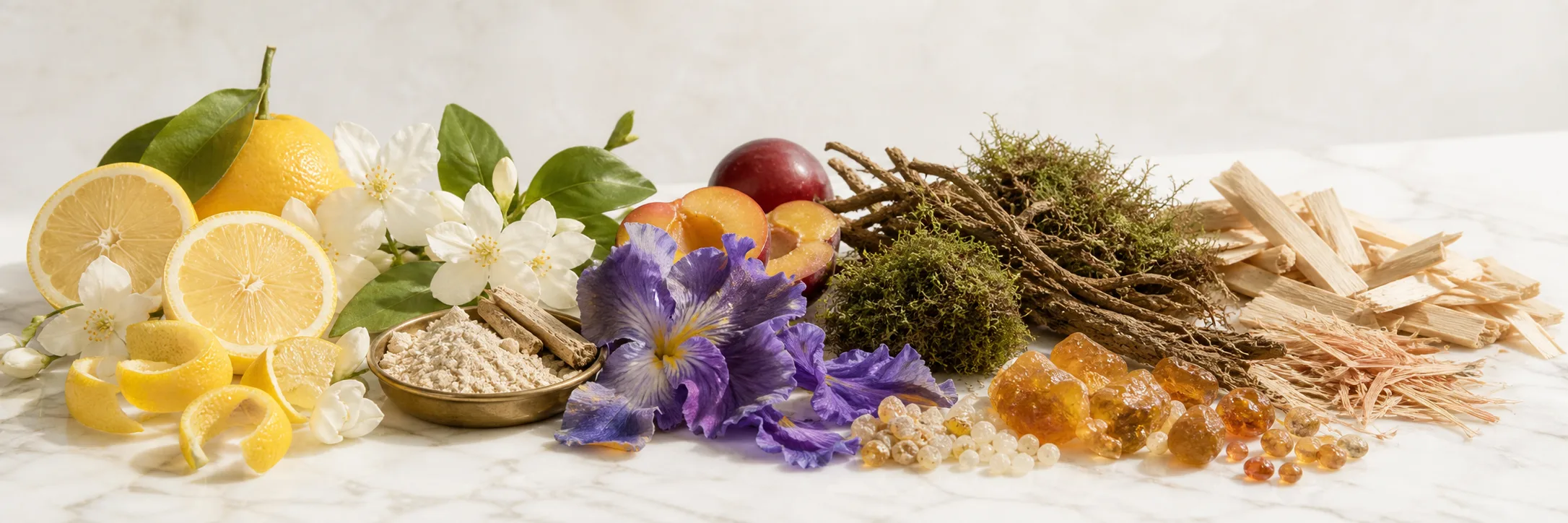
Essence
Chance (the original 2003 eau de toilette, created by Jacques Polge) is the moment Chanel committed to building a younger, more “fun” pillar to sit beside No. 5, Coco, and Coco Mademoiselle - a peppery, citrusy, patchouli-musk fragrance organized around a round bottle (Chanel’s first) and a deliberately upbeat, sporty, jasmine-led personality. The signature smell is pink pepper biting into juicy citrus and a slightly green pineapple, settling onto a clean patchouli-amber-musk base that reads as polished rather than earthy. It is the most herbal, most “perpendicular” Chance - the one that genuinely doesn’t smell like a fruity-floral.
Scent Profile
The opening (first ten to twenty minutes) is sharp and slightly aggressive: pink pepper, lemon, and pineapple in a three-way conversation, with the pineapple acting as a green, slightly turpentine-sour fruit rather than a sweet tropical pulp. There is also a clean patchouli ghost detectable from the very first spray - Polge built the patchouli into the top, not only the base, and that is part of what makes Chance EDT read so differently from the EDP. The first impression is closer to a spicy aromatic than a fruity-floral, which is why several reviewers have called the EDT the most unisex of the Chance line. The heart (one to three hours) brings the floral triangle into view: jasmine, hyacinth, and iris, with hyacinth dominant. Hyacinth is the differentiating note - that wet-green, mineral, slightly bitter floral cue that gives Chance EDT its springtime-park feel. Jasmine is present but transparent (not the indolic, narcotic jasmine of a Joy or a Fracas), and iris is a powdery shadow rather than a soloist. The pink pepper hangs around longer than typical, well into the heart. Robin Krug at Now Smell This characterized the EDT’s signature as “grapefruit plus patchouli plus vanilla plus musk, with negligible florals” - a useful corrective to the marketing presentation: the florals are real but recessed. The drydown (three hours onward) is patchouli + white musk + a polished amber, with vetiver dialing in a dry-green note that prevents the patchouli from going sweet or hippie. The patchouli here is the modern, fractionated, “clean” patchouli that became ubiquitous after the late-1990s pink-pepper-and-patchouli trend (Narciso Rodriguez For Her, Coco Mademoiselle, Angel) - bright, slightly cocoa-tinged, never musty. Vanilla appears in trace amounts; the EDT is markedly less sweet than the EDP. An anonymous long-form review described it well: “Chance is a bit leaner and sparer than many other Chanel scents, right down to its uncomplicated white musk, amber, and soft patchouli base notes.” Linearity is moderate-to-high - Chance EDT keeps its character throughout, with shifts of emphasis rather than dramatic transformation. The signature accord is pink pepper + hyacinth + clean patchouli; that is the recognizable Chance fingerprint.
Performance
Projection is moderate for the first two to three hours, then drops to a close-to-skin scent. Sillage is noticeable in the opening - Chance EDT is one of the louder Chance variants on a fresh spray - but settles within arm’s length by hour three. Longevity on skin runs 5-7 hours for most wearers; on clothing 12-24 hours, with the patchouli-musk base anchoring the trail. Heat helps Chance EDT bloom in a sporty, peppery way; humidity amplifies the pineapple-pink-pepper combination and can make it read a touch synthetic. Cold weather mutes the upper register and the perfume can feel thin in winter. Best application strategy: 3-4 sprays distributed between pulse points and lower-collar clothing; this is a daytime, warm-weather perfume that benefits from generosity but cannot be sprayed on at evening intensity without tipping into the harsh-aldehydic register.
Wearing Context
Best worn spring through early autumn, daytime - office, errands, lunch, casual social. It is one of the few Chanel feminines that genuinely works in a sporty/active context. Falls flat in deep winter, in heavy formal evening contexts, and at the office for anyone whose colleagues skew traditional (the pink-pepper opening reads young and slightly sporty rather than corporate). Social-perception skew: in the 2010s the entire Chance line acquired a “youthful, accessible, slightly entry-level” reputation; today the EDT in particular reads as more sophisticated than the Eau Tendre flankers (it has more bite, more structure). Wearers tend to be in their 20s and 30s but the perfume’s herbal-peppery profile is genuinely unisex - wearer discussions contributors regularly remark on its masculine readability, and at least one prominent review called it “Chanel’s best feminine for women who don’t like feminine perfumes.”
Comparisons & DNA
Chance EDT sits in a specific narrow band - the spicy-floral patchouli pillar of the early 2000s - and its closest peer is Chanel Coco Mademoiselle (2001), which Jacques Polge had created two years earlier. Coco Mademoiselle is sweeter, more orange-rose-patchouli, more obviously feminine; Chance is greener, more peppery, more hyacinth-led, more unisex. The wearer discussions long-review framing that “Coco Mademoiselle remains relatively fruity and shrill, while Chance mellows into a more rounded, and admittedly conventional, floral oriental midsection” is accurate. Narciso Rodriguez For Her (2003) is the white-musk-patchouli sibling - same era, same patchouli aesthetic, more musky and less herbal. Thierry Mugler Angel and Guerlain Shalimar are Robin Krug’s references - she famously described Chance as “Shalimar drawn as a kid’s cartoon” - a sharp criticism that captures Chance’s relationship to richer orientals. Boss Femme and L’Eau d’Issey (the green-aldehydic feminine pillar) sit nearby. Dupes and clones: there is no breakout Lattafa/Armaf clone of Chance EDT specifically (the Chance line is much less cloned than Bleu, Coco Mademoiselle, and Allure Homme Sport); generic department-store knockoffs exist but none have acquired clone-of-the-year status. Lineage within Chanel: Chance EDT is the headwater for the entire Chance flanker family - Eau Fraiche 2007, Eau Tendre 2010, Eau Vive 2015, Eau Tendre EDP 2019, Eau Fraiche EDP 2023, Eau Splendide 2025.
Reception
Critical reception is the most ambivalent of any modern Chanel pillar. Luca Turin and Tania Sanchez gave the Chance line broadly poor marks in Perfumes: The Guide - wearer reports in wearer discussions indexes the rating well below their five-star Chanels - and Robin Krug’s Now Smell This review is the clearest articulation of the case against: “To me, Chanel Chance plays this game. It doctors a big girl’s perfume for little girls by simplifying its heady oriental notes, freshening it up with citrus, and targeting its marketing to younger women… To me, Chance feels off-kilter - or worse, banal.” A long-form anonymous reviewer wrote that Chance “tries so hard to maintain a friendly smile that it flirts with triviality… so bland and nondescript that I’d have trouble picking it out of a lineup of designer floral orientals.” Wearer response is more positive than the critical record. wearer discussions Chance EDT rating sits comfortably above with thousands of votes; wearer discussions similarly. The praise centers on the pink-pepper-and-patchouli signature, the bright spring-day mood, the long-term wearability. Criticisms cluster around three axes: comparisons to Coco Mademoiselle (some find Chance the lesser sibling), the “perfume-counter generic” feel some reviewers report, and a sense among long-term wearers that the perfume has been quietly reformulated. Polarization is moderate - Chance has fewer haters than Coco Mademoiselle but fewer devotees than Coromandel. Blind buy verdict: yes for anyone seeking a peppery, sporty, slightly herbal feminine with prestige branding; sample first if you already own Coco Mademoiselle or Narciso For Her, because the overlap may make Chance redundant.
Versions & Reformulation
The original 2003 Chance was an EDT; Chanel followed with a Parfum in 2003, the EDP in 2005, Eau Fraiche in 2007, Eau Tendre in 2010, Eau Vive in 2015, Eau Tendre EDP in 2019, Eau Fraiche EDP in 2023, and Eau Splendide in 2025. Within the EDT itself, batch-to-batch variation is reported by long-term wearers: at least one reviewer wrote that “Chance must have been reformulated. In the EDP musk seems to dominate and distort the whole thing. The EDT smells more like the scent I experienced years ago, even if it is a little thinner.” Chanel has never confirmed a formal reformulation of the EDT, but pink pepper and patchouli are both IFRA-restricted, and minor adjustments over twenty-two years are nearly certain. The Chance Parfum (2003), in 7.5 ml splash, contains additional notes (ambrette, citron, lemon-cedrat, jasmine absolute) not listed for the EDT and reads creamier, smoother, and more close-to-skin.
Acquisition Notes
Chance EDT is sold in 35, 50, 100, and 150 ml sizes. Pricing tier: Sephora US (2025) lists Chance Eau Tendre EDT 50 ml at $124, with Chance EDT in the same range; the 100 ml runs roughly $155 and the 150 ml roughly $185-195. Decant ecosystem: Surrender to Chance, Scent Split, and MicroPerfumes all carry the EDT in 1-8 ml; MicroPerfumes additionally offers 8 ml travel atomizers.
Notable Facts & Lore
- The name “Chance” is a Gabrielle Chanel quote - “Chance is a way of being” - and the round bottle (Chanel’s first deviation from the rectangular No.
- 5 silhouette) is a deliberate symbol of a “wheel of fortune.”
- Jacques Polge created Chance in 2003 as Chanel’s bet on a younger, more dynamic feminine; the launch advertising photographed by Jean-Paul Goude established a visual language (acrobatic, dance-inflected, vividly colored) that has been carried across every Chance flanker since, with Goude returning as photographer/director for Eau Tendre (2010, model Sigrid Agren), Eau Vive (2015), and the Eau Tendre EDP campaign (2019, choreographed by Ryan Heffington with music by Sam Spiegel and models Abby Champion, Camille Hurel, Rianne Van Rompaey, and Ysaunny Brito).
- The 2024 Chance campaign tapped models Amiah Miller, Maty Fall, Mathilda Gvarliani, and Zuza Bryk to represent the four variants of the line, with film direction by Jean-Pierre Jeunet and print campaign by Steven Meisel (per Glossy).
- The Chance line is consistently among Chanel’s top-selling feminines in North America - a financial workhorse that has subsidized the more idiosyncratic Exclusifs.
- There are no major controversies; the line’s strongest critical opposition has always been the editorial position summarized by Robin Krug at NST.